From Idea to Perfomance in One Day
If you haven’t read it yet, it would make sense to first read my previous post…
I arrive at the Playhouse on Park Theatre a little before 8pm on Friday. It is here I will be meeting my director and my cast members. First, though, I introduce myself to Dawn Loveland, who will be running the 24 Hour Play Festival, and leading all of us through the process. I like Dawn instantly–she immediately makes me think of a younger Tina Fey (a comparison Dawn happily embraces). Each of the participants in the festival are required to bring a prop and the playwrights must include at least one prop in their plays. There are four playwrights, four directors, and twenty actors, and we each take a moment to introduce ourselves and our prop. After that, our names are literally drawn from a hat, and each playwright is randomly assigned a director, and both are randomly assigned five actors.
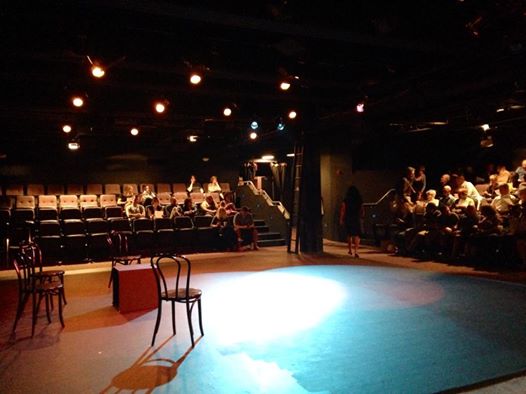
The theatre at Playhouse on Park. The photo was taken by photographer and director Kara Emily Krantz.
The director I will work with in an impressive young woman named Tasya Abbot. Tasya is a Theatre major from Hampshire College, focused on Shakespeare and Hamlet in particular. She is a veteran of the 24 Hour Festival–this is her third year directing. She is extremely bright but also poised in a way that no one her age has any right to be. We spend some time getting to know the cast: John Droney, Roy Donnelly, Rick Fiocco, Sabrina Herrera, and Ann Hutchinson. I like the personalities of the actors; they seem to posses that curious combination of confidence and anxiety common to all good actors. I feel very positive about who I am working with–I just need to make sure I write something worthy of their talents.
At 9pm, Tasya, John, Roy, Rick, Sabrina, and Ann all head home, and myself and the other three playwrights stay behind to write our plays. They are due at 7am. Dawn will stay with us the entire night, and will happily read our plays for feedback at any point we feel we need it. We each find a corner of the theatre and get to work while Dawn paints the stage floor! It’s going to be an industrious night for us all. I sit down and marvel at the fact I have ten hours to write a one act play that will be performed on stage 23 hours from now. For a moment, I wonder what would happen if one of us didn’t finish, and then it occurs to me: what if my play was about the fact that there wasn’t time to finish? I check with Dawn to make sure this isn’t an idea explored by a playwright at a previous festival, and she tells me two things I need to hear: one, it hasn’t been written before, and two, she loves the idea. I decide then that’s the play I am going to write.
I imagine three of the actors appearing on stage with random props, irritated and angry that they have no play to perform, and then discover to their horror that they are being watched by an audience. Just at the moment they are ready to panic, two other actors stroll on stage. They have a play, with dialogue, characters, a story…but the other actors do not. The three left out decide to create their own characters and integrate themselves into the play. So I need to script a play that gives the impression of being improvised by the actors. And it needs to be funny. At about 3:30, I show Dawn my draft. I ask her to tell me whether she thinks it works, because if it doesn’t I’ve only got three and a half hours to come up with something else. As Dawn reads, she is laughing and smiling. She tells me it works and that she really likes it. Relieved, I do a couple of more passes, title it “Unfinished” then head for home at 4am.
At 8am, Tasya, John, Roy, Rick, Sabrina, and Ann show up to begin working on the play, and I return at 12:30. Watching them work, I realize that my confidence in Tasya is well placed. She has a clear vision of what the play should be, and knows exactly how to get the actors there. It’s also clear the actors trust her, so I realize the best thing I can do is make sure I stay out of Tasya’s way. I also see that the actors are an extremely dedicated and skilled group who work hard all day through countless run-throughs and rehearsals, and then finally a full dress rehearsal. They even decide to run lines through the dinner break. I am honored to have my writing in the hands of such talented people.
Finally, at 8pm–24 hours after I met everyone for the first time–the play begins. “Unfinished” goes first and the cast absolutely nails it. They deliver the dialogue splendidly, fall easily into a rhythm, and perhaps most importantly, they seem to be having a great time. The audience responds extremely well to the play, so much so the cast has to pause a couple of times to let the laughter die down. When it’s over I am left feeling proud, exhilarated, and grateful. The other three plays are also quite good, so all in all the evening is a great success.
The 24 Hour Play Festival is exhausting, terrifying, intimidating, inspiring, invigorating, and one of the most challenging creative experiences I have ever had.
And I cannot wait to do it again.
The 24 Hour Play Festival
Beginning tomorrow, I will engage in what might be the most extraordinary writing challenge of my life. The Playhouse on Park Theatre in West Hartford, Connecticut will be hosting the 24 Hour Play Festival. While at first glance that sounds like a festival of around-the-clock plays, it is actually nothing of the sort. It is a festival in which a playwright, a director, and a cast of four have a single 24 hour period to write, rehearse, memorize, and then perform a one-act play before an audience!
Yes, you read that correctly. Friday at 8pm, I will report to the theatre to meet my director and cast. We will spend some time together getting acquainted and team building. After that, the cast and director will go home and I will get to work writing the play. It is due at 7am Saturday morning. When the script is finished, I get to go home and sleep (and anyone who knows me knows that the sleep part will not be occurring). At 8am, the director and cast will show up to begin rehearsing and memorizing my play. At 12:30 pm, I will return to work with my cast and director to help with costumes, props, and provide some technical assistance. Rehearsal work will continue through the afternoon, in addition to some script refining, followed by a full dress rehearsal. We will then all dine together, take a half hour to collect ourselves, and then…curtain!

The Playhouse on Park Theatre in West Hartford, CT. Host of the 24 Hour Play Festival.
So less than forty-eight hours from now, a play I have not yet written directed by someone I have never met featuring a cast I have never seen will already have had its premiere!
Is this insane? Absolutely! Can I wait for it to begin? Absolutely not!
So if you are in the area and want to support local theatre and enable mental illness, please come to the festival. It’s at 8pm on Saturday, August 2nd. Admission is only $10. Please see the Playhouse’s web site for directions and any further information: http://playhouseonpark.org/
I hope to see some of you there! Either way, expect a full report here next week…
Hombre Tortuga! – Part One
As I have mentioned in previous posts, I am a graduate of the University of California at Santa Cruz. At the time I attended, UCSC had some remarkable distinctions. It had no grade point average—most students were not given grades, but were instead given paragraph long narrative evaluations which clearly delineated their strengths and weaknesses. It was also a clothing optional campus; as a result “Naked Frisbee Guy” was a frequent sight at one of the colleges. It also has some exceptional and distinguished alumni—actress Maya Rudolph, filmmaker Miranda July, and writer Molly Antopol. If you are a uniquely talented female whose name begins with an “M,” UCSC is the place for you.
In spite of the fact I lacked those attributes, I still chose to attend UCSC. When I arrived in 1990, the city of Santa Cruz was still suffering the effects of the 1989 Loma Prieta earthquake. Most recall that earthquake from the images of the collapsed Bay Bridge or the interrupted World Series. Not everyone remembers that the quake’s epicenter was Santa Cruz, and its downtown commercial district was destroyed. When I moved there, many businesses were operating out of tents as they awaited insurance and federal monies to rebuild. Some didn’t survive. One of the predictable side effects of this hardship was a lack of employment opportunities and affordable housing, which is why I ended up taking an apartment in a place known as Beach Flats.
Santa Cruz was one of those odd places that had some of their poorest citizens living close to the water (some of its wealthiest citizens also, but not in Beach Flats). The Flats was largely a neighborhood of small aging houses and neglected apartment complexes dominated by South and Central American immigrants, most of whom worked picking up trash at the nearby beach boardwalk, cleaning toilets at one of the economy hotels, or busing tables and washing dishes at a busy chain restaurant.
Being one of the few non-Latinos in the neighborhood, it wasn’t long before the representatives of the underground economy found me. Usually, a young white man walking the streets of Beach Flats was there for one reason and one reason only: to buy drugs. The first few weeks after I moved in, I was frequently asked the question “Hey, you looking for something?” After the dealers realized that I wasn’t looking for something, and that I did in fact live there, they began to leave me alone.

This isn’t an actual photo of Zorro, but this is pretty close to what he looked like–sans the red ribbon.
I had another peculiarity: I owned a pet tortoise. The people in the neighborhood knew this about me because I would sometimes take my tortoise down to the local park and let him run around. He spent most of his life in a 3 X 3 box, and while he had plenty of food and water, and was kept warm with a red ultraviolet lamp, and seemed as happy as I suppose a tortoise could be, I still liked to let him out when I could. I would thus wrap a red ribbon around his shell, and let him wander through the grass and bushes of the local park. The ribbon was so I wouldn’t lose him in the shrubbery—a tortoise’s camouflage is remarkably effective.
Down at the park, there was always a contingent of Badass Latinos in their muscle shirts and hair nets, puffing on cigarettes and successfully conveying a “Don’t fuck with me” vibe. Whenever my tortoise would stroll past them on his way to some Indian Hawthorn he fancied, the Badass Latinos’ faces would light up like children at the zoo. They would all point and shout “Tortuga!” and race off after the little guy. Sometimes the tortoise would rush back over to me, and try to bury himself underneath my hip. It was the closest to cuddling I would ever get with a reptile.
Often, one of the Badass Latinos would wander over to me. The conversation was usually some variation on this:
“Man, is that your turtle?”
“Yes.”
“What’s his name?”
“Zorro.”
“Zorro! Man, that’s fucking hilarious! His name is Zorro!”
I didn’t realize it at the time, but not only was I giving Zorro some much-needed exercise; I was ingratiating myself with the locals. I discovered this in a surprising way one evening when it became clear one of my neighbors was trying to get my attention by shouting a phrase in Spanish:
“Hombre Tortuga! Hey, Hombre Tortuga! Donde estas?”
I had become Turtle Man.
“Relics”: A Poem for My Father
Those of you who follow this blog know this is about the time I disappear for a while. As the school year winds down, the tasks pile up, and something gives. It has been a particularly difficult spring–I can say without exaggeration that it has been the single most stressful year I have ever experienced as an educator. And is most often the case, virtually none of the stress has been caused by my students. There are some things to share about what has been happening, but all in good time. In spite of spring time habit of neglecting my blog, there has been much going on with my writing: in March, I was invited to submit my very first guest blogging assignment, and I did two readings in April. The guest blog post should see publication soon, and one of the readings I did in April is partly the genesis of this post.
I have written about my father before, and the influence he had upon me as an author. I have also told the story about how he stood up for me against an irrational principal–galvanizing in me a lifelong skepticism for authority figures. February is the anniversary of both my father’s birth (the 21st) and his death (the 9th). As a result, it is a difficult month, because I am always caught between how to celebrate his life and to mourn his death since the two are now inextricably linked. I decided a couple of years ago that perhaps the best thing to do is stop fighting that ambivalence–February is always going to feel like this, and I should learn to accept it. It was out of this thought that the poem below emerged. I have never published it, or attempted to, but I have no shared it at a couple of readings, and it’s always well received. So I will publish it here.
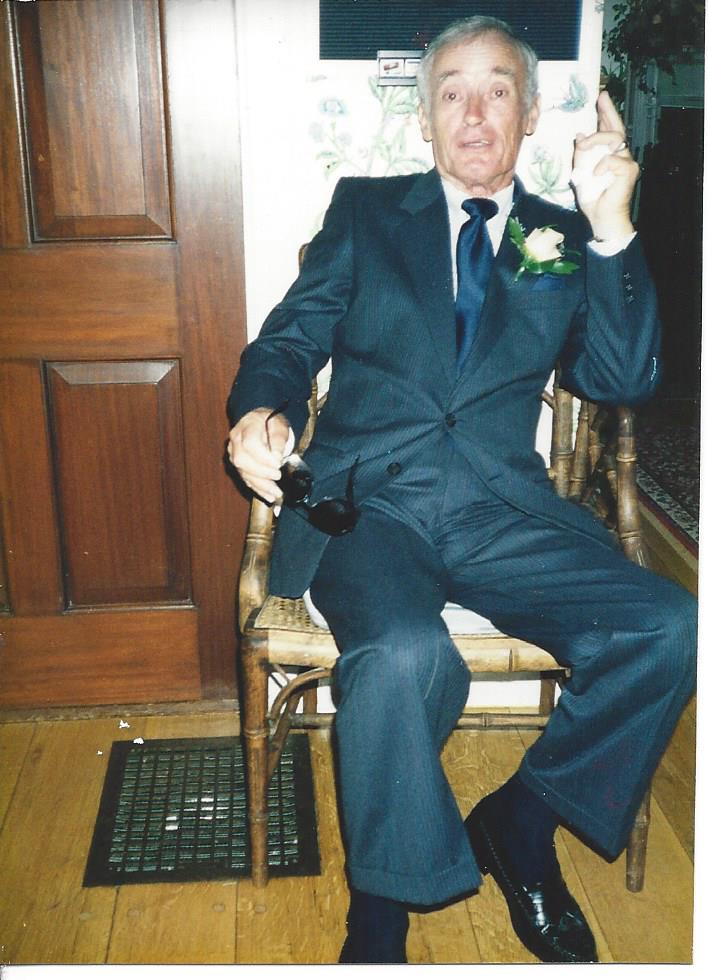
My father, photographed in July 2000. The last picture I have him before his death in 2003.
Relics
The package was nothing but white cardboard
held together with glue and clear tape.
It hadn’t even arrived special delivery.
He found it on the porch when he got home.
He used a letter opener
to sever the tape
and jumped
when the flaps popped straight up.
Hiding beneath layers of bubble wrap
was a metal container
the color of charcoal.
Inside that was a heavy plastic bag
filled with a gritty black dust.
The bag was clasped together
with a gold tag engraved
with his father’s name.
He pushed his way through the overgrown woods
to the river where his father fished as a boy.
He thought about birthdays that arrived
with no presents, or even phone calls.
But then he remembered the night
his father held his hand and spoke gently
explaining why Rick would just let Ilsa
fly off into the darkness.
Cradling the bag
in the crook of his arm
he smiled
wishing his father
had always been
this easy to hold.
Cold Hard Logic
Professor Otte had left me a message asking me to meet him at his office. As the Professor was teaching my Advanced Symbolic Logic class, I spent a lot of time in his office trying desperately to understand the class I was taking. It was a small class–there were seven of us, and I was the only undergraduate. The others were mathematics and linguistics graduate students. I had always been good at logic–I scored in the upper 5% on the logic section on the GRE–but I desperately wished the class had come with subtitles. I was sure Professor Otte wanted to discuss some assignment I had botched up, but that wasn’t why he called me (there is a another great story from this class, but I will share it next time).
The reason was a tutoring job. There was a student athlete over the hill at San Jose state who was taking a logic class, and needed tutoring from an expert. As there was no philosophy program at SJSU they gazed southward down route 17, across the Santa Cruz Mountains, and settled on Professor Otte for a recommendation. He selected me–the student struggling the most in his logic class. When I asked why not any of the grad students who clearly had access to the logic Rosetta Stone that I did not, the Professor told me that he thought I had the best social and communication skills in the class, and would therefore be a better teacher. Given the social awkwardness that hung over the class like smog in the San Fernando Valley, his compliment struck me as equivalent to being called the thinnest kid at fat camp. Or the finest ballerina in Galveston. But I could use the extra money, and I was curious to see how well I could communicate logic to someone who actually knew less than I did. So I accepted the job. (Of course, now I teach philosophy and logic to high school students, so guess what, Professor? Your instincts were good.)
So I climbed on to my 250cc Honda Helix motorcycle (shoving by long-haired, scraggly bearded self under a helmet and climbing on the Helix to teach logic was about as badass as I ever got) and headed over the mountains to San Jose. I was greeted at the door by a middle-aged and very kind Japanese couple, who expressed warm gratitude that I had traveled to help their daughter succeed in the logic class. I was ushered into the living room, fussed over, brought green tea and bean cakes, and treated like a long-lost nephew. Finally, my student arrived, and I felt my heart skip a beat when I saw her. She was beautiful, and had probably the kindest and most welcoming smile of any woman I had ever seen. Unlike other instances when I have been surprised by a beautiful woman, I kept my cool.

Hey, she looks familiar!
The parents bid a hasty retreat, and left us alone to do our work (but not so alone that the parents weren’t within ear shot in the room adjacent). I quickly saw that she was taking a Formal Logic class, and that while she understood it, her athletic schedule was causing her to miss significant class time. I noticed her text was Patrick Hurley’s “Introduction to Logic”–a book I knew well from two logic classes I had aced. I thus felt supremely confident that I could be a very effective logic coach.
And she was an excellent student. She immediately picked up the difference between Modus Tollens and Modus Ponens, could design Hypothetical and Disjunctive Syllogisms at the drop of the hat, and even mastered the Reductio Ad Absurdum. She could easily identify the difference between deductive and inductive logic, grasped the nuances of necessary and sufficient condition, and wrote truth tables with such skill it would have even made Wittgenstein proud (once he was done lambasting us for studying philosophy after him). She was a natural, and really seemed to enjoy mastering the material. We had a great time–it was one of the first moments in my life when I really felt the joy of teaching.
On one of my last visits to the house, I passed by her trophy case–it was packed with awards from her career as an ice skater. I paused to admire her accolades, and then turned to her and said something really insightful, along the lines of ‘Wow. You’re really good!” to which she humbly replied. “I do all right.” We made some more small talk, and then I headed home.
After my very last visit, when I felt confident my protégé would nail her final exam, the whole family came out to say goodbye. Dad handed me an envelope which I would discover contained a bonus for all my efforts, and as I pulled away I glanced back at the house to see them waving to me from the front stoop. I remember wondering if I would ever see them again.
I did–but it wasn’t until the following January when I happened to be watching the Winter Olympics and realized that my student was a star athlete by the name of Kristi Yamaguchi. I watched her win the gold medal that year, adding a powerful exclamation mark to a career that has also included thirteen world and national championships.
Oh, and one “A” in Formal Logic.
Growing Up Part-Time Indian Revisted, Part Six
We arrive at the local jail off of the reservation. As I had been arrested six times before, this was an establishment with which I was rather familiar. I had, though, never before been shipped there was so many others—about 200 altogether, and I doubted the jail had the capacity for us all. To solve that problem our jailers shoved us into tiny cells in which were crammed together like refugees in an internment camp. We felt like it as well.
Most disturbing, none of us who required medical attention were getting any. When we screamed at the guards, begging them to help those most in need, their response at most was swearing and admonishments to keep our mouths shut. Mostly they just ignored us. We were growing more and more worried, until a group of EMTs entered the wing and begin extracting those that needed the help the most, finally dispatching them to the local hospital. Relieved, we were still covered in each other’s sweat and blood, and it was hard to move in our cells. No surprise we began to direct our anger at each other—which was probably by design.
The door to our wing opened again, and we waited for the guard to again tell us to “Shut the fuck up!”—but to our surprise, it was not the guard that appeared before us. A hush fell over the entire wing as we realized who had just entered: a Lakota Indian with his dark hair pulled back in a pair of long braids, six feet of attitude and charisma that entranced everyone in his orbit, including the guards. Oh my God, do you know who that is? Holy Shit! It’s Russell Means! Russell Fucking Means!
The guard opened one of the cells and Russell entered. Instinctively, we made a place for him to sit, but he waved us off. He told us how he had been with us on the reservation, how he negotiated the medical assistance for the protestors in exchange for spending the night in jail with us and not alerting his media contacts until morning. I suspect our jailers really didn’t want him in there because the sight of Russell immediately lifted our spirits.

Russell Means was with us!
And that wasn’t all—he told us great stories about being a member of the American Indian Movement, about Marlon Brando, Larry Flynt, and his new friend, Daniel-Day Lewis. He told hilarious jokes, and got us all to sing Lakota songs together. This jocularity was clearly too much for our jailers, as they frequently popped in not to tell us we were too loud, but to remind us we were in jail and not to be enjoying ourselves that much.
Relaxed, many of us began to drift off to sleep, and at the very least felt things would be better in the morning. This calmness, though, was clearly the last straw for our jailers, who decided to play one last card: they set the toilets to flush over and over again, and the wave of irritation and anger began cascading its way back through the wing. Russell, a veteran of many arrests, was familiar with this tactic, and gave us all some excellent advice: “Don’t think of it as flushing toilets. Imagine yourself on a beach somewhere. That sound is the tide coming in. Trust me. Close your eyes and do that. It will be fine.”
And he was right. It did begin to sound like that, and I think we were all asleep within ten minutes. Finally having to concede defeat, the toilets shut off, and those still awake enjoyed a snicker of satisfaction.
The next morning, we were released and followed Russell Means outside. He gave a brief statement to the press, after which we stumbled to busses, waiting rides, and any other way we could to get home. It wouldn’t be so easy for my Uncle Chester, who was found guilty of attempted assault on a federal officer and spent several years in federal prison. All for the crime of having a cattle ranch.
For those who may not be aware, or who believe that land rights issues are a thing of the past, or that casinos have become the great equalizer for American Indian tribes, this story should be a reminder that there is much work left to be done.
Growing Up Part-Time Indian Revisted, Part Five
As expected, we were ordered to move. When we refused, the tanks were rolled in closer, but we gambled that they wouldn’t actually use the National Guard to fire on a group of unarmed civilians on what was essentially a foreign country, so we called their bluff. The tanks rolled backwards, and the guardsmen were ordered back. We were given another chance to surrender, and our silence gave them the only answer they were going to receive. That’s when the mercenaries–the rather unfunny group of individuals with the funny name of the Wackenhuts–were ordered forward.
The Wackenhuts are intimidating–trained paramilitaries, armed to the teeth, head to toe in desert camo. Unlike law enforcement agents, Wackenhuts are private security, so they do not need to identify themselves if asked, and they wear latex gloves to ensure they leave no finger prints on anyone they arrest. This gives them something of a license to treat those they arrest with a certain amount of roughness, as it is hard to identity “the scary looking dude in camo with an AK-47” as they describes virtually every member of a Wackenhut battalion. Still, we squeezed each other’s arms tighter, determined to keep our promise to Chester.
The Wackenhuts took several intimidating steps forward, then marched off to the sides to make room for the fire trucks. It was at that point we knew how we were going to be dealt with. We would come to find out later that the reason they had to import San Francisco firefighters is they couldn’t find any in the area willing to do their dirty work for them. I am also certain the overtime bill for the SFFD was staggering. I also hope no one in the city by the bay lost their lives in a fire that day, because the trucks had instead turned their hoses on us.
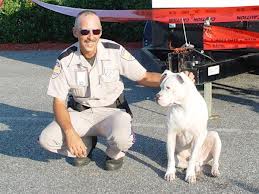
Wackenhuts: not actually this cuddly
I had been beaten, tear gassed, pepper sprayed, but this was first experience with a fire hose. I do not recommend it. I suffered a direct hit to my sternum, and a hose sized bruise stayed there for over a week. Another protester ended up with a ruptured spleen, another was hit in the face with such force his eye popped out of his socket. The hoses pushed our line of defense out of the way in a matter of minutes, and two hundred human beings looked like the pebbles and leaves being hosed off a driveway.
After we were adequately saturated, and laying in a puddles of pain and water, then the Wackenhuts moved in to make the arrests. They were, as ever, less than gentle. They dragged people by their hair, thumped some with billy clubs (including myself–twice), elbowed others in the face as we were literally dragged off to the waiting empty school busses. Before placing us on the busses, they handcuffed with plastic zip ties. Mine was tied so tightly my wrists instantly began to bleed–and I was by no means alone.
After what seemed like hours, but was probably more like minutes, the bus was filled with protestors, sopping wet, bleeding, moaning in pain–one of us holding his eye socket inside his head with nothing but his hands. All of our pleas for medical attention were ignored as the bus finally lurched forward, on its way to incarcerate us.
Growing Up Part-Time Indian Revisted, Part 4
I have been arrested seven times. Many people who know me–especially my students–find that hard to believe. Mind you, I have never been convicted, but it remains something of which I am very proud. This is due to the fact that my arrests were all for the crime of civil disobedience.
I don’t claim to be their equals, but I embrace the fact that I am associated with the thought and actions of Thoreau, Gandhi, King, the Danes during the Second World War, and the Polish Solidarity movement. I would like to say that my actions of myself and those I stood with made just as much of a difference, but I know that’s not true. I do think, however, that our actions had something to do with the fact there has not been an explosion at the Nevada Test Site since 1992.
There are many stories of my arrests, but I am going to tell this one, as I think carries with it extremes: an extreme miscarriage of justice, and an extreme response to those who wished to peacefully prevent it.
My Uncle Chester was a cattle farmer. He was more than that, of course–like many Baby Boomer American Indians, he fought in Vietnam. The military recruiters did a good job of reaching out to young men on Indian reservations during the 1960’s, convincing them that they were going to rise the defense of indigenous people (the South Vietnamese) against an invading colonial army (the North Vietnamese). A chance to be a warrior, like their ancestors. Many young men were seduced by this pitch–particularly in light of the fact that had few other job opportunities on the reservation. So why not? Chester was one of those who decided to join.
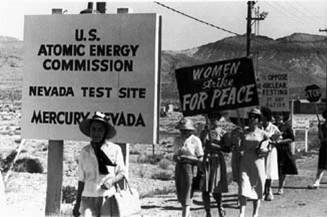
There is a long history of civil disobedience at the Nevada Test Site
One day he was hurt in what he described as a covert mission into enemy territory, and a rather inconvenient chunk of shrapnel ended up in his leg. He was patched up, and honorably discharged, but since his mission was secret, he was never given a purple heart, and was declined the pension for soldiers wounded in combat. This may seem difficult to believe, but when you speak to American Indian men who were wounded in Vietnam, they have a very similar story. This makes me doubt this was a coincidence.
Chester, though, had put all that behind him, and a successful cattle ranch that he loved to run. Then one day, federal agents cited him for the crime of “overgrazing on federal land”–a crime that only applies to those who lease land for their livestock. The law specifically states that reservation Indians are exempt from this law, but it was being invoked against him. He was slapped with a staggering fine which he could not pay. So, all of his cattle was confiscated–which we have always suspected was the real reason for his arrest. Some much larger cattle rancher with political influence pulled strings to shut down his operation. The feds, though, weren’t satisfied with this. They announced the value of his cattle did not equal the value of the fine, and if he couldn’t pay, he would be incarcerated.
So many of us decided that would never happen. The day that he was going to be arrested, we were going to put ourselves between the federal agents and Uncle Chester. They were going to have to go through us to get to him. There were about two hundred of us–we locked arms and made a circle around Chester’s cottage.
Facing us were two FBI Agents, a battalion of mercenaries, two divisions of the Nevada National Guard, several tanks and military helicopters, not to mention two San Francisco Fire Department hook and ladder trucks, and several empty school busses. We didn’t know what was about to happen, but we knew it was going to be ugly.
Yes, I Am Grateful
I know it is something of a cliché to write posts with this title near Thanksgiving, but I am going to for a couple of reasons. One, it’s now Friday–Thanksgiving is over! The real reason, though, is that something rather extraordinary happened to me at work this Monday, I feel compelled to write about it in these terms.
Don’t worry–next time, I will return to the Duck Valley Reservation to continue my story as a Part-Time Indian. You won’t want to miss my foray into civil disobedience. Until then…
You may recall the amazing response I had to World Parkinson’s Day last April. In that case, I planned the event, communicated it to my students and colleagues, and asked for their assistance. If you read that post, you know how everyone came through in a big way. This past Monday, however, my colleagues and friends at the high school really outdid themselves.

I’m one of the first people who arrive at the school, so I rarely see my colleagues when I enter the building. However, as they began to arrive, I noticed that many of them were all wearing the same button: a button with a circle and a line through the letters “PD.” These buttons were created by the Parkinson’s Action Network, and they are part of the Network’s campaign to stomp out Parkinson’s. I had never before seen the buttons, but I had plenty of opportunities to make up for that because all of my colleagues–teachers, administrators, custodians, secretaries, instructional assistants–were wearing them. And they were doing so in honor of my birthday.
Moreover, upon entering the teacher’s lounge, I noticed a massive cake with the words “Happy Birthday, Kevin” and several more NO PD logos decorating the frosting. It turns out Sandy, the school nurse, and two other teachers (Jeff and Diane) hatched this master plan to show support for my fight against my illness, and decided the best way to show that support is by surprising me on my birthday. Anyone who knows me has probably worked out that I had a lot of trouble keeping my eyes dry that day. I certainly felt supported–and tremendously special.
So that’s one of the reasons I am grateful this week. Do you like and admire your work colleagues? That’s great, but let me tell you something–I will put my coworkers up against any other group of coworkers anywhere. I know they’d come out on top.
Growing Up Part-Time Indian Revisted, Part 3
It may seem self-evident to point out that seeing an atomic explosion was the single most terrifying thing I have ever seen in my life. When I saw it explode, I was not aware of Robert Oppenheimer’s quote: “Now I am become Death, the destroyer of worlds.” When I read that quote several years later, I had no difficulty at all understanding what he meant. Unlike Oppenheimer, I was not responsible for the existence of the bomb, but the explosion was such that it seemed to be destroying a fabric of reality in front of my eyes.
I think the thing that is most shocking about watching an atomic explosion is the fact that for the first few seconds there is…silence. You see the cloud slowly begin to rise, and you wonder: where is the deafening boom? The cloud grows larger and larger, seeming to absorb and expel all of the matter in its vicinity. You continue to watch, bracing yourself for the sound, but it does not come. Just when you are at the point where your brain begins to reconcile the fact that you are watching an explosion that will generate no sound at all, you are suddenly hit with a wave of deafening thunder. We were miles away, but the entire mountain we stood on trembled with such force I was certain it was going to collapse around us. Growing up in California, I have endured about a dozen earthquakes, including the Loma Prieta earthquake in 1989 that leveled significant parts of the San Francisco Bay Area. No earthquake could even compare to the rumbling of the earth I felt that day.
I stared helplessly as the cloud expanded and rose, dwarfing the hills and mountains behind it. As it expanded, growing thousands of feet every second, I would become convinced that it couldn’t possibly grow any larger. Then it would. Then I would try to convince myself that it was now as large as it possible could be. Then, a few seconds later, it would be twice the size it was before. Looking back on it, I realize now that I may have actually been bargaining with God: please don’t make it any larger than this. Or this. Or this. And each time it did, I could feel more of the planet dying, more of my family history being obliterated, and my connection to my ancestors slowly eradicated. I felt alone, found myself questioning the meaning and purpose of any human being alive. If we could do this, we didn’t need God. We didn’t need the devil. We had accomplished the task of making our entire civilization disposable, and virtually every other living creature along with it.

Bill Bryson wrote in his memoir of growing up in the 1950s how Americans felt indestructible, so much so that tourists used to picnic in the desert and watch the bomb explode. After words, scientists would scan them with Geiger counters to see how radioactive we were. This was also the time that we thought that a turtle named Burt could teach us to “Duck and Cover” so we could survive a nuclear attack, and that bomb shelters were worthwhile investments. I am often tempted to laugh at those absurdities, but when I think about the explosion I witnessed, I find it almost impossible to do so.
On the way back to the reservation, my Grandfather said nothing to me, even though I sat in the car trembling and weeping the entire drive. When we got back, I felt compelled to ask him why he wanted me to see that. I was so angry at him for showing that to me. He must have known what it would do to me, that it was an image that would keep me awake for the next several nights and haunt me to my final day on this planet. When I finally mustered the question, I expected him to give me the type of answer he usually did: you’ll understand later, that’s for you to decide, or why do you think? For one of the few times in our relationship, he gave me a pretty direct answer:
“That bomb is a part of who you are. It represents everything that’s been taken from us, and everything we need to fight against to take it back. You needed to see it because that’s part of your fight now, and will be for the rest of your life.”
I stared at him a moment, not really comprehending everything he meant by that. Finally, some part of me seemed to understand, so I nodded as my sobs grew louder. He pulled me into an embrace and let me cry into his chest. I still remember the scent of leather and tobacco that filled my nostrils.
And you know something? I’m still nodding to him. Even today. Because that day changed me forever.

