Growing Up Part-Time Indian Revisted, Part 2
Yes, it’s a long title, but it will have to do.
Spending my youth on the reservation presented a particular number of challenges. First of all, I kept my feet firmly planted in two very different worlds. Life on the reservation was as different as it could be from my neighborhood in San Diego; it was smaller, there was more poverty, and the pace of life was far different from that of a major California metropolis. For one thing, I had to learn how to live on “Indian Time” on the reservation. No one had a clock, or a watch, and when I enquired about the time, the conversation often went like this:
Me: What time are we having dinner?
Grandpa/Aunt/Uncle: When everyone gets here.
Me: When are we going to leave?
Grandpa/Aunt/Uncle: When we’re ready.
I remember how irritated I used to be by this when I was younger, but after a while, I learned to embrace life in this way, and realized it made much more sense. As my grandfather used to say, “You should live on Indian time. White man time will give you stomach cancer.” I think he stole that from a movie, but his point was well taken.

I also loved the fact that my Indian relatives were quiet, and didn’t insist on me talking all that much. As a young man struggling with a stutter, this was a blessing. I hated having to speak, and I hated the often impatient tone with which I was treated when I couldn’t get my words out. I remember once when my Uncle Steve asked me a question once, and when I tried to answer, he just put his hand on my shoulder and said, ‘Don’t worry about it, dude. You don’t have to talk. Just get good at listening. Most people are shitty at it.” I remember the feeling of relief that came over me when he said this. Not only did I not have to talk, but my inability to speak might make me good at something no one else is? This stutter thing might not be so bad.
As quiet as my relatives were, they could be brutally honest and direct. I recall one long drive I was on with my grandfather and two uncles were on our way to a Pow-Wow (I don’t recall exactly where). For the first two and a half hours, no one in the car said one word. Then, my Uncle Steve turned to my Uncle Clyde and said “That hat looks stupid.”
Clyde gazed at Steve a moment, processing his brother’s opinion. Finally, he replied “I like this hat.”
Steve simply shrugged, and then said “Okay.” No other words were uttered for the next ninety minutes.
There was another trip I took with my grandfather in silence I sometimes wish he had spoken to me more. The only thing he told me was that we were going for a ride, and then we headed south. After a long drive he pulled off the road, and we spent a half an hour scaling a nearby hill. When we reached the top, my grandfather began to pray. I didn’t really understand what we were there for at first until he put his hand on my arm and pointed.
“You want to look there. Should be any minute now.”
It was then that I realized where he was pointing: the Nevada Test Site.
Growing Up Part-Time Indian Revisted
Back in February, I was asked to give a talk at Eastern Connecticut State University to give a talk on growing up as a part-time Indian. I had been meaning to come back to this topic for some time, hoping to expand on this story for those of you who didn’t hear my talk. Which, let’s face it, was most of you. All these months later, I have returned to it.
I borrow the title from Sherman Alexie, whom I hope can forgive me, because it really did apply to me. I would spend ten months of the year living in a residential southern California city (San Diego) and then spend my summers in the Duck Valley Indian Reservation on the Nevada-Idaho border. To say that I lived my young life in two very different worlds would be to understand the matter significantly. As a young man, I struggled mightily to figure out which world I truly belonged to. I still sometimes wonder.
A little background: the Ruby Valley Treaty of 1863 recognized Western Shoshone sovereignty and the tribes right to control 60 million acres of territory, most of it in Nevada. Like many treaties between American Indian nations and the United States government, it has been ignored and violated over the centuries. This should surprise no student of American history. Whether the example is the horrid Trail of Tears, the slaughter at Wounded Knee, small pox blankets, or the ghastly boarding schools of the twentieth century, Indian sovereignty has been scarcely respected. Unless, of course, your tribe has a profitable casino that provides the tribe with political clout. This is the case of Foxwoods and Mohegan Sun here in Connecticut; most reservation Indians do not live in environments flush with cash.

In addition to these crimes, the Western Shoshone have had to cope with two other egregious violations of their land rights: one on end of Shoshone territory is the Nevada Test Site, where since 1951, 1021 atomic tests have occurred on lands that by treaty belong to the Western Shoshone. The end result is that the Shoshone nation is the single most bombed nation on earth. It is common to read the terrible accounts of Hiroshima and Nagasaki, or the test on Bikini Island, and all humans should be aware of this. No other country in the world has had to endure the destruction caused by the detonation of over 1,000 bombs, in addition to the sicknesses and health issues brought about by the amount of radiation released into the atmosphere and the environment.
That would be bad enough, but on the other end of Shoshone territory is something called the Yucca Mountain Nuclear Repository. Despite its holy status to the Western Shoshone, Yucca Mountain was annexed decades ago for this purpose, and no member of the tribe has been able to set foot on the Mountain since. In the meantime, a tunnel several miles deep has been dug in anticipation of the repository opening and accepting shipments of nuclear waste from throughout the country (and, if profitable, the world). Never mind that no member of the tribe consented to the use of the mountain for this purpose, or that it rests on an aquifer and an earthquake fault. The good news is that Harry Reid’s clout in the United States Senate has kept the repository from opening. There is no guarantee, though, this will remain constant.
It is into this environment I found myself thrust each summer I visited the tribe. I had no idea how it would fundamentally form the person I would become in ways so profound I am still struggling to understand them. And it is with this background I will next time begin to tell my story.
It’s Been Too Long
Once I returned from France in July, it seemed like my life kicked into high gear again. Before I knew it, I was getting ready for a new school year, attempting to understand a new teacher evaluation system no one could adequately explain, contract negotiations with my local Board of Education, trying to be an effective union president, and oh yes, teaching my classes. And then the next thing I knew, the first quarter was over, and it was November! And I hadn’t posted anything since July. It goes by way too fast.
So now I am back, in spite of the fact that I am well into National Novel Writing Month (8400 words and counting!). Thus, I am going to use this newfound writing energy to keep up with this blog with more regularity. I have many more stories to tell, some updates on my screenwriting, and thoughts about the current state of teaching. Lots of things knocking around in my head that will soon find their way to this page. It won’t start today, as this is a short message to let you know I haven’t disappeared. I will be back tomorrow with a much longer post–one far more worthy of my excellent readership. Until then, thanks for your patience.
Reflecting on France
Fifteen days. Two flights, eight train rides, countless Metro rides, half a dozen boat trips on the Seine, a cable car ride up and down the Eiffel tower, one rather tense van ride around the Arc De Triomphe, a week of driving in Provence, and lots and lots of walking. And through all of that traveling, I noticed a number of things about France that I wanted to share here as a summary. First, some of my favorite things:
–A great way to end a trip is to be voluntarily bumped from a flight so you get air ticket vouchers in Euros, a free hotel stay, three meals, and a bonus day in Paris. Thanks, Ralph Nader! And thanks to Melissa, our dog sitter, for agreeing to stay an extra night.
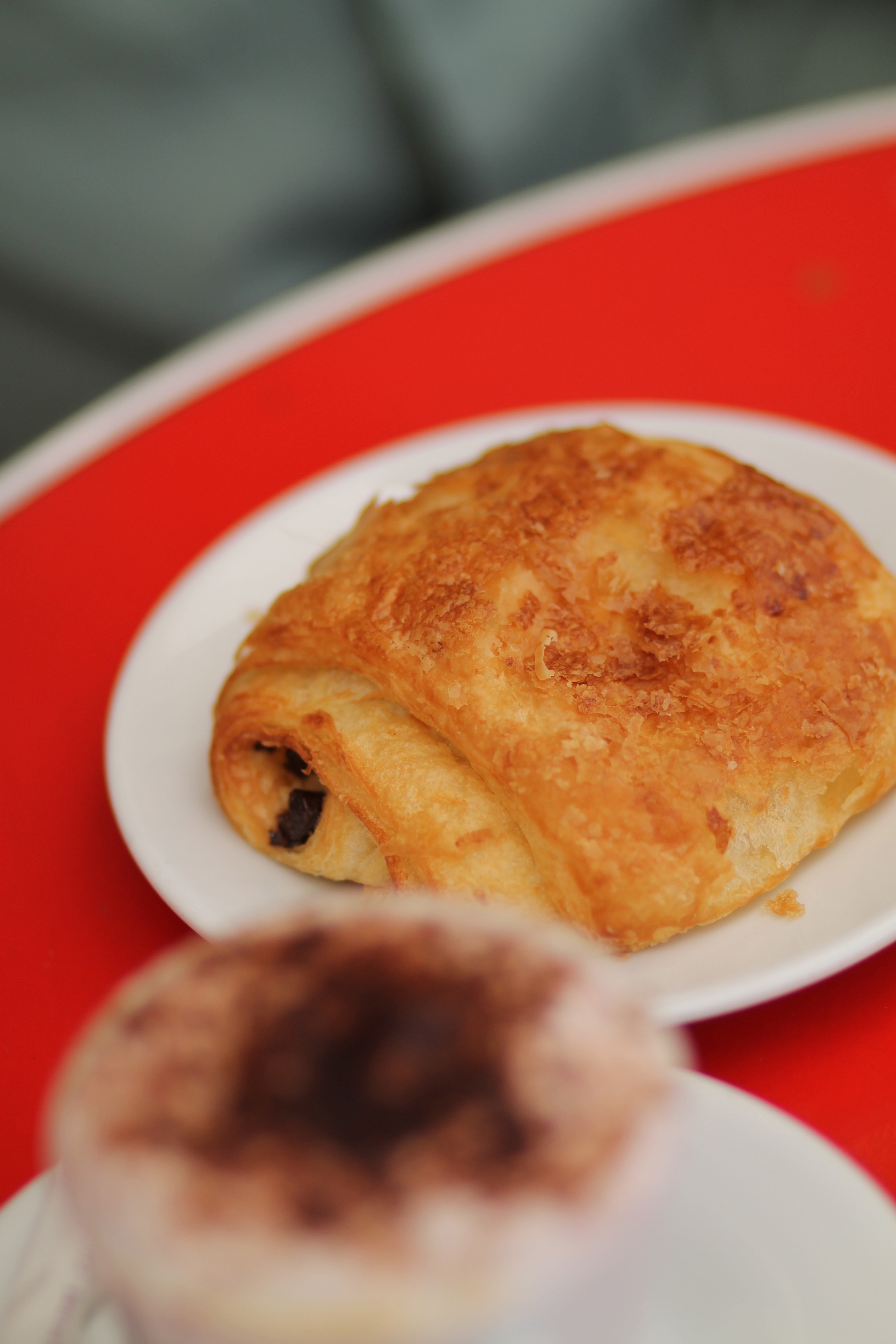
— Croissants and pastries are amazing! And French people do actually walk around with baguettes. It’s not just a stereotype.
–The Metro Subway System is efficient, easy to navigate and understand. The one in Montreal has all but three of those qualities, so it’s clearly not a language issue.
–France is very English friendly, and most of the people we met were very kind, helpful, and open. Yes, a couple of rude waiters, but I can find those in New York City speaking my own language. In contrast to the stereotype we have in the United States, the French are a very welcoming people.
–The French love their dogs, and bring them everywhere: on trains, into restaurants, into museums. They might be more dog crazy than the United States.
–Museums are really crowded, which can be annoying at times…but it’s really exciting so many people want to see art, so no complaints here.
–There is nothing better than eating a crepe on the street!

And now some wry observations:
–The United States may not have a lot of manufacturing to export, but we do a great job of exporting our popular culture. I saw a lot of Europeans wearing Yankee caps, Hollister shirts, and a number of other pieces of clothing containing geographical and cultural references they may not have understood. It’s interesting, because you rarely see “Surf Marseilles” shirts or hats for the Bruges football team in the United States. Globalization is clearly alive and well, but as usual, it’s a one-sided endeavor.
–Parisians, you have a beautiful city, but please stop treating your parks like ash trays and garbage cans. It is much more fun to sit in a park that doesn’t resemble the back lot of a recycling center.
–Romas, I know that France and virtually every other European nation has treated you like second class citizens since like, forever. But does that scam where you pretend to find my dropped wedding ring and sell it back to me really work? I got proposed to by at least six Roma women and one man.
–French drivers really help me appreciate the cool, reasoned approach of Italian drivers.
–Young French people: you are beautiful and handsome, but won’t stay that way unless you quit smoking. Fever cigarette butts in the parks as well.
And a few rants:
–American tourist: the reason we don’t use the term “mineral water” has nothing to do with the fact that our water was fewer minerals in it. We just don’t use that term to describe our Poland Springs and our Aquafina. Both of those contain minerals. If you have more thoughts like this, please keep them to yourself.
–American father with his teenage daughters who wanted to see Shakespeare and Company: Why did you storm our of there shouting “I am not staying in that place. We are leaving. Now!” What were you afraid of, exactly? Books? Ideas? The fact that your teenage daughters were interested in reading? Maybe you should have relaxed and had a mineral water.
–All tourists who run across the roundabout to get to the Arc de Triomphe: did you notice there is no crosswalk? Please use the tunnels the good people of Paris so generously built for you so you don’t have to race screaming through traffic, and literally run the risk of being scraped off the hoods of taxis by irritated French policemen wearing hazmat suits. Thank you.
–And to the young man at the mass in Chartres Cathedral: First of all, no one since the Reagan administration ended has any excuse for wearing a Chucky from “Child’s Play” t-shirt anywhere, much less into one of the most beautiful cathedrals in the whole world. I wasn’t raised Catholic, and haven’t been to a mass in 25 years, but even I know you aren’t also supposed to take photographs during the service. There were just so many things wrong about you.
Thanks to all of you who went along with my first foray into travel writing. I hope you enjoyed it. I sincerely hope these posts gave you some sense of how really wonderful a trip it was.
Be Happy–Eat Chocolate!
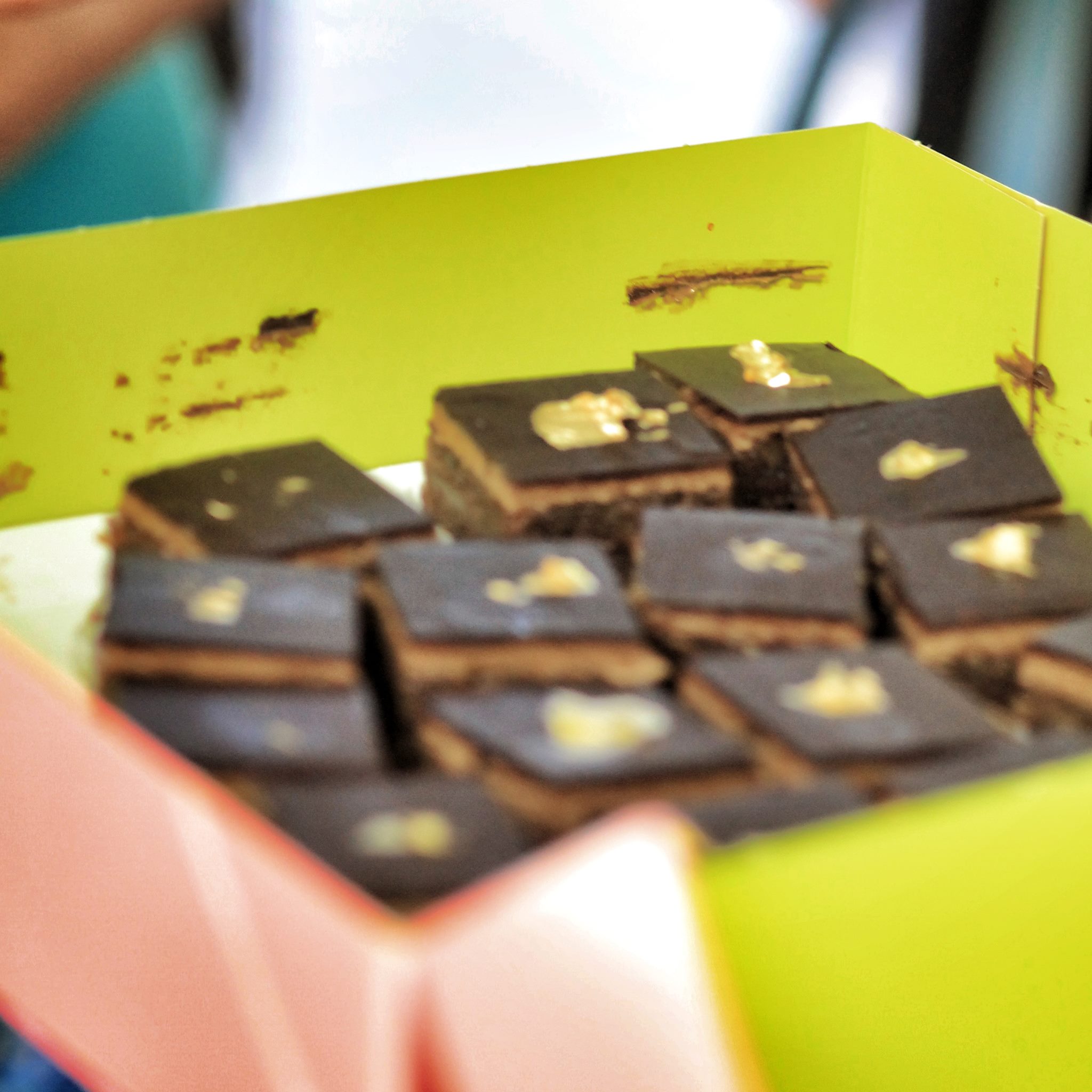
Opera pastries. Rich and delicious!
One of the best things about Paris is, of course, chocolate. What better way to learn (and taste) the different types of Parisian chocolate than a tour? Ours, sponsored by a company called “Paris Walks” and let by an American expatriate name Richelle did just that–and more.
First was a visit to a patisserie, where we sampled scrumptious chocolate eclairs and the out-of-this-world opera pastries pictured above. Chocolate, buttercream, sponge cake, and vanilla all stacked up for a decadent, satisfying whole. Richelle also took the time to point out some of the more curious aspects of the neighborhoods in which we passed–Moliere’s birthplace (and later, his statue); a pharmacy that once sold invisible ink used by one of Marie Antoinette’s lovers to send her discreet notes (the advertisement that the pharmacy carried such ink is still visible on the building’s facade); fragments of the nearly thousand-year-old wall erected to protect Paris from the English; and a trip through the Vero-Dodat, one of Paris’ last remaining arcade (covered) passageways. Our minds were nurtured as much as our bellies.
All bets were off, though, when we visited three superb chocolate boutiques: the first was Cote de France, wherein we sampled dark and milk chocolate ganaches and pralines. We were taught the proper way to sample a real piece of chocolate (bite into it once, feel the snap, and let it melt in your mouth). We were treated to different, surprising flavors including hazelnut and ginger. The second boutique was Michel Cluziel, where we sampled bits of dark and milk, the best hot chocolate I have ever had in my life, and a praline spread described as “Nutella without the palm oil.” A jar of the spread somehow found its way into our suitcase.
The final stop was a chocolatier appropriately named Jean-Paul Hevin, who treated us to a variety of samples including raspberry chocolates and even salted caramel macaroons. At this point my amygdala and my taste buds were in overload as Richelle bid us adieu.
Stumbling back out into the sun, we wandered up and down rue Saint Honore, blissfully reeling from our chocolate high. Why would you need anything else?
In Monet’s Garden

Monet’s actual water lilies.
When I was a child, my father had a print portraying Claude Monet’s garden in his bedroom, and another of “Water Lilies” in his office. I remember being entranced by these paintings–they were beautiful, yet also very calming. During some of the darker moments of my childhood, I would often stare at these images, and wish I could escape to them. I wonder if my father sometimes wished for the same thing.
As I got older, I was shocked to discover that these gardens and lilies did exist. Not only that–I could go see them for myself in Giverny, a tiny hamlet an hour outside of Paris. I learned this from an East Asian professor, who explained that Monet was fascinated with Japanese Zen artwork–so much so that Monet’s house was filled with works of the Japanese Zen masters. I had appreciated the meditative effect of studying these Japanese artists, and now I knew that my similar reaction to their works and Monet’s was no coincidence.
Today, I finally got to see Monet’s garden. And I have to say it–it was like the paintings had come to life. The garden itself I could only describe as beautiful chaos. Every kind of flower you could imagine is there. Sunflowers and lavender? Well, this is the French countryside. Of course! Hydrangea? In several colors. Single yellow roses jutting out from nowhere? Sure. How about something crazy like wild blueberry bushes? Those, too. And of course–water lilies.
Just as his impressive garden inspired the great painter’s own work, everywhere you looked on the grounds you would find a painter or sketch artist themselves inspired to create. For myself, I just wanted to sit quietly and absorb everything. All of these images and colors that I had once yearned to escape to were all here in front of me. Like a palette with more hues than I could possibly imagine.
And sure enough…Monet’s house is itself one of the most impressive galleries of Japanese artwork I had ever seen. Life is good when it meets your high expectations.
Keeping Company with Shakespeare

I know that the Shakespeare and Company bookstore on the Left Bank of the Seine is not the original. It does still have a great deal in common with its predecessor, including an impressive selection of books crammed into a very tiny space. The bookshelves themselves are ancient, rich with the character of another time. Even the woman who currently owns the store is named Sylvia, after the original store’s founder–the impressive Sylvia Beach.
Ms. Beach was knows for hosting the likes of Ernest Hemingway, George Bernard Shaw, Gertrude Stein, and Ezra Pound. Sylvia also published James Joyce’s “Ulysses” when no other publisher would go near it. Her shop became a center of great literature, intellectual discourse, and readings from some of the most important writers of the twentieth century. Put another way–there was no way I was going to spend a week in Paris and not visit.
It did not disappoint. The ghosts of the great writers and history it contained appeared present in the store, and most customers seem to sense this. Bookstores tend to be quiet places, but browsers moved through the stacks in what I can only describe as a reverent silence. Climbing the ancient wooden staircase to the top floor revealed a room full of used hardcovers, and down the hall a group of children enjoying an enthusiastic reading of “Alice in Wonderland” (sadly, not by Lewis Carroll).
I emerged with a charming collection of John Keats’ poems. As many of you know, Keats is a particular favorite of mine. Indeed, I titled one of my screenplays “Season of Mists.”
A couple of other touches remain from the old store: you can rent an old manual typewriter to work on your manuscript. Where would you take it? The rooms upstairs are still let out at little or no charge to working writers.
Hmm. I think I’ll be coming back to Paris.
Yes, the Eiffel Tower
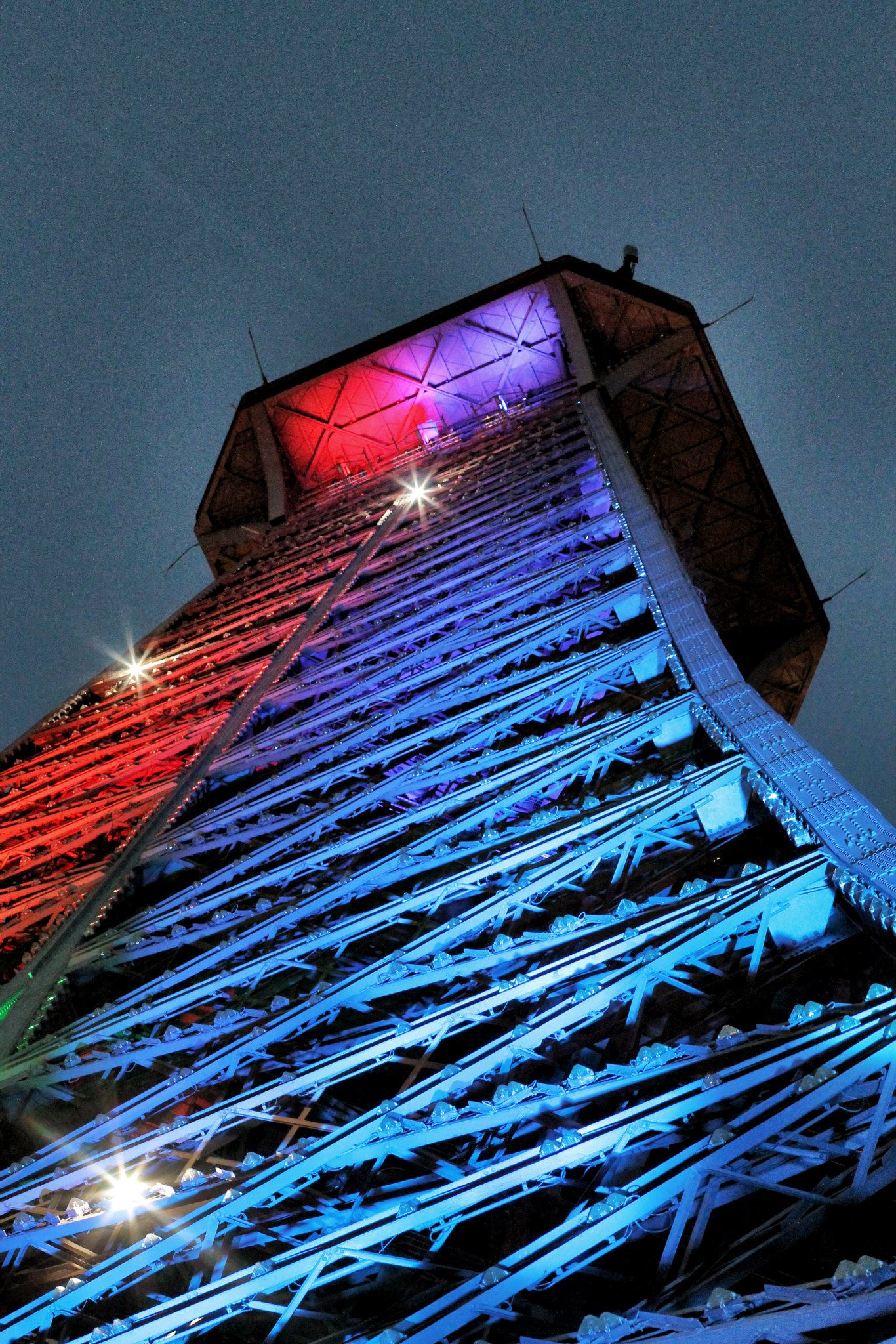
A view of the Tower at night from the second level.
I know what you are thinking–what else could he possibly have to say about the Eiffel Tower? One of the most iconic sites and images in the world. One of the few structures where you could show a picture to just about anyone on earth and they would recognize it instantly. It has been filmed and photographed as many times as there are rivets in it (2.5 million). There are fake versions at Epcot Center in Florida and in Las Vegas. It is the ultimate tourism cliché.
And yet…if you have actually been to the tower, you know when it is standing before you, none of that matters. It is an awesome structure. I don’t think you can really appreciate just how impressive it is until you find yourself dwarfed at its feet. You expect the Empire State Building to be huge, and it is. You expect the Burj Khalifa to have a view of what looks like the entire Arabian Peninsula, and it does. Perhaps because the Eiffel Tower exists for no other purpose than to look at and from it, we don’t anticipate its sheer power. That is part of what I think overwhelms us in its presence.
It is also a work of architectural genius. Built in slightly over two years, it boasts a modular design that allowed it to be assembled in pieces. Once the lower pieces were fastened, the tower could then support the weight of the next piece to follow. Given the tower is comprised of almost nothing but iron girders, air and wind easily passes through it so it never shakes or rocks. I think the most amazing thing about it is that the iron in the tower is used so efficiently that if it were melted down, and the liquid were spread out across an area the size of the tower base, it would be…two and half inches deep.
We visited the tower at night, courtesy of a Skip the Line tour from a company called Easy Pass. I highly recommend this, because you do indeed skip the long queue waiting to enter, and find yourself at the second level very quickly. Our tour guide was a smart, funny, charismatic young woman named Ellen. Ellen hails from Dublin, so we learned about the tower, Gustav Eiffel and much of Paris through the sound of a charming Irish brogue. If I had been a single man in my early twenties, I probably would have proposed to Ellen right after the tour.
But I am almost none of those things, so I instead enjoyed the tremendous views and the absolute wonder that is the Eiffel Tower. It is not what you would expect. It is so much more.
Chartres During the Day
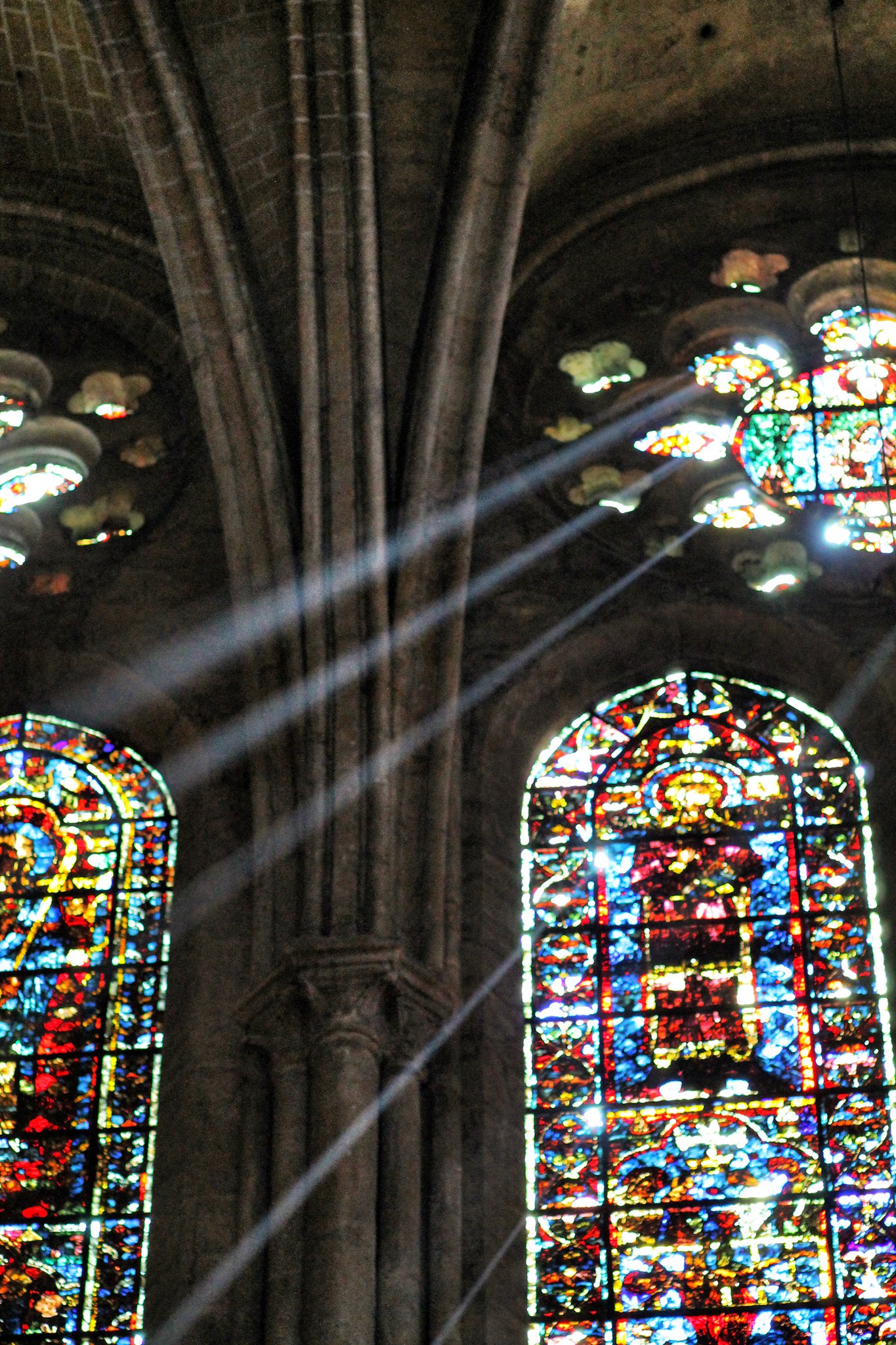
The Cathedral—officially named the Cathedral Notre-Dame de Chartres—was built in 1194. It was a replacement, however, for the original that had burned down. Indeed, a church devoted to the reverence of the Virgin Mary has sat in this spot since the fourth century. Part of the Cathedral floor actually remains from that period.
The place is huge. The nave is 427 feet long, 20 feet wide, and 120 feet high. Even the pipe organ makes you feel small; it is 80 feet off the ground, 30 feet wide and about 20 feet tall. Most impressive—and beautiful—is the 28,000 square feet of stained glass.
One of these glass windows is called the “Blue Virgin Window.” This mid-twelfth century stained glass depicts Mary dressed in blue on a rich red background, cradling Jesus while the dove of the Holy Spirit rests on her shoulder. For centuries the Blue Virgin has been a must see for pilgrims.
Those same pilgrims also continue to be in awe of Mary’s Veil. The veil was supposedly worn when Mary gave birth to Jesus. It is displayed behind a locked gate, in a glass window with a golden frame. Recent tests confirm that the material itself and the weaving technique date the cloth to the first century, so if this isn’t the genuine article, it’s from the same time period. No bogus Shroud of Turin here.
I think the most moving part of the day occurred in a small chapel in the Cathedral know as the Chapel of Our Lady on the Pillar. It is traditional for pilgrims to kiss the column in reverence and prayer, and I noticed a South Asian woman—dressed all in blue—doing just that. When she rose, and turned to leave the chapel, I also noticed she was pregnant.
Later, exiting the Cathedral, I saw her sitting outside, gently weeping. I don’t now how far she had travelled—the Catholic community in Mumbai, perhaps? —but I imagine the emotional and spiritual power of her experience made it worth the trip.
The great literary critic and avowed atheist Christopher Hitchens once called being in Chartres the closest to holy he has ever felt. That alone should tell you about the Cathedral’s majesty and mystical beauty.
Chartres at Night

We arrived in town tired from a day of travel, so we headed to a café in the shadow of the great Cathedral for a late dinner. We knew that they made an effort to bathe the 13th century behemoth in light, and thought we could take an after meal stroll and enjoy the decoration. We had no idea what we were in for.
First of all, they do not simply bathe the Cathedral in light. They instead project an entire light show on the building’s façade, using its architectural dimension and design as a rich palette for the colors. Part performance art, part animation, part spiritual celebration, it is unlike any light show I have ever seen.
As you watch, the building transforms and blends into a kaleidoscope of hues, then shifts to three-dimensional calligraphic excerpts from scripture, to animated dancers “building” the cathedral before your very eyes. It is also synched to a gentle yet uplifting soundtrack comprised of electronic keyboard, harp, and gorgeous soprano singing. Hundreds of us stood there transfixed as the Cathedral—already regarded as one of the most beautiful in the world—transformed into something even more miraculous.
And we haven’t even yet been inside.

