The Liebster Blog Award Challenge
I have been nominated by the superb Adite Banerjie to take the Liebster Blog Award Challenge. The aim is to help bloggers spread the word about each other’s blogs. Adite is an excellent blogger and screenwriter, and I am looking forward to reading her first novel which will be published this fall. She is also only one of only two of my Facebook friends whom I actually haven’t met. As she explains, “Every nominee has to write 11 interesting/little known facts about herself, answer 11 questions set by the person who has nominated her and nominate 11 bloggers to take the challenge (and set 11 questions for them).” So here we go.

First, my eleven facts. I am going to try not to allude to anything I have already written about in this blog, but I may expand on them in later entries.
1. I was once alone in room with Renee Zellweger. Ok, it was a restaurant foyer, but both sets of doors were closed at the time, so technically this is true.
2. I am the President of my local teacher’s union.
3. Next year I will have my very first second generation student. I am officially old.
4. I have Parkinson’s Disease. This is the only thing I have in common with Muhammad Ali–other than the killer right hook.
5. I once had a pet tortoise named “Zorro.” I lost him in a divorce.
6. I was bullied in high school–by girls, who constantly made fun of the fact that I had no butt. True, girls were making fun of me, but on the other hand they were paying attention to me. It was a confusing time.
7. I was part of a group of high school kids who heaved our lunches, rocks, and assorted bits of landscaping at members of the Ku Klux Klan. I didn’t have a very nuanced view of tolerance in the tenth grade.
8. I was cast as Horatio in a junior theatre production of Hamlet because I was the only one in the cast who could cry on cue. Not sure what it says about me that I could do that at age 16.
9. I am a recovering alcoholic with 29 years of sobriety.
10. My college, UC Santa Cruz, at the time had no letter grades and was officially a clothing optional campus. This was proven each day by the presence of “Naked Frisbee Guy.”
11. Speaking of UC Santa Cruz, my wife and I had several classes together and some friends in common, but we didn’t meet until 5 years after graduation on the other side of the country.
I will now answer Adite’s 11 questions for me:
1. What’s your favourite time to write or do creative work? And why?
I like to write late in the evening, I think because it taps into my natural night owlishness.
2. What’s the first thing that crossed your mind when you woke up this morning?
Is that the dog cuddled against me or my wife?
3. What’s the one thing that drives you batshit crazy?
Other than bat shit? Condescension. It’s a great way to see how short-tempered I can be.
4. Describe briefly any one unforgettable moment in your life.
The day I married Valerie, my wife. I remember being sublimely happy.
5. Which is your must-do dream vacation?
The Galapagos Islands. The most unique place on earth.
6. Fill this blank: At age 10 you dreamt of “being _____ when I grow up.”
Someone who could talk without a stutter. A bit sad, I know, but’s how I felt.
7. If you could travel back in time which “period” would you visit?
I’d go to London in the 1960s, so I could see the Who, the Stones, Yes, and Jimi Hendrix all starting out and playing the Marquee Club.
8. If you could transform yourself into a celebrity for one day, who would you pick?
Colin Firth. That way I’d still have my wife’s undying devotion.
9. Complete this sentence. Fun is ________
Laughter.
10. If you could change any one of your (bad) habits what would that be? (You’re not allowed to say you don’t have any bad habits!!)
I would eradicate once and for all my social nervousness.
11. Tell us something that excites you about your current project.
It’s a teleplay about a high school, and it’s not silly and filled with autotuned signing. In other words, its real, which means no one’s ever seen that on television before.
Now my 11 questions for A Detailed House, Brant Smith, Beneath the Lamp Post, Emily Knudsen, Lesley Carter, Melissa Nosal, Mike Barnett, Sanchari Sur, Sushil Kumar, Ayanna Nahmias, and Valerie Brodie:
1. What’s the single most embarrassing thing to ever happen to you?
2. What book do you remember reading as a child that has stayed with you since?
3. What’s the one thing you would change about the world if you could?
4. If you had to pick a moment in your life that defines who you are, what would it be?
5. What song do you want played at your funeral?
6. You can have any meal on earth tonight, and money is no object. What do you choose?
7. What is your greatest fear?
8. What is your pet peeve?
9. Who is the person you admire most in the world, and why?
10. What is it in your life that gives you the most joy?
11. If you could live in one place on earth (and money was no object) where would it be, and why?
Looking forward to your responses!
Growing Up a Part-Time Indian
Just a quick post to let everyone know about a talk I am giving at Eastern Connecticut State University on Monday, February 25, 3pm, at the Student Center Theater. As the title of this post suggests, it’s called “Growing Up a Part-Time Indian.” I hope Sherman Alexie can forgive me for that.
I hope many of you can attend. If you cannot, I plan on including many of the stories I will tell in future editions of this blog, so fear not should you miss it.
Check out the amazing poster created by ECSU student Melissa Nosal. One of my former students, it was her idea to have me do the talk. None of it would have occurred without her efforts, and for that I am grateful. The poster is here:
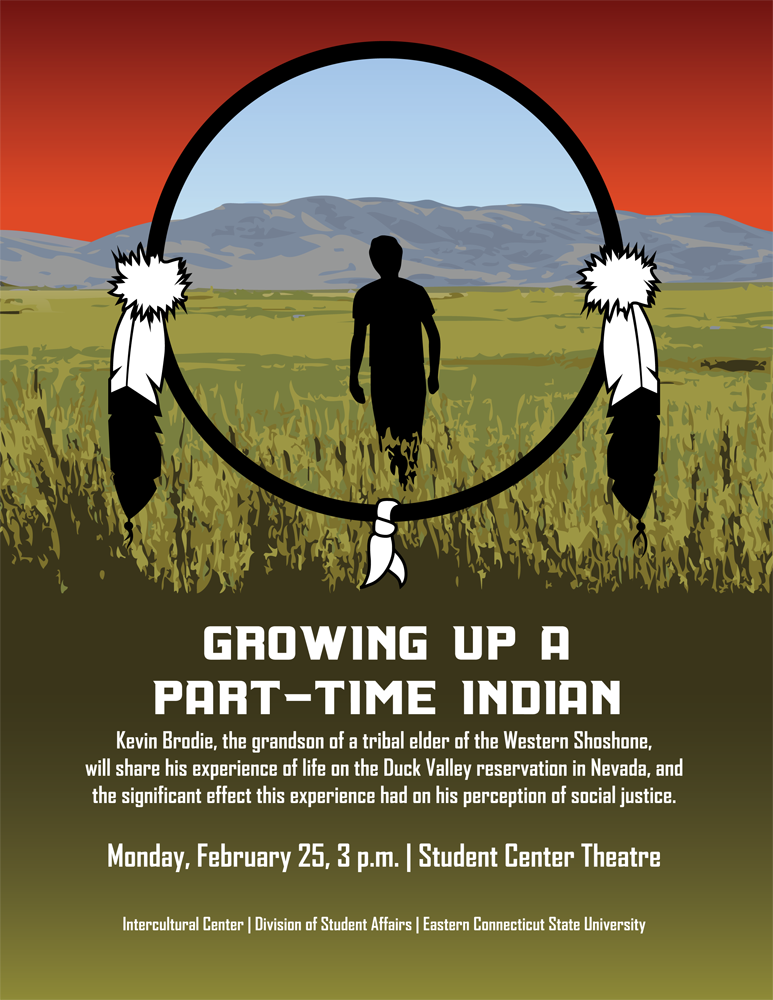
Melissa also does an excellent blog, which you can find linked at my blog roll below. Please do check it out.
That’s all for now.
This Needs to Stop. Now.
After the horrible school shootings in Newtown, Connecticut on Friday, I felt the need to reach out to several friends and tell them I was glad they and their children were safe, and to also express my love for them. Dan Blair, one of my dearest friends on earth, wrote this in response to my email:
“When I heard CT State Police say that the public was safe and the scene had been secured, I wondered what sort of dark humor that was … when have we been safe from …that? We’ve returned to what things were the moment before it started and we weren’t safe then, either.”
There’s a reason we all thought Dan was the smartest guy in our grad program a few years back. He was right a lot back then, and he’s right about this. My school district’s Superintendent–after saying nothing about this to her staff the entire school day–sent out an after school robocall to everyone in the district assuring us that the schools were safe, and that we had instituted new safety procedures. The problem was not simply that the Superintendent clearly read this prepared statement in a Watson Compter-like monotone. It’s that many of those new procedures were also in place at Sandy Hook Elementary School.
When you are an educator and something like this happens, it affects you in a very particular way. You look at you school differently, you look at your leadership differently, you look at your students differently, you look at yourself differently. You can’t help but think: that could have been here. If it had been, what would I have done? What could I have done? Every time something like this happens, all of us in this profession lose something we can’t get back. And while statistically schools are still some of the safest public places in the world, we become very cognizant of what can go tragically wrong in the environments we work so hard to cultivate as positive, secure spaces.
A recent Mother Jones article showed that over the last thirty years, there have been 62 mass killings in the United States, defined as a public killing of more than four people. That’s an average of more than two a year, but that doesn’t tell you the whole story. Seven of those have been in the last twelve months. The profile of the killers is very consistent: males in their twenties who suffered from untreated mental illness who had access to legal automatic weapons. Morbid as it may have been to study this, it tells us two very important things about the country we live in. One, our mental health system has failed. Two, our gun safety laws have also failed. This is clearly what we have to address.
We need to make mental health a priority again. It hasn’t been in quite some time, because it is deemed too expensive. There are also no political consequences for attacking the mentally ill, as we generally have little or no sympathy for them in our society. Programs get cut, few people notice or care. Yes, it will be expensive–but we certainly have the money for costly wars and drone attacks. Having a fully developed mental health care system would be a lot cheaper and actually keep us safer than attacking farmers in the Pakistani mountains. Also, notice the irony that we have billions of dollars to commit acts of violence around the world, yet no money to help a mentally unstable person who might somehow get the impression that violence is an acceptable solution to his problems.
Secondly, our gun control laws must change. Yes, I am aware that guns don’t cause violence and people do. I am not suggesting we ban all guns. I am suggesting we make it much, much harder for people to obtain automatic assault weapons like the Glock. If you make it harder for a mentally ill person to kill dozens of people at once, two things are going to happen: the violence will either not occur or it will be far less extreme. The reason the people in Arizona were allowed to stop Jared Laughner was that he had to pause and reload after firing off dozens of rounds. What if he had to after firing off just a few? The situation would have been far less tragic. Will this stop all of the mindless killings? Of course not. But since we can’t stop them all, why is it we can’t take any steps to stop some?
Yes, there are professional criminals who still be able to get automatic weapons illegally, but we aren’t talking about criminal mafias and drug cartels. We’re talking about mentally ill loners unable to grasp the consequences of their actions. Does anyone actually think that any of the mass murderers of Columbine, Aurora, and now Newtown would have been savvy enough to obtain their automatic weapons illegally? This is not a radical idea. We already agree there is a line. Even the most vociferous gun rights advocate would not argue that the average citizen should have access to rocket launchers, hand grenades, and weapons grade plutonium. I am just arguing where I think the line should be.
Maybe you disagree with that, and that’s fine. What you cannot claim is that nothing should be done to address our failed mental health system. So argue that people should still have access to automatic weapons. But argue just as strongly that we need to invest in and overhaul our mental health system so the Adam Lanzas of the world get the treatment they need. We won’t be able to help everyone, I know. But we can help some, and that to me seems like a worthwhile endeavor. Imagine what would happen if the National Rifle Association (who believe it or not, used to support gun control) actually put its considerable political clout into lobbying for an increased investment and expansion of mental health in this country, instead of worrying about really important things like President Obama sending in UN troops to confiscate their shotguns.
So it’s up to us. All of us. We need to fix this, and we know how. We just need to have the courage to say that we want all of our communities to be as safe as they can be, and do what needs to be done. And we need to do it now. We failed the children in Sandy Hook. We can’t fail any others.
When a Student Gets It
As if often the case this time of year, I have fallen behind on my blog. The reason for this is because of the beginning of the school year, which has been especially busy for me this year. Classes are larger, staff is smaller, responsibilities are spread amongst fewer teachers, and I have stepped forward to be my district union president. Before I knew it, the first quarter had ended, but I had not yet managed to get back to the blog until now.
Spending so much of my time thinking about the stress of teaching got me reflecting on the rewards of the job. Sure, the frustrations are legion, and I have certainly expressed those in this space before. I don’t want to do that today, though. I want to share with you an assignment that made me extremely proud to do what I do. In the high school philosophy class, the students’ final exam is to watch Randy Pausch’s powerful “Last Lecture” and then go off and create their own version of the lecture as high school juniors and seniors. It is, by design, an extremely unstructured assignment. Some students are intimidated by the lack of structure, and find themselves at a loose end trying to figure out exactly what it is they want to say, and how it is they want to say it. Others find this challenge exciting, and relish the opportunity to create a project that is truly their own–which is the whole reason I leave the assignment so unstructured. Mind you, not every assignment calls for a lack of structure, but I believe strongly that this one does.
I am not certain if Morgan, the student who produced the video below, was intimidated or excited, or perhaps a little of both. All I know is that I was totally moved by what she produced, and the thought of the work she did has gotten me through some very trying days in the classroom. When a student does work like this, I am reminded why it is that I do my job, and why I still want to keep showing up every day, in spite of the stress and irritation it presents. Check it out–I think you’ll enjoy it:
In his lecture, Pausch discusses the notion of the “head fake”–the idea that we learn something best when we think we are learning something else (recall Daniel-San learning to “wax on, wax off” in the “Karate Kid”). Morgan cleverly includes her own head fake when she mentions at the end that her video wasn’t really for my assignment–it was for her kid brother. And if you are concerned, Morgan has given me permission to show this video here. She is now a college freshman at Ithaca college, no doubt impressing her TAs and professors up there.
Creation Myths, Part Two
So there I was again: the office with the frosted glass window on the door that read “DR. RICHARD SIX–PRINCIPAL.”
Dr. Six glared at me, no doubt trying to develop a coping strategy for my potential delinquency. First a pervert, now an upstart know it all? Who did I think I was–the Italian Prime Minister?
This time my father was coming. I couldn’t decide if this was a good thing. My father was the gentlest soul I have ever known, but he was working two jobs: managing a drive-in theatre at night, and driving a taxi cab during the day (bonus: when the black and white cab was parked in the driveway, neighborhood kids thought my dad was a cop. I got a welcome respite from bullying.) If he was on his way, he was interrupted from his only four-hour window of sleep. What would that mean for me?
I discovered shortly after he was escorted into the office. He looked exhausted–flushed skin, bloodshot eyes, unkempt hair. I instantly felt guilty, and sank further into my seat. And near as I can recall, what follows was the exchange between the principal and my father.
Dr. Six began. “Kevin was sent to my office for being rude and disruptive in class.”
My father eyed Dr. Six with confusion, then turned to me just as baffled. “He was?” I couldn’t look him in the eye.
“Yes,” Dr. Six continued. “He interrupted Mrs. Rathbun during her lesson–”
“Who the hell is Mrs. Rathbun?”
Dr. Six was taken aback. He was clearly not used to being spoken to this way. My eyes perked up a little, because I had never heard my father express impatience with anybody. Dr. Six cleared his throat.
“That’s Kevin’s teacher.”
“Rathbun? Her name is Rathbun?” Wait a minute. Dad’s making fun of Mrs. Rathbun’s name? We always made fun of her name behind her back. I suddenly started to feel better–like my father was protecting me.
Dr. Six plodded along. “”Yes. Kevin corrected her during a science lesson.” For a second, although I cannot be certain, my father looked like he tried to suppress a smile. He then turned to me and said, “Tell me what happened.”
Dr. Six rose from his chair. “Look, Mr. Brodie, I really don’t think–”
“Yes. I’ve noticed.” The principal stood dumbfounded, his mouth agape. “I’d very much like to hear what my son has to say.” My father turned back to me, clearly uninterested whether Dr. Six approved.
I always found it easier to speak to my father, because he waited for me to finish, and never showed the slightest irritation with my stammer. I took a breath: “S-s-she s-s-said dinosaurs ex-existed at the s-s-same t-t-ime as cavemen.”
My father nodded, patted me on my shoulder. He turned back to Dr. Six. “Is that true?”
“Well, that’s not really the point–”
“Oh, I think it is.
“Mr. Brodie, try to understand–”
“You’re an idiot!”
What? What? Oh my god–did my father just call the principal an idiot? To his face? Not only that, his voice did something else I had never heard it do before: it rose!
“And that Mrs. Ratbomb–or whatever the hell her name is–is also an idiot! You’ve got a teacher doing science lessons with second graders telling them that dinosaurs and early humans overlapped! And in your wisdom decide the real problem is the fact that my seven-year-old son had the nerve to know more than she does? You don’t need to wake me up after working twenty hours and waste my time with goddamn foolishness! You need to get Mrs. Ratsass in here and explain to her what the hell science is!”
I couldn’t believe what was happening. Who was this angry man who looked like my father? Had he been possessed by a demon? Was he really the Hulk? (“Dad smash!”) In spite of my disbelief, I was beginning to grow confident that I wasn’t going to be in trouble. I was starting to worry that Dr. Six might be, though.
My father continued his rant. “What are you trying to teach him? That he shouldn’t be right? That he should just shut up and listen, even if he’s taught something false? Is that your theory of education? Where the hell did you learn to run a school? Madrid?”
“Mr. Brodie, I think that’s–”
“Shut up!” He turned and extended his hand to me. “Come on, son” his voice instantly reverting to normal. “Let’s go home.”
He led me into the foyer, and it was then that I realized that my father’s tirade and drawn a crowd. All of the office staff, several teachers and students had gathered to see what the ruckus was. My father turned and stared down Dr. Six one last time. He then slammed the door with such fury I actually jumped.
I looked back at it just long enough to see the words “DR. RICHARD SIX–PRINCIPAL” disappear, and the floor cover with shattered glass. Framed by the empty window that once held his name and title was Dr. Six’ horrified face, his eyes the size of salad plates.
Oh, man. That’s it. We are so in trouble now.
My father, though, simply took a step forward, and got in one last dig: “Serves you right, you bloody fascist.” Then we walked out, all of the gathered staff staring at us like catatonic mental patients.
After that, Mrs. Rathbun never said a word to me, and Dr. Six was transferred to another school. My father was never billed for the door.
Postscript: Later, I learned that those who espouse the belief in Creationism include the perspective that dinosaurs and early humans coexisted, given that the universe is no more than 10,000 years old. This is likely what Mrs. Rathbun believed. You know–science.
Creation Myths, Part One
You may be happy to discover that I made it through all of first grade without being sent to the principal’s office, and was off to a good start in the second grade. I likely would have made it the entire year if my teacher hadn’t been Mrs. Rathbun (like the infamous Dr. Six, this is a name I am not fabricating).
Like many second grade boys, I was obsessed with dinosaurs. Giant, near-mythological reptiles, terrifying yet fascinating—how could a boy resist? I think what really got me hooked was a visit to the San Diego Zoo when I got to ride a giant Galapagos tortoise. I had seen tortoises before, but never one so big you could ride it! (This was also before it would have occurred to me to be troubled by a noble endangered creature being turned into a sideshow freak for profit.) Mind you, we didn’t go very far or very quickly, but just the idea that a small reptile could also come in such a huge form fired my imagination.
After that, I wanted to learn everything I could about dinosaurs, and I found myself a teacher—Roy Chapman Andrews. Long before Indiana Jones (or, to a lesser extent, Ross Geller) made archeology cool, there was Professor Andrews. He spent his life digging up dinosaur bones in the Gobi Desert and running the American Museum of Natural History, but he also wrote books for elementary school kids who wanted to learn more about Triceratops. I devoured all of his books at the local library, and got to the point where I could list all of the known dinosaur species, in what part of the world they lived, in what period they emerged and disappeared. I could tell you that, but I didn’t because of my stammer. That was all right, though—why talk to someone when you could just read another Andrews book?
I was never tempted to speak up in class until one rainy afternoon when Mrs. Rathbun began discussing dinosaurs. Suddenly, she had my attention, if not my participation. She asked the class:
“What were the names of the giant reptiles that lived in the past?”
Maria Gonzales raised her hand. “Dinosaurs!”
“Yes, that’s right, Maria! Dinosaurs!” Yes, she was right, but it hardly merited that much excitement. Who wouldn’t know that? Mrs. Rathbun asked a follow-up.
“And who else lived with the dinosaurs?”
I was pleasantly surprised that she would ask about the various plant and insect life from that period, but she then made the mistake of calling on Tony Nobiensky. In seven years of elementary school, Tony never got a single question right—including “What’s the name of our school?” It was Thomas Jefferson elementary, but Tony answered “George Jefferson.” And his answer to this question:
“Cavemen!”
I snickered under my breath. Cavemen! First of all, that’s a totally inaccurate and oversimplified description of our human ancestors. (Probably not my exact thoughts at the time, but still.) Go ahead Mrs. Rathbun, be gentle. Our Tony knows not what he does.
“That’s right, Tony. Cavemen!”
What? What? WHAT???? I did not just hear her say that. Tony smiled, smugly, believing himself to be correct, and not a single one of my classmates raised an objection. They were all going to accept Mrs. Rathbun’s answer. I didn’t understand how she could tell the class this, when everyone knew that humans came millions of years after the dinosaurs went extinct. It didn’t surprise me that Tony thought “The Flintstones” was real, but my teacher? I found myself trembling, trying desperately to spit words out. Mrs. Rathbun noticed, and called on me, no doubt wondering what my problem was. I so desperately wanted to explain myself with the eloquence and factual documentation of Professor Andrews, but unfortunately the only words that would come out were these:
“Y-y-y-you’re…wr-wr-wrong!”
And then I was back in the principal’s office. What occurred after I arrived will be next time.
Stranded
I am a nervous person. This is not news to anyone who knows me. My neurologist is convinced the reasons are purely physical, and perhaps she’s right. I don’t know if what happened to me on the first day of kindergarten is connected with my public unease, but it probably didn’t help. All I know is that there are times in social situations I lack composure and style. And there are also times I could only describe as embarrassing disasters.
I have every confidence when I met Valerie (to whom I am happily married), I made a fool out of myself during our first conversation. I remember loving the sound of her voice. I also remember being enthralled by her gorgeous looks and irresistible smile. I also recall feeling entranced by her humor and intelligence, and how much I didn’t want our time together to end. But I don’t remember a single thing that I said to her. My brain, in a heroic gesture of compassion, deleted that part of the memory from my mental core. I once asked Valerie, in spite of how I must have sounded that first meeting, why she still wanted to see me again. She smiled kindly, patted my hand, and said “I just knew you’re the one.” That is perhaps the sweetest way imaginable to be told, “Yes, you did you make a fool out of yourself, but it was okay with me.”
There is, though, a story from a few years B.V (Before Valerie) that still causes me to shrink and tremble every time I think about it. So, naturally, I’m going to share it with you.
I was at the Strand Bookstore in New York City, one of my favorite places on earth. Fifteen miles of books, and I could spend months exploring every inch of the place. Just seeing the street sign from Union Square puts me in a good mood. When I die, and my ancestors welcome me to the afterlife, I’m afraid I am going to march right past grandma and the sweet scent of her rhubarb pie to the guy in the red shirt with two toned hair and a nose ring directing me to the table of new arrivals. That’s right—The Strand is heaven.
Although one night, it pretty much turned into hell.
I was there on a crisp March evening, and I did what I usually do at the Strand—I closed the place down. It was a few minutes before ten, so I headed over to the cashier’s line and waited my turn. Miraculously, I was leaving with only five books. Pretty good for me.
I heard the shout of “Next,” and approached the till. A friendly voice offered a warm “Good evening,” as I dropped the books on the counter. I smiled and my eyes shot up to the cashier, ready to say a polite “Good evening” back.
But then I saw her.
Outside of Valerie, she was the single most beautiful woman I had ever seen. She was luminous. I think it was probably the track lighting, but I swear there was a halo shining down upon her. She had lustrous shoulder length black hair, perfect olive skin, one eye colored gentle hazel, and the other colored a soft blue-green. When she smiled at me to ask if I had found what I was looking for, I actually gasped.
Surprised and concerned, she narrowed her eyes at me. No doubt she was wondering if I was having some sort of asthmatic attack. Had I been smooth, I probably would have just coughed, and pretended allergies were getting to me. If I had a bit more poise, I would have just simply said “sorry,” and proceeded with the transaction. We could both pretend it wasn’t awkward, and get on with our lives. But instead, I followed up the gasp with:
“Oh my God! You are stunningly beautiful!”
This time, her eyes widened in shock and confusion. In spite of her looks, she actually had the good grace to be humble. Had I had just the slightest amount of social skill, I would have proceeded with the transaction in an uncomfortable silence. Then I could slink out, and neither of us would ever discuss this again with anyone we knew (at least I wouldn’t). At this point, that would have been the best of all possible outcomes.
But I couldn’t believe what I had just said, so I panicked. I gazed straight down at the floor, no longer able to look her in the eye. If there was a part of my brain shouting “STOP TALKING! JUST STOP TALKING!” I couldn’t hear it. Instead, I tried to explain myself:
“I’m sorry I mean I’m not sorry you’re stunningly beautiful I’m sorry I said that to you I mean I’m not really because it’s true and someone should say that to you but it probably shouldn’t be me since I’m a total stranger but I don’t know maybe it’s nice to hear it from total strangers but I guess it can be kind of annoying how much is it?”
Still studying the floor tiles, I handed her a large bill from my wallet. I then grabbed my books and raced out of the store. I have a vague recollection of her shouting about my change, but there was no way I was going back. I sprinted towards the Union Square subway station, wanting the earth to literally swallow me up.
Postscript: A couple of years ago, I told a group of 12th grade girls this story, and asked them to rate my behavior on the Creepy Scale: 1) being awkward and harmless and 10) being I’m reaching for the mace can in my purse. They all agreed on “2”, because I was embarrassed and apologetic and clearly not trying to hit on the woman. I felt a bit better after that, but I still sometimes wish my neurologist had a pill I could take.
The First Day of the Rest of My Life, Part Two
My teacher, Mrs. Lazaro, raced over to Lori, at whom I stared dumbfounded. Why was she screaming? No woman ever screamed at Humphrey Bogart.
Mrs. Lazaro asked Lori what could possibly be wrong. Lori raised an accusatory finger at me and shouted “HE KISSED ME! ON THE LIPS!”
Mrs. Lazaro turned to me, horrified. The girls in the class all let out a collective gasp, and wrinkled their faces. Some actually looked away, unable to gaze upon the episode of human tragedy unfolding before them. The boys, though, just shook their heads in disappointment. You kissed a girl? Girls are horrible, disgusting, filled with cooties. You’re not supposed to even talk to them, much less kiss them. In fact, the only excuse for ever interacting with a girl was to torment her with the small animal corpse you found in the street. I’m afraid, Kevin, you have left us no choice but to make your life a living hell this year.
I looked around the room, holding my hands out in confusion. You have to understand! I thought she wanted me to kiss her! My silent plea was to no avail. Mrs. Lazaro guided a now sobbing Lori away, and narrowed her eyes at me as if to say “you’ll get yours, young man. Just you wait.”
I didn’t have to wait long. A dark shadow appeared in the doorway, blocking all of the fluorescent lighting from the hallway. I looked over to see a giant of a man–basically a wall with a head. His face was smothered by a massive gray beard, so much so that a Hasidic or Amish man might look upon him and remark “That’s a little much, don’t you think?” His voice thundered so loudly everyone, including Mrs. Lazaro, jumped.
“KEVIN BRODIE? COME WITH ME!”
I gulped, and glanced over at Lori again. Her face was hidden in Mrs. Lazaro’s skirt. Mrs. Lazaro nodded in satisfaction, confident that I was going to receive the justice I deserved. All of the other students turned away. Happily, none of them saw fit to shout “Dead Man Walking!” I put my head down, and wandered over to the my executioner.
He slammed shut the classroom door and lowered his head down to mine. I can still recall the stench of Old Spice and Folgers that radiated from his face. “I am your principal. My name is Dr. Six!” (Note: this name is not a pseudonym.) Really, Dr. Six? My principal has a bad super villain name? Is he the arch nemesis of Prime Number Man? Or, are school principalships passed down through heredity? He’ll be principal for life and then when he dies his son, Doctor Seven, becomes principal?
Of course, I wasn’t actually thinking that at the time. I was far too terrified. I followed Dr. Six to his office at the end of the hall. He yanked open the door, nearlly ripping off its hinges, then pointed at a lime green plastic chair in the corner.
“Sit here!” He then disappeared behind a frosted glass that had the word PRINCIPAL engraved upon it. I looked around the room. No other students awaited Dr. Six’s wrath. The only other person in there was a woman about the age of my grandmother perched behind a desk and a 1950s Royal typewriter. Her grey eyes peered down at me while her mouth “tsked, tsked” a few times, as if to say “They start so young these days.”
After what felt like several days, Dr. Six swung the door open, and shouted my name. I entered, half expecting to find instruments of torture attached to the walls, perhaps even a collection of trophy body parts on the desk. Instead, what I saw was a ping-pong paddle. I looked around the room. There was no table, and Dr. Six didn’t seem like the type to play ping-pong, much less engage in any activities that one could construe as “fun.”
He showed me the paddle, and asked if I knew what spanking was. Oh god! Is that what was going to happen? If he tries to spank me with those arms of his, he’s going to send me torpedo-like through the wall. I nodded, and he outlined how this was the sort of punishment worthy of misguided boys who make the sorts of decisions I do. At that time, it was no longer legal for school officials to mete out corporal punishment–but it was still legal to threaten students with it. Being largely unaware of the nuances of California child protection law, I trembled in fear.
It was then that my mother entered the office and sat down. I tried a few times to make eye contact with her, but she wouldn’t even look at me. Instead, she and Dr. Six were engaged in the gravest conversation I had ever in my young life overheard. Was I going off to war? I don’t really recall most of what was said, and likely there was much I didn’t understand, but I do remember the general tone of the conversation was that I was on an irrevocable road to perversion and sexual deviance, and it had to be stopped now.
Finally, my mother turned to me, her face etched with repulsion, and asked “Why did you do that to that poor girl?”
My entire body quivered in frustration, as tears began to pour from my eyes. I struggled for words as my mother sighed with impatience. Dr. Six stared at me without blinking, licking his lips like a hunter who had just discovered a new species of woodland creature he’d like to kill. Finally, I stammered out a sentence:
“I….I….I….j-j-j-just th-th-thought s-s-she w-w-was…p-p-pretty…!”
My mother, Mrs. Lazaro, and Dr. Six all got their wish. I never spoke to Lori again–in fact, I don’t think I spoke to another girl until the tenth grade. The boys would make kissing sounds at me, if they weren’t heaving rocks in my general direction. The girls just screamed and ran from me like an escaped carnival freak. My mother became obsessed with the notion that I was up to perpetual no good in my room, and would frequently summon me to sit with her in the living room, where no doubt my deviant behavior could be more closely monitored.
Years later, I asked my father if he remembered the episode. He told me that my mother waited up for him until 2am to return from work so she could tell him the entire sordid tale. My father’s response?
“Well, at least we know he’s not gay!”
The First Day of the Rest of My Life, Part One
Many people in their life have been sent to the principal’s office. Those that haven’t likely know someone who has. Virtually every teacher has sent a student there. It is very rare, however, to find someone who was sent to the principal’s office in kindergarten. Indeed, I am the only person I have ever known who was sent to the principal’s office on the first day of kindergarten.
Anyone that knows me now would likely be surprised to discover I was a quiet, shy child who rarely spoke. This is not unusual for a five year old, but I also suffered from a dreadful stammer. I learned very early on that few people were interested in patiently tolerating a stutterer, and many would express that intolerance with cruelty. Thus, on the first day of school, with no incentive whatsoever to draw attention to myself, I did my best to blend into the wallpaper.
And I have to say, kindergarten was kind of fun. We played games, we chased each other on tiny bicycles in the courtyard, we learned about animals, and we took a nap! I remember that the night before my sister had succeeded in frightening me with the news that I would be in school for the next thirteen years. I don’t know what she was all worked up about. I could so do this for thirteen years.
Before that reality check would arrive on day one of the first grade (Desks? Math? No nap time? Have I been sent to a Gulag?) , I had another one waiting for me. Being the early seventies, the California education system had embraced a theory called “essentialism.” Essentialism was the view that there were no inherent behavioral differences between boys and girls, that gender roles were 100% socially constructed, and that both sexes were “essentially” the same. All we had to do was educate our children in an enlightened way, and these sexist and oppressive gender assumptions would be gone in a generation. A Utopian idea (that would eventually require its own reality check), but what it meant for me was that boys and girls would be partnered up and working together at an activity normally associated with a specific gender role. Today, we would be cooking something in the kitchen, and I was partnered with Lori Saunders.
I don’t remember what it was we were supposed to cook (with an EZ Bake Oven, no doubt to allay safety concerns), but I remember Lori vividly. She had pig tails and wore a blue polka dot dress–the kind of thing mothers and aunts and grandmothers would see at Osh Kosh, and react with a deafening chorus of cooing. Lori introduced herself–and shook my hand! She instantly learned my name! Oh my God, she was talking to me! To be honest, she pretty much talked nonstop. She clearly required no conversational input from me, and I was happy to oblige. Unlike my constantly talking sister, though, Lori’s chatter wasn’t as irritating as a swarm of gnats on a humid summer night. If it was possible to be smitten at age five, then I was smitten.
Clearly an expert on the EZ Bake Oven, I listened transfixed as she explained to me the device’s many mechanical nuances, a litany of what she had baked with the help of the amazing sixty watt light bulb, and who in her family had enjoyed these treats the most. Then, there was a pause–she probably needed to breathe–and she fell silent. Lori stared at me a moment, clearly expecting me to pick up my cue and begin speaking. Uh-oh. I didn’t want to talk and have her hear my stammer. What if she laughed? What if she made fun of me? Or worse–what if she looked at me with pity?
Her mouth curled into a kind smile, and I knew instantly what I had to do. Most five year old boys, I suspect, didn’t know moments like this existed, but most five year old boys didn’t spend Sunday mornings with their fathers watching old black and white movies they didn’t fully understand. But I understood enough to realize that Lori Saunders, just like all those equally beautiful movie starlets, wanted me to kiss her.
So I did. Not a gentle peck on the cheek, but a full-on lip smack. No tongue, of course–I didn’t know that was a thing yet–but I knew from the movies that when a girl wanted to be kissed, you kissed her on the lips. Perfect! Who needs to talk when you can just kiss?
I don’t really know how I thought Lori would react. Would she say something pithy and Lauren Bacall-like: “It’s even better when you help?” Maybe, like Rita Hayworth, she’d sigh and yank me back into her arms for another. I do know that I wasn’t expecting the color to completely drain from her face and for her to scream. Not just any scream–a long, blood-curdling shriek, like a coyote with its foot caught in a bear trap. It was at that moment I realized I may have done something wrong.
And what happened after that? For next time.

