Provence: Day 6
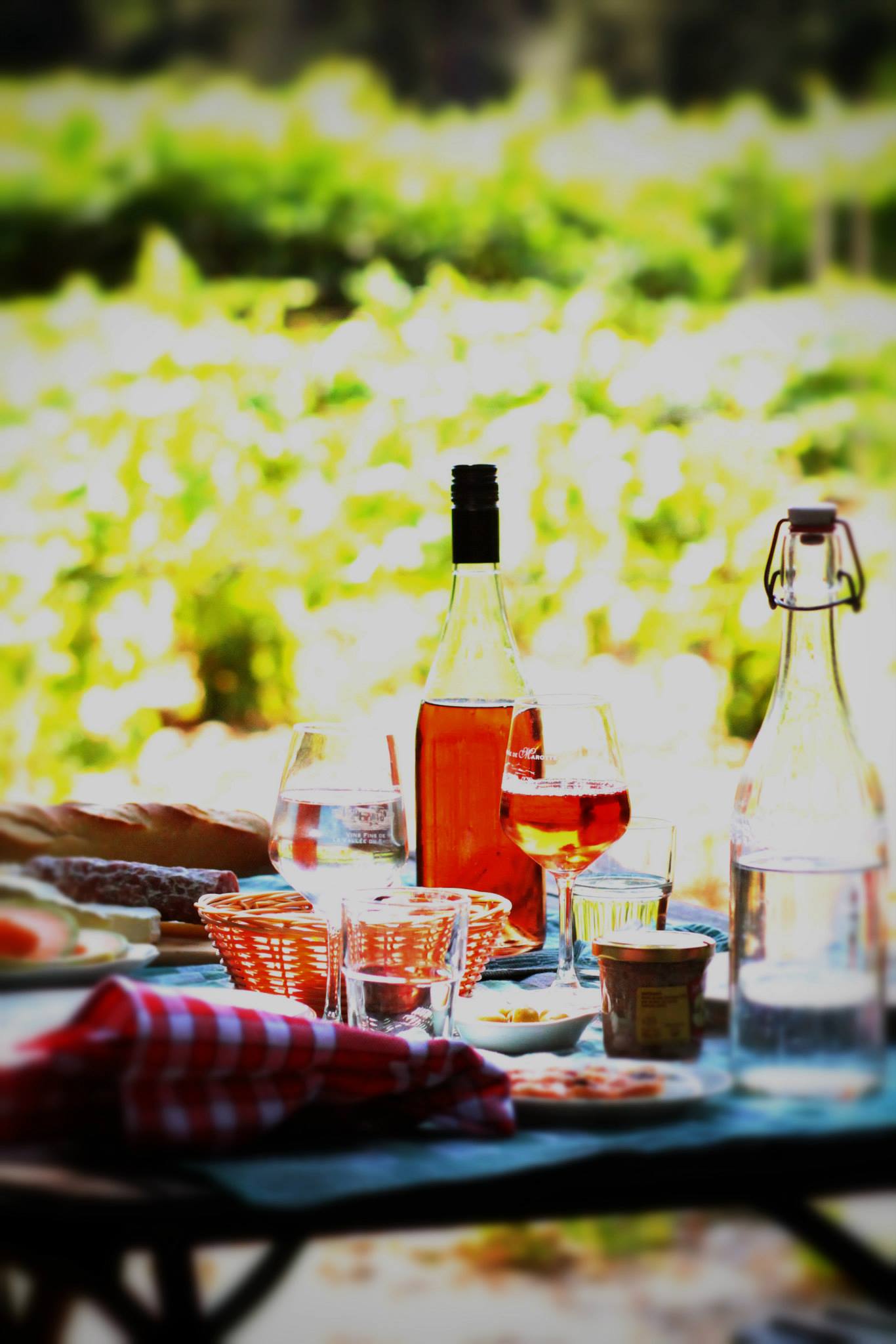
Table Vigneronne at Domaine de Marotte Vineyard
If you are wondering what happened to Day 5, it was spent mostly at poolside. It was a perfect, quiet day in the Provence sunshine, and I spent most of it breezing through Tina Fey’s “Bossypants.” Everything I just wrote is highly recommended.
Much of Day 6 was spent at the Domaine De Marotte vineyard, just outside of Carpentras. It is owned and run by a Dutch couple, Daan and Elvire Vandykman (I think spell check is about to explode) who moved here in 1998 with a dream of making great wine with love and care.
The vineyard is a former monastery—indeed, the main walkway through the vineyard is still in the sign of a cross. This seems an appropriate history, given that Daan and Elvire are intensely devoted to their pure, labor intensive, natural approach to winemaking.
Valerie was impressed by the wines she had at the tasting—all of which are named after one of the Vandykman’s four children. For myself, Daan hooked me up with his own delicious and refreshing grape juice. A singularly impressive host, he was running the tasting for three different couples, seamlessly shifting between French, Dutch, and English in explaining the different grapes and answering the guests’ questions.
After this, it was time for our Table Vigneronne—a picnic basket prepared for us that featured breads, cheeses, a bottle of one of their best wines, salami, four tapenades, and fresh melon. We found an empty table in the vineyard, and thoroughly enjoyed a delicious, peaceful meal amidst the grapevines. A perfect final day in Provence.
Provence: Day 4
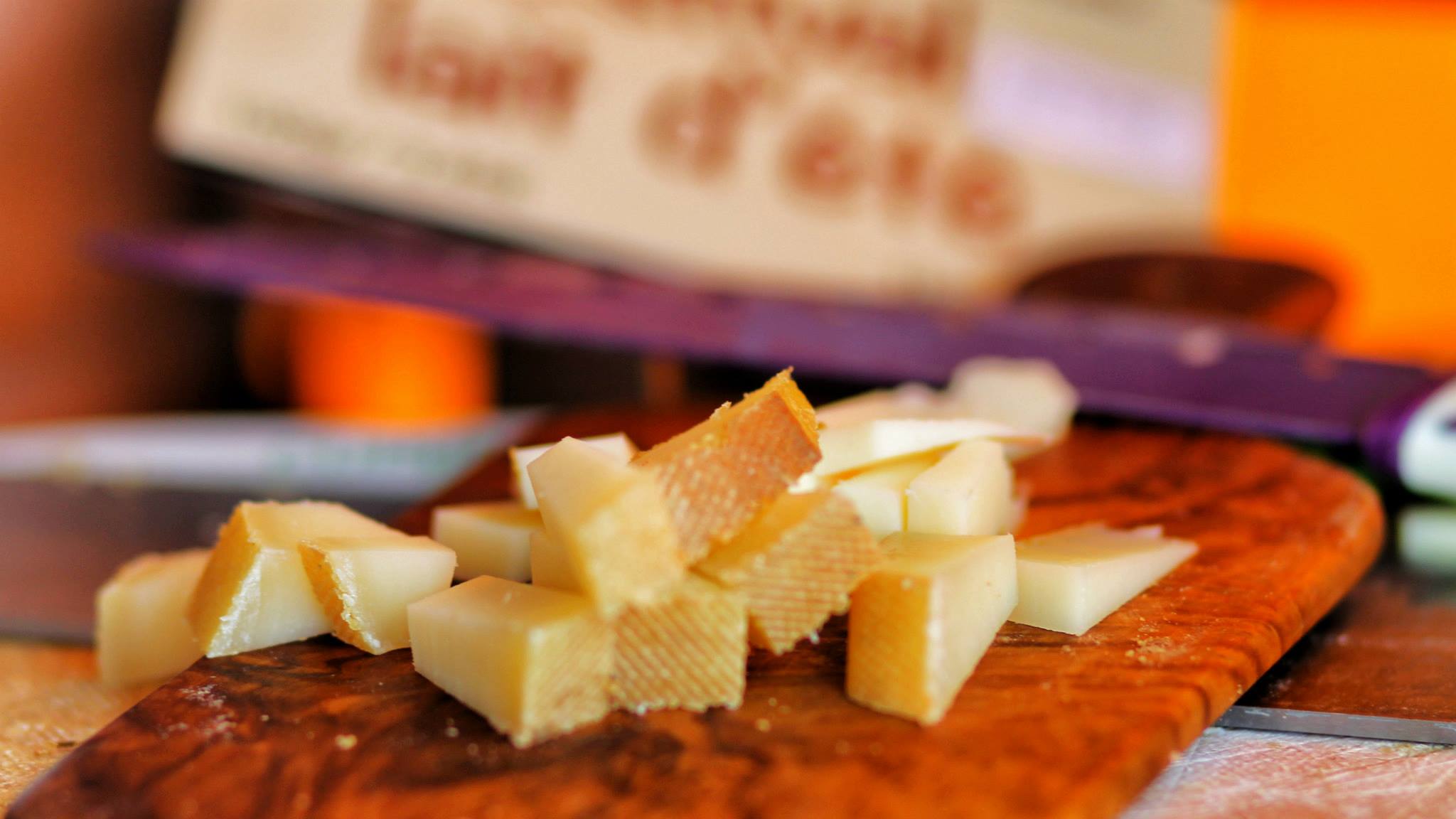
Cheese at the market in Arles.
A trip to Arles, a beautiful ancient city, known for its open-air market, two great Roman theatres (the Classical and the Arena), and one of Van Gogh’s most productive (read: manic) periods.
Given its proximity to Marseilles, there is now a considerable North African and Islamic presence in Arles. As a result, many of the vendors hailed from the other side of the Mediterranean, and some of the market offerings included Halal meats and a wide array of hijab choices. In addition, there were countless samples of fresh fruit (primarily melon), delicious pistachio nougat cut from a loaf about the size of an SUV, and many scrumptious cheeses to be sampled. And sampled again. And again.
After the market, we decided to take Rick Steves’ walking tour through Van Gogh’s Arles. We visited many of the locations of some of his most famous paintings, learned about his desperate loneliness, and his explosions of rage. We lunched at the famous Café la Nuit, a famous setting for a Van Gogh painting and where he famously argued with Paul Gauguin. Van Gogh became so enraged he chased Gauguin down the streets of Arles brandishing a razor. Later that evening, Van Gogh would use the razor to cut off his ear lobe and present it to Rachel, his favorite at a local brothel, insisting she “treasure this precious object.” Our lunch was far less dramatic.
Later that afternoon, we drove down to the Camargue, a beautiful nature reserve known for wild bulls, wild boars, and…pink flamingos. I had never associated pink flamingos with France before, but there were hundreds of them. We stopped along the road at one point to climb into a hide to get a good look at the birds and to take photographs. It was wonderfully peaceful, but then another couple showed up. They quietly took photographs, and then a third couple arrived. They too were unobtrusive and respectful. A few moments later, two busses packed with tourists spilled open and attempted to squeeze themselves into the hide that was maybe 10 x 4 feet. Were they going for some sort of record? It was at that point we retreated, and decided to move on.
Day 3: Provence in Ruins
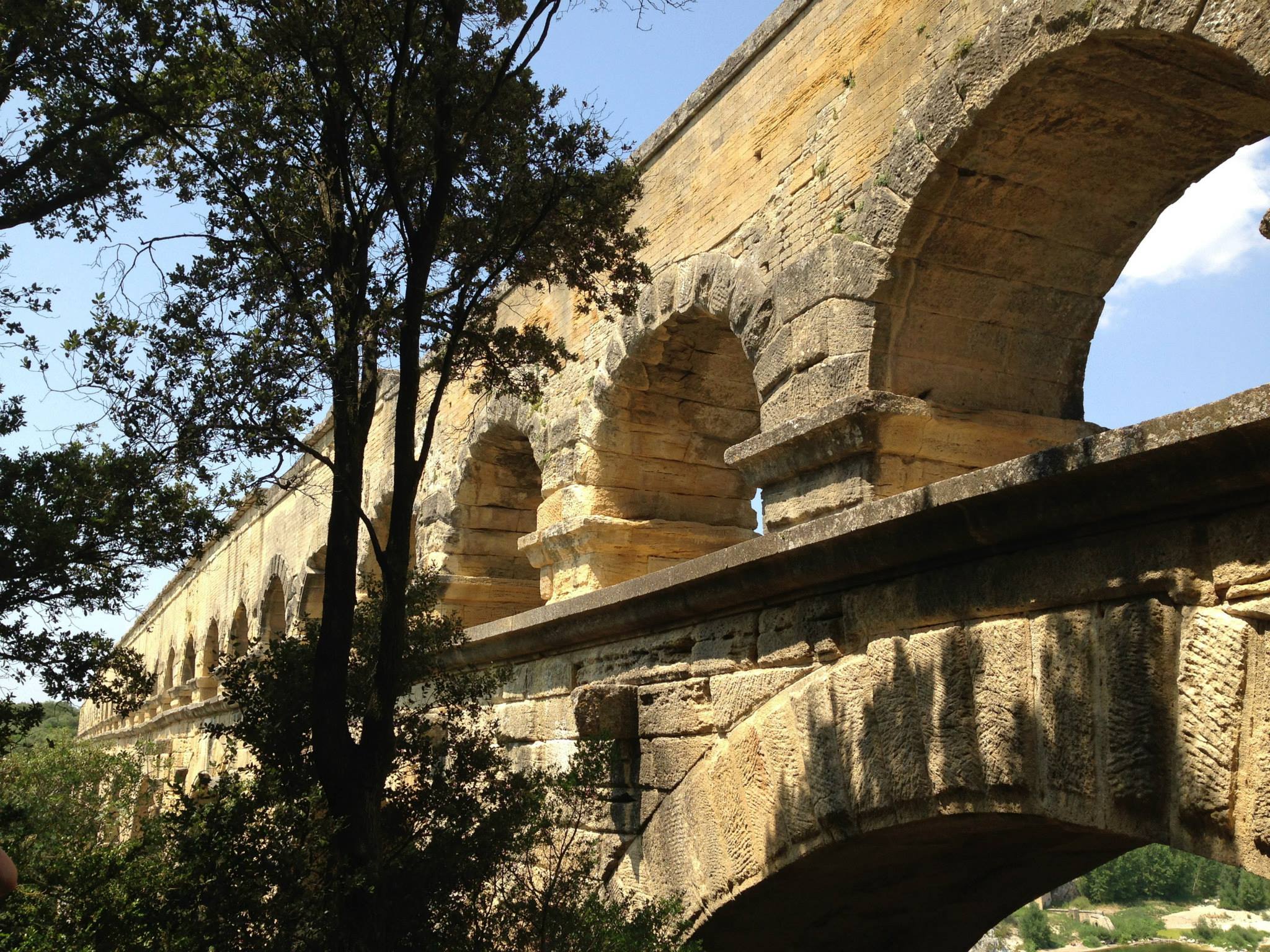
Provence takes its name from the Romans—this area was literally a “Roman Province.” It was established primarily as a retirement community for Roman soldiers. For some reason, Emperor Augustus didn’t want a large group of relatively young, well-trained idle soldiers hanging about the capital. So he sent them here. Augustus was clearly on to something—if President Obama sent me here to retire, I would gladly take him up on it.
As a result, Roman ruins are a frequent sight throughout this area, primarily in places like Arles, Orange and Nimes. Arguably the most impressive is the Pont Du Gard (photo above). A perfectly preserved Roman aqueduct built around 19 B.C., it was an important link of a 30 mile canal that, by dropping one inch every 350 feet, supplied nine million gallons of water per day to Nimes.
The fact that something like this was constructed 2000 years ago and still stands is a testament to what the Romans were able to accomplish with fine engineering, patience, and thousands of slave laborers. The bridge was put to the test in 2002 during a period of torrential rains and intense flooding. Would the bridge be able to withstand the flooding? The Roman engineers had designed buttresses at the base of the bridge to divert floodwaters away from the feet of the arches. To everyone’s astonishment, the buttresses worked and the bridge held its ground. By contrast, my oil tank lasted three decades.
When you visit the Pont Du Gard today, you can walk across it, swim beneath it, follow countless hiking trails on both the right and left bank to appreciate its beauty and majesty from a number of perspectives. No matter how you look at it, you can’t help but be awestruck at its beauty and longevity. In New England, a building that remains from the 18th century impresses us. Here, not so much.
Provence: Day Two
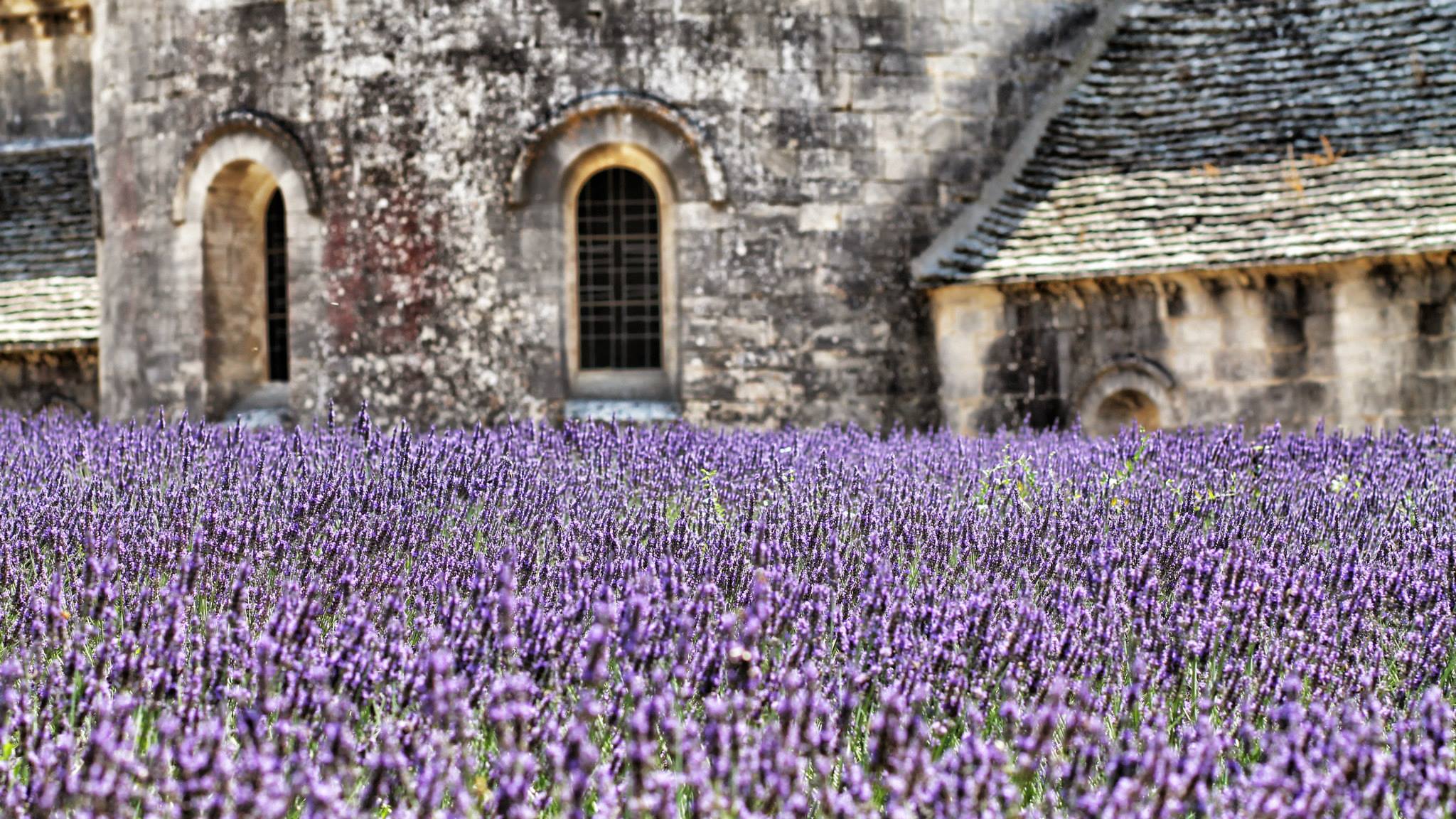
Lavender. Provence is so much about lavender. You hear this all the time, and then you get here and you finally understand. It grows everywhere, and is such an inherent part of the area’s economy, an entire museum is devoted to it.
The aptly named Lavender Museum in Coustellet will tell you everything you ever wanted to know about its history, growth and production. Know the difference between fine lavender and lavandine? I didn’t either, but now I do (fine grows by seeding, is cultivated carefully by hand, and used medicinally; lavandine is cloned, mass-produced, and is distilled into soaps, oils and candles). Curious about the distillation process of lavender, and how it has improved since the 17th century? Well, this museum is for you.
Of course, no museum experience would be complete without the tour steering you to the gift shop/boutique, where very attractive young people lovingly spread essential oils on your hands and wrists. Resistance is futile; we walked out with a sachet and several soaps.
As charming and fun as that was, nothing really prepares you for the lavender fields when you see them. The one we visited was at the Abbey Notre-Dame de Senanque (photo above), just outside the hill town of Gordes. As you pass through Gordes and begin descending the hillside towards the Abbey, the sight of what appears to be a massive carpet of violet immediately strikes you. As you close in on it, you can’t help but be amazed by its enormity and beauty.
The still-functioning Cistercian Abbey was built in the 12th century, and its sheer simplicity provides a breathtaking backdrop to the fields. The aroma is as intoxicating as you would imagine, but standed or seated amongst lavender in this monastic setting can’t help but quiet your mind. I found it had a sincere meditative quality that I did not expect—so much so that I didn’t mind the preponderance of bees, despite my allergies. The bees also were as uninterested in me, clearly finding the lavender just as captivating.
The photos do not do it justice, and the descriptions are not hyperbolic—you haven’t really experienced lavender until you’ve experienced it in Provence.
Provence: Day One

Awaiting our arrival in Provence!
A plane, a train and an automobile. That is not meant to be an aphorism: that is literally the path we took. Flight from Boston, train from Paris, a rental car from Avignon, and we arrived at our gite: Mas Saint Antoine in Rognonas.
As I write this, a thunderously loud chorus of cicadas echoes from every direction. Local legend has it that God sent the cicadas as a penance for the locals’ laziness, so he sent “la cigale” to disturb their afternoon siestas. I don’t how effective that was, but I do know it didn’t keep our jet lagged bodies from sleeping in this morning.
Mas Saint Antoine is as lovely, welcoming and as relaxing as you would want from a gite in Provence. It is run by two New Zealanders (who clearly tired of paradise and decided to escape it by moving to paradise) named Keryn and Kerrin. We were welcomed with a bottle of wine, lavender sachets (the grounds are covered with lavender plants and plum trees) and an inviting swimming pool is a short walk from our apartment. One of the good things about being at a pool surrounded by British tourist–I am actually one of the least white and most fit men there! That’s right, Brits—get a load of this relative lack of pastiness and my Yoga physique!
In the evening, we wandered into town. Knowing it was Bastille Day, we expected it to be quiet, but we thought that would be a good way to check out what the town was like—and to scope out the local boulangerie. It was eerily quiet, and mostly empty…until we turned down a lane and stumbled upon the locals’ celebration: a carnival, several restaurants open only for those in the know, and a massive community dinner before an open air concert. The funny thing was that there was no sign advertising it, and you couldn’t hear it until you were almost on top of it. If you lived there, you knew it was happening, and if you didn’t…well, it wasn’t for you anyway.
They kindly allowed two interlopers to stroll through, lost in wonder at the hidden energy of Rognonas.
Provence: Day Zero
Had a wi-fi problem the first couple of days, so I’m a little behind. Here is the first entry…
We were scheduled to leave for France in 24 hours, and I was in the midst of packing, cleaning the house, and sorting out the last-minute details. It was then I noticed the puddle.
We had a few days of heavy rain (including a tornado just a few miles away), so a small amount of water on the basement floor wasn’t anything new or alarming. However, all of the water had dried up except for this one little spot. Most concerning was its location: right underneath the oil tank.
I leaned over to run my finger through the puddle, hoping to find nothing but dampness. No such luck–it was oil. I reached up to the valve, and it to was covered with oil. That’s a good sign, I thought. A leaky valve is a simple, quick job, probably not too expensive. I’ll call the oil company and see if they can come out today or tomorrow morning.
About an hour later, Mike from the oil company was at our door. Mike knows us pretty well. He installed our furnace, replaced one of our registers, and changed that valve only a few months ago. Part of me believes that Mike is the only person who actually works for this company, so I wasn’t surprised when he showed up.
I of course shared with him my superb diagnosis of the problem, because he clearly needs my help to figure out what it is he does for a living. Hopefully, he took it for what it actually was—not an act of condescension, but a gesture of optimism.
Either way, he spent less than five minutes to determine the real problem: the oil is not leaking from the valve. It’s leaking from the tank on to the valve. And the floor.
Oh. Right. What can you do?
“You need a new oil tank.”
Um…I’m leaving for France at 2:00 p.m. tomorrow. How are you going to install a new oil tank before then?
“Well, we can leave it for two weeks, and take care of it when you get back.”
Hmm. I’m thinking that Melissa—the young woman who will be housesitting for us—probably wants hot water for the next couple of weeks. Not an option.
A quick glance at our furnace, and its connections—all of which were installed by Mike—and he says “Take me two hours. I’ll be done before you leave.”
So while Valerie and I spent the morning before our trip finishing packing, eating any leftover perishable food (mashed potatoes with sliced cucumber and cheese? Sounds great!) , Mike and his assistant worked in our basement. A little more than two hours (and a little less than $2000 later) it was done.
As Rick Steves says: always reserve your museum tickets in advance, and be sure to engage in an expensive capital improvement the morning you fly to Europe. Keep on travelling!
Off to France!

Lavender fields in Provence.
This is not a travel writing blog. If you want to read an excellent one, I recommend Lesley Carter’s Bucket List Publications. Aside from being a relentlessly entertaining writer, you will develop an envy for the remarkable life Ms. Carter lives. Partly inspired by Lesley’s blog, I am going to dip my toe into the pond of travel writing.
Leaving on Friday, July 12, my wife Valerie and I will be spending two weeks in France–the first week in Provence, the second in Paris with a one night stopover in Chartres.
We will be bringing along our MacBook Air, so I will have the opportunity to blog about the trip. I have never done travel writing before, and I am excited to see how well I can translate my experiences into the blog.
There will be some photos to go with it, but you will be happy to know they will be taken by Valerie. Unfortunately, the Parkinson’s tremors generally create the illusion that I am taking photographs during an earthquake. However, if an earthquake does happen, I will try to take photos then, because I am curious to see how they would come out.
So that’s what you can expect from me for the next couple of weeks. Hopefully compelling details of our adventures, combined with some intriguing photographs. We will then discover how well I can get my Anthony Bourdain on–aside from snark and a love a street food. Got those already.
An Unexpected Honor
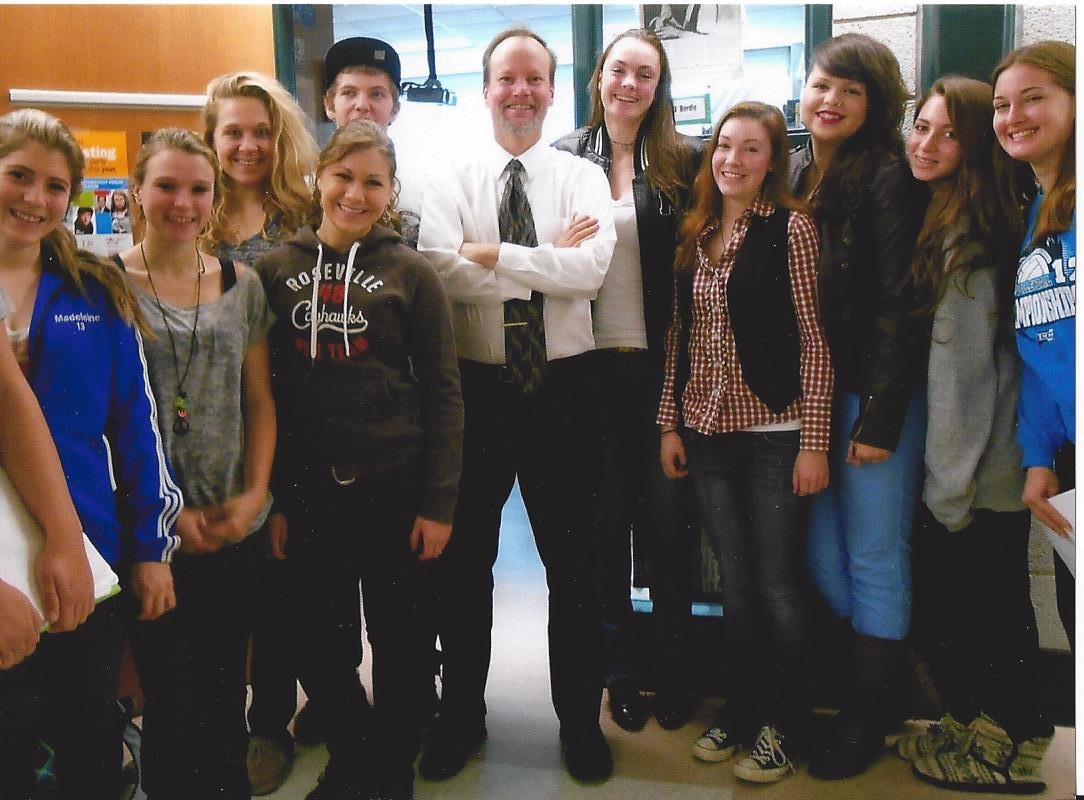
With members of the class of 2013, to whom I will always be grateful.
This was the third remarkable event, which happened just before the end of the school year…
A few weeks ago Diane, an esteemed member of our English department, stopped by my classroom after school.
“Hey,” she wondered, “were you planning on going to the Senior Banquet on Thursday?”
I wasn’t. I usually don’t. It’s a nice event in which the seniors get their yearbooks and enjoy a fun meal together, but I spend a great deal of time at my school already, so it wasn’t an event I considered a priority.
Diane was silent for a moment, and then responded in what I could only describe as a deliberate, suggestive tone. “It would be a really good thing if you were there.”
Um…okay. Thanks for that cryptic answer. Perhaps it would have been better in a coded letter?
It took me a few moments to realize what she meant. Diane, being yearbook advisor, is expected to attend, and outside of the class advisors, there is only one other staff member who is invited. And for only one reason. That had to be me.
When I finally absorbed Diane’s true meaning, I smiled and told her, “I’ll be there.”
I arrived at the banquet, and enjoyed mingling with many of the students, the class advisors, and my building principal. When it came time to distribute the yearbooks, the editors—two dear young women named Chelsea and Rebecca—read from a plaque they had prepared. Here were the words:
“Throughout these past four years, this teacher’s involvement with the members of the class of 2013 has been evident. Through his leadership of the GSA (Gay Straight Alliance) and the Connecticut Youth Forum, he has brought awareness and acceptance to the school community. Many students have the opportunity to learn under his guidance in his Civics and Philosophy classes. Prompting debates on important issues, he has inspired many students to respect differences in opinion and has opened their eyes to world issues. He has helped students self-reflect and has taught many in the class of 2013 about life in general. As a result of his investment in the betterment of the school, Mr. Kevin Brodie deserves the yearbook dedication.”
I know this is a blog, but my words cannot adequately express how moved I was by this dedication. I was district Teacher of the Year in 2008, and I was proud to be named so. To have the respect of your peers is extremely important. However, I became a teacher to make a difference in the lives of students. When they take the time to not only acknowledge what you have done, but honor it with their appreciation—that makes it all worthwhile.
I cannot imagine a better feeling as an educator. This dedication will stay will me always.
An Evening With Paul Rusesabagina
This is remarkable event number two. Here is the story…
It had taken eight years. It was May 2005 when I had first shown “Hotel Rwanda” to my Government and Politics class. The students were held riveted by the remarkable story of Paul Rusesabagina and the lives of 1,268 he rescued from the Rwandan genocide. Everyone knows the story of Oscar Schindler, and the story of Chiune Sugihara has for years been a fascination of mine. Unlike those gentlemen, Mr. Rusesabagina was still alive. Was it possible to reach him, and invite him to our school? What would it take to get him here?
I looked up Paul on the internet, and discovered he did make public appearances on behalf of his Hotel Rwanda Foundation. I have always been a great believer in inviting interesting people to my school. Very often, I get turned down, but occasionally the answer is yes. A few years back, Senator Christopher Dodd finally accepted an invitation to visit our school and speak to my politics class. My philosophy has always been: the worse they could say is no, right?
So, for seven years, I contacted the Foundation and left voice mails and emails that were never answered. It was becoming a yearly ritual for me: leave the message, don’t get a reply, and try again next year. Don Quixote had nothing on me. My windmill was the Hotel Rwanda Foundation.
And then a year ago, someone answered the phone.
This was Paul’s manager, an impressive bundle of energy and passion named Kitty Kurth. I had a wonderful conversation with Kitty, but was discouraged when it became plain that we couldn’t afford Mr. Rusesabagina’s asking price. I was encouraged, though, by Kitty’s final words to me: “Don’t worry. We’ll figure out a way to make this happen.” For some reason, I believed her.
A year of exchanged phone calls, text, and emails, and I still wasn’t totally convinced it was going to happen. Then on April 19, I got a text message from Kitty: Paul will be at your school on May 14. This is it! Paul Rusesabagina is coming! This is amazing!
Then it hit me: that left us less than three weeks to put the whole event together.
So, once again, my amazing battalion of students and staff came through. The plan was that we would charge every patron who wished to attend a $10 donation to the Hotel Rwanda Foundation. We would do publicity in local papers, local schools and colleges. We would organize gift baskets to be raffled off, and the foods class would make items to be sold at a bake sale. An aspiring filmmaker student of mine, Aurora, would videotape the talk and we would sell DVD’s to raise more funds. Paul would also sell and sign copies of his memoir “An Ordinary Man.” We would pull out all the stops to make this worth his while.
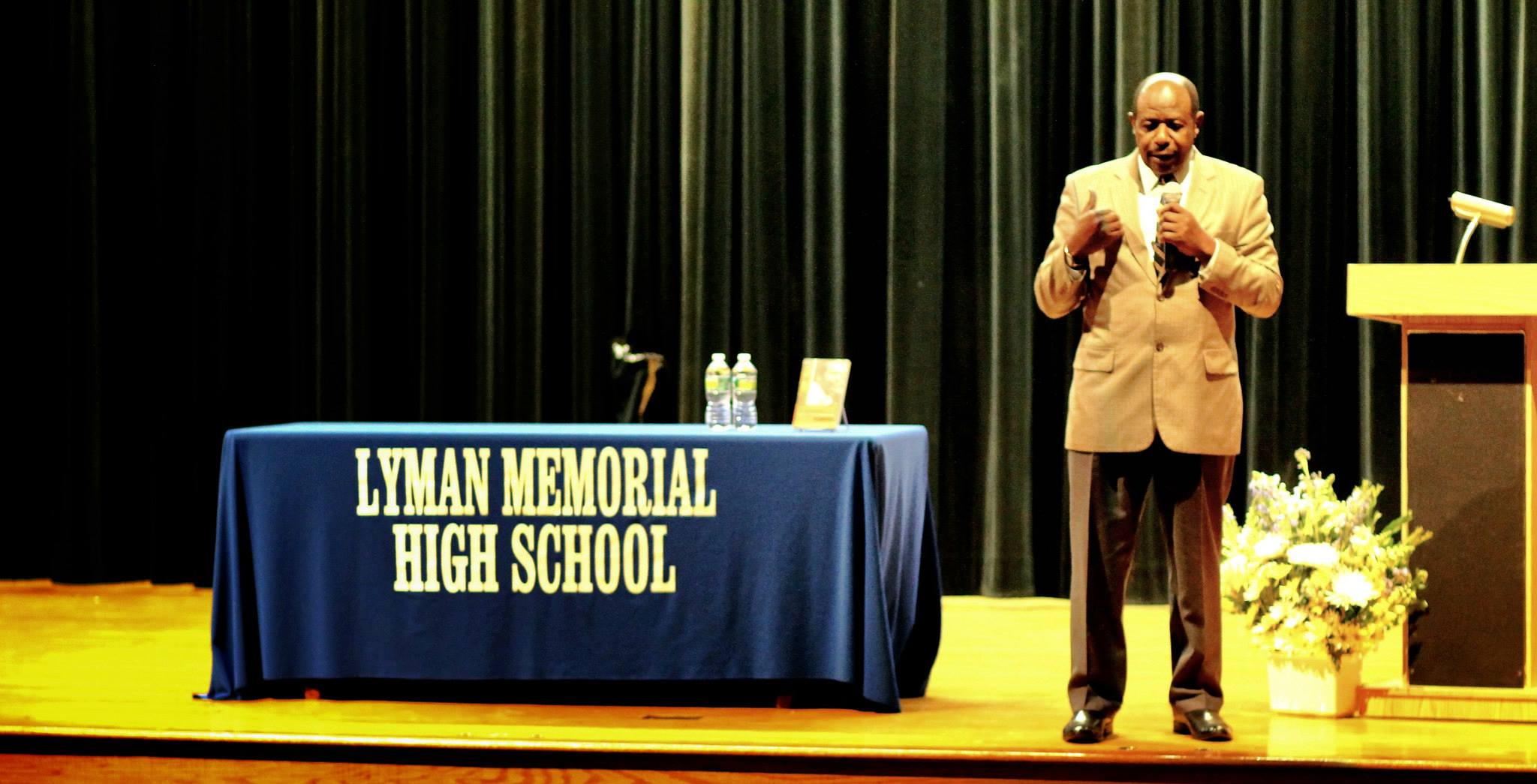
On May 14, I drove out to TF Green airport in Rhode Island and picked up Paul and Kitty from their hotel. Paul Rusesabagina was in my car! After returning to Connecticut and a lovely dinner with a former student and now colleague named Maggie, we headed to the high school. Paul spoke to a packed audience. It was a thrilling once in a life time experience for the student and community members who chose to attend. I still can’t believe it happened.
We ended up raising $4000 for the Foundation, and I am grateful to all my colleagues and students who volunteered their time and energy to make it a reality. I also discovered why Kitty was so optimistic: she believes in public education, and makes sure Paul visits public schools–even those that can’t afford him.
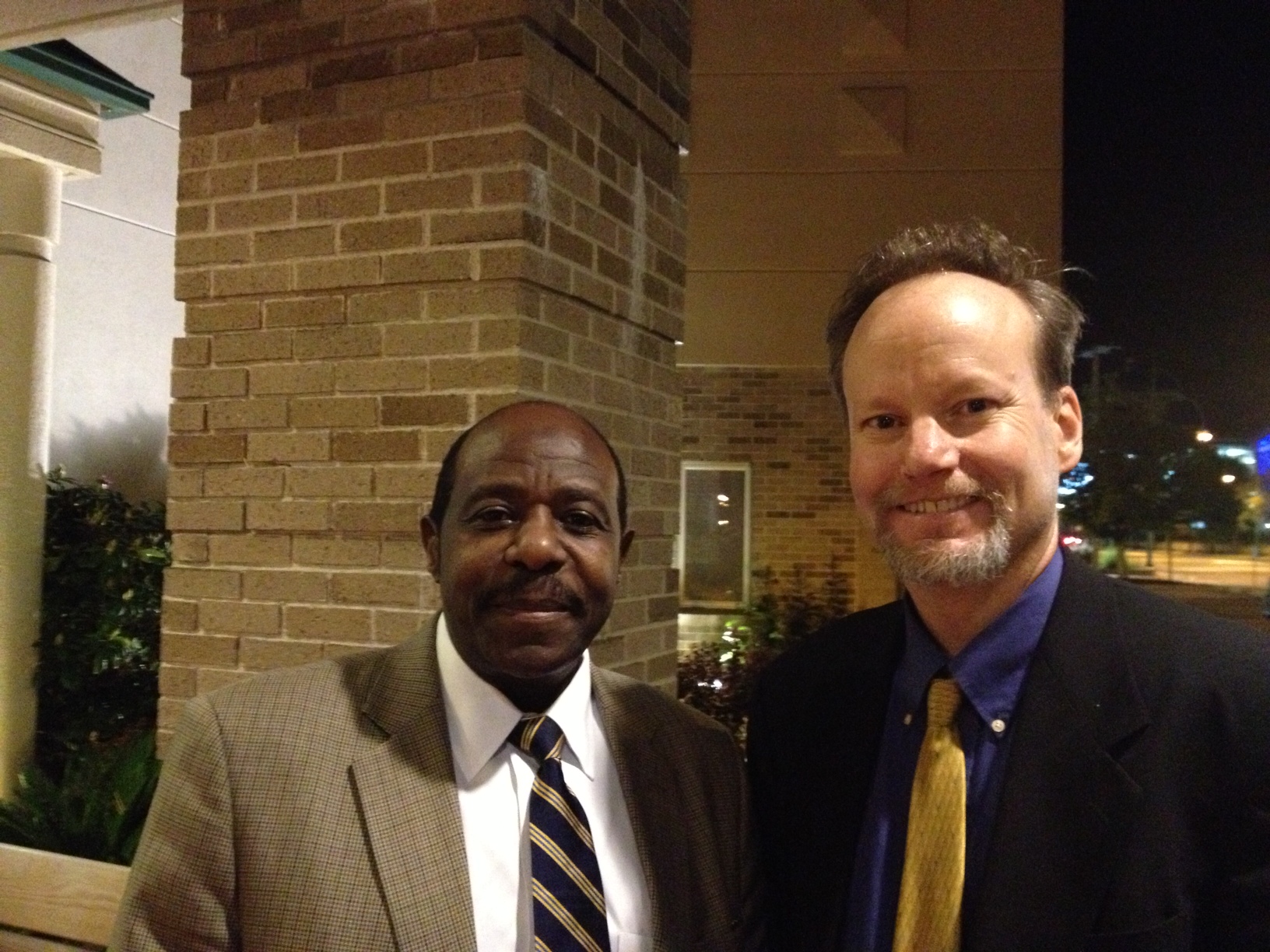
Paul and I at his hotel in Rhode Island. Even my hair was excited to meet him.
During his talk, I remember Paul saying this: “All my life, I had been taught to fight with words.” Fighting with words, of course, is how he saved all of those people. That quote will stick with me for the rest of my life, and hopefully everyone else who was there that night. As it turns out–an extraordinary man.
Observing World Parkinson’s Day
I know this actually happened in April, but I am very behind! The school year was intensely busy, but the last few months were marked by some extraordinary events. I’ll be writing about them the next couple of days. Here is the first:
I hadn’t really thought about April being Parkinson’s Awareness Month. Perhaps it’s because Parkinson’s is the illness I live with, so I need no special reminder to be aware. I was, however, struck by the observation of World Parkinson’s Day– April 11, in honor of Dr. Parkinson’s birthday. I liked this because I’ve always appreciated the fact that Parkinson’s was not named after the first patient stricken with the disease; it was named after the physician who first diagnosed and attempted to treat it. In 1980, Dutch horticulturist J.W.S. Van der Wereld developed a tulip in Dr. Parkinson’s honor, and since then the symbol of World Parkinson’s Day has been a red tulip. Struck by this hopeful and beautiful gesture, I suddenly found myself inspired to do something.

I teach in a vocational agricultural school with a greenhouse and a dedicated group of students developing their floral design skills. I began to wonder how possible it is to get red tulips we can sell on April 11, and then donate the proceeds to the Michael J. Fox Foundation. It would be perfect–an awareness and fundraising campaign built around the day’s symbol. Convinced of the efficacy of the idea, I spoke to Meagan, the floral design teacher, who assured me it was doable in two weeks. We would sell 150 tulips at $1 each—not a huge amount, but as my father used to say “Don’t be afraid to piss in the ocean, because every little bit helps.” Okay, maybe not the most applicable saying for this event, but you get the larger point.
Very quickly, my colleagues and students stepped forward to help advertise the event. Flyers, posters, and a banner were put in place for all to see. A student volunteered to help me with an announcement. Another pitch was made to my colleagues at a staff meeting. A battalion of students were recruited to help me sell on the 11th. We began sales at 7:05 am in the atrium of the school, where all students and staff must pass through to reach their classrooms. We were sold out by 7:35, and even after that, donations continued to trickle in. One colleague wrote me a check for $100; another paid me $60 for one tulip, so that by the end of the day we had raised nearly $450. I couldn’t believe the level of enthusiasm and generosity put forward by my colleagues and students.
As wonderful as that was, there were several magical moments from that day that will stick with me always.
–At about 10am, one of the secretaries showed up with two boxes from the Magnolia Bakery in New York. The Magnolia has been selling Fox Foundation cup cakes as a fundraiser, and my dear wife Valerie decided to surprise me with a box in honor of this day. The second box was sent to me by my good friend and colleague Liza. That’s right—I got not one, but two boxes of cupcakes! I shared most of them with the staff members who had been so helpful, but kept two of them for myself because a) they were delicious and b) I am not an idiot.

–One student was so excited about the success of the fundraiser, he announced “Next year, we’ll tell Michael J. Fox about it and get him to come here!”
–Another stopped by to see me during the day to ask me what Parkinson’s was. When I explained to her the illness, and the difficult symptoms it causes, she smiled at me and said, “But look at you. You do so well. You’re here every day teaching!”
–While I was explaining the virtues of the Fox Foundation to one of my classes, another student said to me “We know it’s a good cause and everything, but you do know everyone did this for you, right?”
Michael J Fox’s memoir is entitled “Lucky Man,” wherein he describes how in spite of his illness, he feels he has led a very fortunate life. While I certainly haven’t had the life of the fantastic Mr. Fox, I am beginning to understand what he means.

