My First Three Act
It’s always a satisfying feeling when you have progressed enough with a piece of writing that it feels like time share it with others. In one sense, the work is “finished,” although once you share it with other writers you know it’s not even close. Yet, it’s still a lovely place to be–you’ve gotten this far, so you know your piece has potential. It has a beginning, a middle, and an end; it likely has characters you like, and the odd good line.
My most recent project is special for a couple of reasons. One, it’s my first three act play (I have written three one acts and one two act). Even though I still love screenwriting, and even wrote a poem this week, I find I am thoroughly enjoying my foray into playwrighting. It feels like every new idea wants to manifest itself as a play. Who am I to resist?
The second reason this project is special is the topic: the American Indian boarding school system. If you aren’t familiar with the history, in 1879, the United States and Canadian governments instituted an educational program for the children of their native populations. Native children were taken from their parents against their will and placed in these boarding schools throughout the country. In these schools, the students were not allowed to speak their own language, practice their religion, have contact with their families, or express even the slightest inkling of individuality. Any such infraction was met with abuse and violence.

The point of this was for the US and Canada to solve their “Indian Problem” by eradicating native culture from it’s youngest members. The objective, according to Captain Richard Henry Platt, the army officer selected by the US to create and supervise the school system was to “kill the Indian, save the man” in every pupil. Research indicates that the rate of abuse in these schools was 100%. Since the operation of these schools was contracted to the Catholic church, sexual abuse was also rampant. And if you are starting to feel grateful that such a practice has the virtue of being distant history, you should know that the last school in this system stayed open until 1990.
I had never heard of this system until my grandfather told me about it when I was a teenager. The reason he saw fit to share this with me was that he himself had been enrolled in one of these schools, and six decades later, he was still traumatized by the memory. He was more willing to discuss fighting in the Pacific theater during World War II than his experiences in the boarding schools. The only thing he told me is that he had tried to escape three times–and once he hid in a barn.
So I have written a play set in 1950 wherein a teenage boy named Daniel escapes from one of these schools and hides in a barn. Since my grandfather gave me no details, I have decided to fill them in. The barn is owned by a family of Sikhs from Punjab who have recently fled to escape the horrors of Partition. They must decide whether to hand Daniel over to law enforcement, or protect him and risk their immigrant status. Daniel, meanwhile, has to decide whether he can trust this family of strangers and allow himself to be helped or take his chances on the run and riding the rails.
The title of the play is “Save the Man.” I will always wonder if my grandfather were still alive, he would be able to watch it.
The First Launch
After 22 years in the high school classroom, I have had my share of graduates who have gone on to do amazing things. An environmental lawyer. An emmy winning computer animator. A counselor for a sexual assault crisis service. A grammy nominated sound engineer. An FBI agent. A television director and editor. An opera singer. A program director for Habitat for Humanity. A stage actor. A founder and director of a dance company in New York. That’s just part of the list. Flipping through their bios on pages like Linked In, it’s easy to be impressed. It’s also an honor to know that I may have been able to contribute to their journey in some way. And of course, it makes me very proud.
Last week. though, was a first: I had never before had the good fortune to attend a former student’s book launch. It’s always a good day when one of your former students stops by to visit you. It’s even better when that student presents you with a signed copy of her recently published memoir.
 I had the good fortune of having Ludmila as a senior in my philosophy course. My first impressions were good ones–she was intuitive, very smart, funny, and a strong writer. As I got to know her, I learned more of her story. Born in the Ukraine, she was adopted from an orphanage by an American couple at age 14 (very late for a typical adoption) and arrived without knowing a word of English. A mere seven years later, here she was writing, reading, and discussing philosophy in her second language. When she shared with me some of the trauma she endured during her young life, I was simply in awe of her fortitude. “A Single Desperate Prayer” is the story of her childhood, and her journey to the United States as an adoptee.
I think it is fair to say the book launch was an unqualified success. The room at the Jonathan Trumbull library (in Lebanon, CT) was overflowing with attendees–extra chairs had to be brought in, and standing room likely violated the fire code. Ludmila read three chapters, did a short PowerPoint not only on her life, but on the work of Hope Now Ministries (more on that below) This was followed by a thoughtful Q&A, and then the book signing. Happily, all of the books brought to the reading were sold. Aside from seeing Ludmila, it was also great to see former students, colleagues and parents that I’ve known over the years.
And all of us were brought together in joy to celebrate this remarkable young woman.
To learn more about Ludmila, and order a copy of her book, visit her web page.
To learn more about Hope Now Ministries, which provides financial aid for orphaned children in Crimea (from where Ludmila originally hails), visit their web page. Ludmila is donating 10% of her book sales to New Hope Ministries.
King of Pain
It may seem a bit obvious to say, but living in chronic pain is incredibly difficult. If you, like me, find yourself in this situation, you know whereof I speak. If you don’t, I think it is difficult for you to understand what it truly is like to live a life wherein each step one takes is a painful one.
I think part of the perception comes from how those of us with chronic pain are perceived. If we have a cane, or a walker, or other obvious signs of a life lived with discomfort, it is easy for others to have empathy. They see the struggle, they imagine how they would feel if that was them, and they understand on some level how hard it would be. They may even be motivated to help, or feel gratitude for their own good health.

When the chronic pain is less obvious, when we don’t always show the overt signs of living in pain, such empathy seems harder to come by. This is understandable–we don’t appear to be in pain. We aren’t groaning, moving slowly, straining so much tears pour out of our eyes. How much pain could we be in?
This is a reasonable question, and frankly has no simple answer. It is complicated by the fact that people may not believe you are truly in pain; perhaps you’re a whiner, a big baby, a wimp. Suck it up. Be a man(advice sometimes inexplicably offered to females)! Shake it off! Medical professionals may also doubt you are in the level of pain that you proclaim. It is understandable why medical professionals may be skeptical–they certainly have their fair share of patients who may be craving attention, hoping for an opioid prescription, or just afflicted with Munchausen’s Syndrome.
Being aware of why someone may not take your chronic pain seriously doesn’t make it any easier when someone doesn’t. This is why it is important to have an understanding as to why many of us in constant pain don’t seem to meet your presuppositions of what it is supposed to look like. There is a simple reason for this disjunct between expectation and reality:
We’ve gotten used to it.
Before I continue, I want to unequivocally reject the term “Chronic Pain Warrior.” I once used this term myself; I suppose there was a certain dignity in it. I don’t think warrior is a good metaphor for this type of condition. First of all, wars are fought by choice. There is a moral argument made by both sides during a war–the reason a soldier is fighting in war is an ethical one. For a good reason, perhaps, but most likely for a bad one. Either way, being a warrior is a role that one chooses for oneself. I never chose my pain, and never would have. So I am not a warrior.
What I have become (and there are so many like me) is one who has figured out how to adapt. Being in chronic pain forces this type of adaptation. You develop an ability to cope. First you start by ignoring the pain. When that doesn’t work, you find ways to distract yourself from it. Then, when that no longer accomplishes what you need it to, you finally reach acceptance. I am in pain. I am always going to be in pain. I need to make peace with this, or I will cease to live, and my life will be replaced instead by a melancholy existence.
When you reach this acceptance, something remarkable happens. Your brain finally understands what you want it to do, and your synapses continue to function in spite of your pain. It’s always there, and you always notice it. But it doesn’t stop you from climbing out of bed, from showering, from climbing in and out of your car, from doing your work. From walking and exercising. Yes, all of it hurts, and maybe you still wince from time to time, but you realize much to your surprise that you can cope with it. Why? Because you have to. You have no other choice.
My pain comes largely from Parkinson’s Disease (I have other neurological issues that contribute to the pain, but that is too much to discuss here). The aches and pains in my joints and extremities on some days can feel intolerable. The strain of constantly coping with the discomfort of Parkinson’s on my nervous system and muscles adds to the pain. Indeed, my body developed a largely inexplicable back and leg pain that was originally assumed to be a herniated disc. I was given three cortisone injections, a facet injection, sent to physical therapy, a chiropractor (who succeeded in making my pain worse, while his office manager hounded me for payment before ever sending me an invoice). Nothing worked. I was convinced it would never improve, and struggled mightily to reach acceptance.
Of course because nothing was working, medical professionals I consulted seemed to doubt I was in the pain I claimed. The disc was not sufficiently herniated; and if it were, one of the treatments would have certainly worked. My orthopedist–who was perhaps the most empathetic of all of my doctors–suggested I take an EMG to ascertain the levels of which my nerves appeared disrupted by the pain. The EMG was unpleasant, but the results were clear; I was in a great deal of pain. With no other option, a neurosurgeon got the brainstorm to treat my symptoms, and not continue to search for an underlying cause. I was prescribed a nerve pain medication, which worked remarkably well. This meant I had damaged nerves in my lower back and legs, but from what? The only answer appeared to be the strain on my body from Parkinson’s.
Even though the nerve pain has receded, my good ol’ Parkinson’s pain remains. This is a truth of chronic pain–you are never pain-free, there are just levels which are easier to tolerate than others. This can be complicated and frustrating, because a medical professional will ask me whether something hurts–yes, of course it does. It always hurts, whether you do what you’re doing or not. It just hurts more or less. The other strange side effect of being in constant pain is you don’t realize immediately if you hurt yourself. You are constantly trying to figure out where any cuts and bruises originate, because you didn’t realize what you had done. Why is my elbow bleeding? Where did that bruise on my knee come from? Sometimes you can figure it out, but otherwise, you throw a band-aid on it and get on with your day. (By the way, the person who finally invents a band-aid you can open one-handed will become a billionaire.)
I know many with chronic pain can no longer function well, and have lost the ability to cope. They tend to live very sedentary, probably unhappy, lives. I understand this completely–it takes a great deal of energy to be in chronic pain. There are days when I don’t want to get up and face it. One of these days, I may become like them.
I don’t know when that day will come. For now, I cope. But please, don’t call me a warrior, or some other New Age trope. I’m in pain, and I’m alive. And if you aren’t able to see it or understand, I’m afraid my life is under no obligation to make sense to you. It just has to make sense to me.
A Twenty Year Retreat
For nearly two decades, I have been attending the annual Martin Luther King weekend writers’ retreat at Mercy-by-the-Sea (a Catholic retreat center) in Madison, Connecticut. The retreat was originally organized by the members of Still River Writers, the writers group I have been with since April of 1998. Despite the fact that the retreat moved from Madison to Enders Island (another Catholic retreat center on Long Island Sound) for a few years and has occasionally shifted to President’s Day weekend, this retreat has been a constant in my life over the last twenty years.
The building we occupy at Mercy is called Seascape. It is different from the rest of the buildings on the campus, partly because it is newer than the other structures, which tend to be dark and monastic. Seascape is brighter, painted in pastels, with several large windows to view the sea and welcome the sun. It also feels more like a private residence, because unlike the rest of Mercy, it was–Phil Donahue and Marlo Thomas once called it home. When they decided to relocate from Madison, they donated the building to Mercy.
Due to my proximity to Mercy and my work schedule, I am usually the first to arrive. After I settle in and unpack, I make myself a cup of tea and enjoy the views. I like to pretend it’s my own personal beach house until someone inevitably arrives to shatter the illusion. It is always fun while it lasts…
Over the years, I have forged a number of wonderful, enduring relationships which have helped me grow both as an author, but most importantly, as a person. The exposure to all of the poets, prose poets, novelists, short story authors, non-fiction chroniclers, memoirists, playwrights, screenwriters, and songwriters over the years have influenced me in ways I am only just beginning to understand.
In that time, I have written five screenplays, one teleplay, four stage plays, a few dozen poems and a handful of essays. I have won thirteen awards, was twice nominated for the Pushcart Prize, published some of the poems and essays, and began blogging. I have also optioned two of my screenplays, seen three of my one acts produced, held a staged reading for my full length play in New York, and found an agent. I sincerely believe that none of that would have occurred without the annual retreat providing me with lengthy blocks of time to write, helpful feedback from peers, and a confidence that has increased with each passing year.
And I tend not to waste those blocks of time. A few years ago, a wrote the first draft of a 95 screenplay over one of these weekends; my roommate had to excuse himself and write elsewhere because he found it exhausting to be in the presence of such mania. I can’t really say I blame him. I also wrote the first draft of my full length stage play “Invincible Summer” at Seascape, and this year wrote 40 pages of my new play–and I am quite happy how it’s turning out.
Of course, the retreat is also where I met the woman I love–fifteen years ago! To say that our lives have changed since that first meeting is to significantly understate the matter…
We can at times look back over the years and reflect upon a decision that radically shaped the trajectory of our life. My decision to attend my very first writers retreat during the waning months of the Clinton Administration unequivocally falls into that category.
Why Unions Matter, Part Four
To finish up this series, I am going to address many of the most common objections about unions, and show why these either don’t hold water, or are based upon misconceptions. There are many; I am going to focus on the five most common I encounter in opinion pieces, views expressed to me in person, and social media posts.
-
- People needed unions in the past, but not today. I think my discussion of the costs of neoliberal economic policy has debunked this, but just to sum up: wages are in decline, the cost of living has increased, profits are at record highs, both of which can be directly attributable to the decline of unions beginning in the 1970s. If it were true that unions were no longer necessary, then the decline in union membership would lead to an increase in wages and quality of life. In fact, the opposite has occurred.
- Unions obtain benefits for themselves other workers lack. Why should they get special treatment? My usual response to this is: if you work in an industry where some of the workers are unionized, and others are not, and you find yourself in the latter category, then… why aren’t you unionized? Chances are that union you resent would be very happy to have you as members. Furthermore, the assumption that unions get “special treatment” is not a valid one; unions get fair treatment for their employees. If you find yourself resenting union benefits, it’s likely because you are not being treated fairly. Lastly, even if you are non-union in a heavily unionized industry, you do benefit, because that union tends to drive the wages and benefits up. A nonunion employer still has to compete the union employer. I knew someone who was a non-union ER nurse, and her wages and benefits were very strong because most of the nurses in her town were unionized.
- I’m a non union salaried professional who has to work with union employees. Their contract lets them go home before me and my assistant makes more than me. How is that fair? Simply put, it’s not fair. But the problem may not be the union contract, it might be yours. If you are expected to work more than a forty hour work week, and your are not paid more than your assistant, then I don’t think you received a fair deal. I think the problem is your employer taking advantage of you. Too bad you are not in a union…Additionally, as a salaried professional, you probably think of your job as a career. To many blue-collar union employees, they have a job. They aren’t doing it because of their dedication to whatever industry you happen to be in. They want to put in their 40 hours and go home to their families. That, frankly, sounds much healthier than working 60 hours a week and collapsing onto your bed for a restless night sleep. And if that’s the only way you can get the job done…then the problem is your employer.
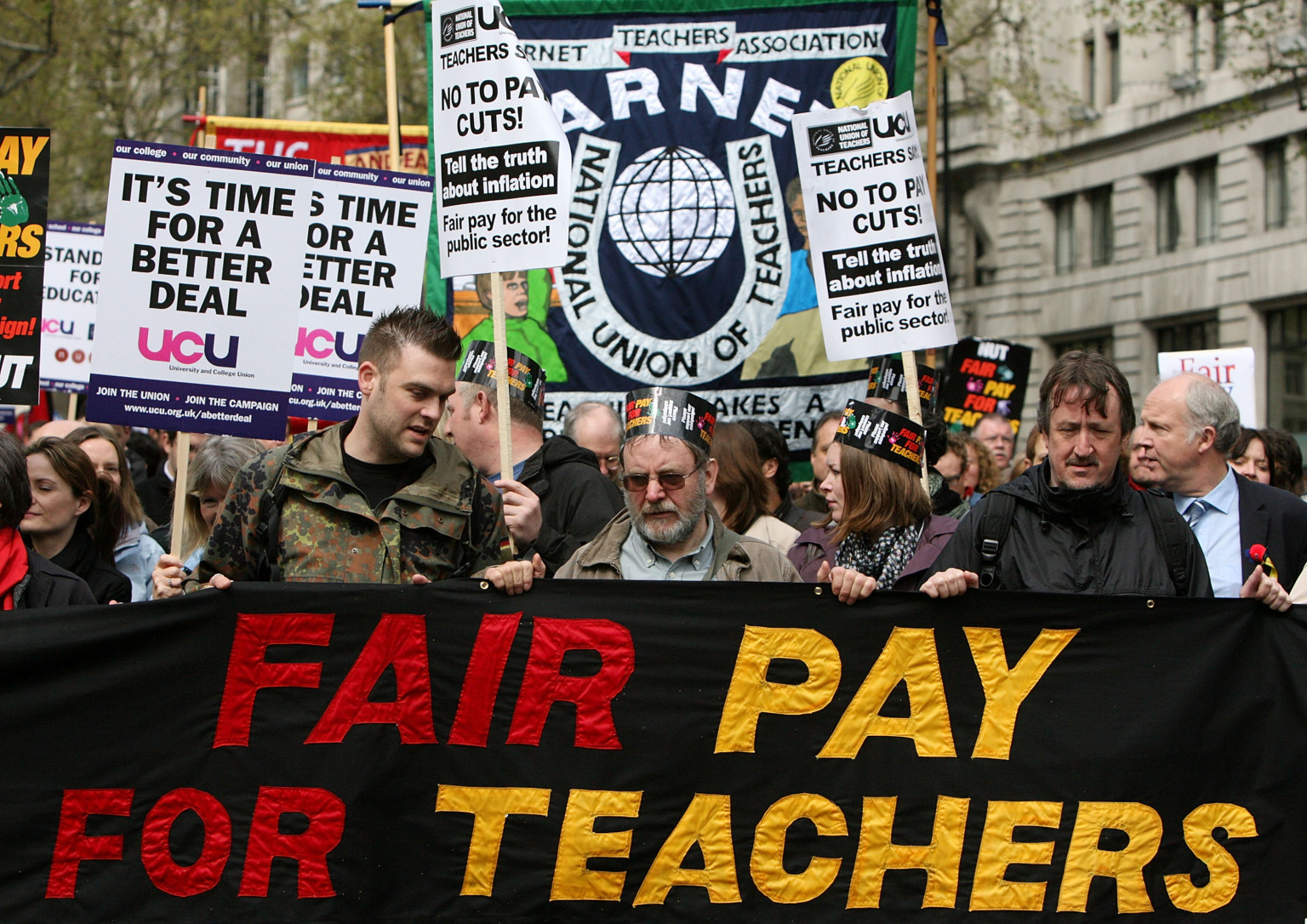
- Unions protect incompetent workers. There is some validity to this. As a teacher, we often hear this common objection We are told it’s impossible to fire union teachers, or state employees. And yes, just cause clauses and due process procedures do make it harder to dismiss contracted employees. But it is hardly impossible. If an administrator or supervisor feels that an employee is not doing their job, they can follow the process and have them dismissed. They just have to be able to document the problems. An attentive, competent leader should be able to do that–and usually they succeed. Many supervisors, however, don’t want to bother. Or those that do fail to follow procedure. If that’s so, the issue isn’t the bargaining unit–the issue is leadership. School reformers spend a great deal of time discussing the problem of teachers in schools, but rarely discuss administrators. Any teacher will tell you that there is a dearth of good leadership in schools. Administrators are often failed teachers, who by definition, tend to be poor leaders, or individuals with business backgrounds and no educational experience. As a result, they are largely ineffectual. A few years ago, I worked with a teacher close to retirement who ceased to read the work handed in to him. He would assign a grade based largely on how he felt about the student, but never read their work. Students would intentionally put silly messages in the work to see if he noticed; he never did. This was common knowledge at the school, and students complained about it. The school leadership could have done something about it, but they chose to ignore it. And while certainly the teacher’s behavior was on him, it wasn’t his union contract that protected him. It was poor leadership.
- Why do you need due process, anyway? The era of sweatshops is over in the United States. First of all, I’m not sure I’d say that to a fast food employee. Or, someone working in a garment district…in a sweatshop. Aside from that, though, due process protects employees from personal vendettas and incompetence. If you think neither are a real problem in the workplace, then I suspect you are not actually employed. I have had colleagues had their lives turned into a living hell due to the personal vendetta of a superintendent. I have also had many female colleagues made uncomfortable by a sexually inappropriate male colleague who held power in the district. A colleague in another district was falsely accused of an inappropriate relationship with a student, and another was disciplined for the poor performance of students she didn’t actually have in class. Whether these incidents were the result of vendetta or incompetence is not always clear. Regardless, due process offers union employees a level of protection. Keep in mind: I work in a school. I am supposedly surrounded by intelligent, educated people. So if it happens there, it can happen anywhere. All workers should be entitled to some level of due process. If most employees do not have this protection, the solution is not to eliminate it for those that do have it. Of course, there are some laws that can protect non-union employees from some of these situations. How, then, did those laws get on the books? Union organizing.
In these last four posts, I have attempted to make it clear why unions are still important today–arguably, as important today as they have ever been. As human institutions, they are by definition imperfect, but I think the historical and economic evidence make it clear that they have done more to benefit working and middle class people than just about any other force in history. And that, more than ever, is why individuals with power and wealth have worked so hard to discredit and dispose of them.
The truth is, they have nearly succeeded. The only thing that can stop them is us.
Why Unions Matter, Part Three
I think its easy to see how neoliberalism would put a giant stake through the heart of private sector unions. But what would be the advantage of breaking public sector unions, if they were not affecting the profit margins of a private enterprise? Why such economic (and actual) hostility?
There is no one answer this question. The answer is as complicated as it is multifaceted. I will do my best to break it down as follows:
- The Libertarian Objection: Many conservatives have accepted the libertarian/Randian perspective that there is no such thing as the collective good. There are only individuals. If you accept that as axiomatic, then collective bargaining is hostile to your view of economics and liberty. You already think of tax collection as theft. The idea that tax money would therefore go to pay unionized workers is unthinkable. As former Libertarian Party candidate Gary Johnson described it, “all services should follow the Uber model.”
- The Taxation Objection: The bastard child of the Libertarian Objection, this is the idea that government should be smaller, deliver fewer services, and charge little or no taxes. Unionized workers bargaining for contracts that include cost of living increases and health insurance make it difficult to keep those precious taxes lower. So, eliminate unions and their contracts, and you can, as Grover Norquist put it, “Cut government…down to the size where we can drown it in the bathtub.” It is this philosophy that has motivated the likes of Scott Walker and Rick Snyder to help crush collective bargaining in their pro-labor states. You cannot cut taxes for the wealthiest residents of your state and balance your budget without cutting spending. You can cut spending if your public sector workers have their salaries and benefits cuts. That can’t really occur until you either dispose of (or signifantly hamper) collective bargaining.
- Fear of Solidarity: As the Powell memorandum makes clear, businesses, multinational corporations, and the wealthy believe it to be a moral imperative to concentrate their power. The biggest threat to that concentration is unionism. Public sector workers have, by and large, been popular and provide services many citizens depend upon. Becoming a unionized public sector worker has also been a common path for working class Americans–especially people of color–to join the middle class. If being in a union is aspirational, that makes it a threat to wealth and power, public or private sector. You remove that opportunity, it ceases to be an aspiration. Wages are down, taxes are down–and profits are at record highs. This is not an accident, or the result of the “Invisible Hand” of the market place. This is engineered through legislation and litigation.

Another factor at play here is the distinctions between public sector employees. Many public workers will be attacked and devalued by corporate media, with two notable exceptions: police and fire departments. The Janus v AFSCME decision affects these unions as well, but there is far less anxiety expressed from those bargaining units. Part of the reason is that many police and fire departments tend to donate funds to Republican candidates, whereas other unions tend to support Democrats (for reasons I will get into in part four). The other reason is that police and fire provide a service that the wealthy value over all the others: they protect property.
It’s easy for corporate media to trash teachers, bus drivers, public health care workers, and public college professors, because those with wealth and power will never use their services. If they are of no use, why pay for them? But they have use for police officers and firefighters, so their collective bargaining units are tolerated.
Former journalist and current charlatan Campbell Brown for years has worked to try to privatize education–which cannot happen until the unions are gone. Ms. Brown has sadly, run out of valid arguments to make her case, so she usually defaults to the charge that teachers unions “protect child molesters.” What she is referring to is the due process rights public sector employees (and some private sector union members) have if if they are accused of misbehavior. Police officers also have these due process rights, but Ms. Brown has yet to accuse police unions of “protecting child murderers.” It would seem there is a double standard at work here.
Economists Joseph Stiglitz, Dean Baker, Paul Krugman, and Thomas Pikkety have made it clear in their research that the higher standard of living brought about union contracts not only created the middle class, but the investment in public sector unions has injected billions of dollars into the economy. Simply put, people with economic security spend more, which stimulates all of the other economic sectors. These sectors function as a tax base, so the state’s investment pays itself back countless times over. As a result, the economy grows and wealth is generated. There is a problem, though–the wealth is not concentrated into the hands of the few. It is those hands that have worked so hard to reverse the tide–and Janus is their most recent victory.
In part four, I will refute some of the most common objections to the existence of public sector unions.
Why Unions Matter, Part Two
It’s unclear how many at the time took Lewis Powell’s memorandum seriously. What is not in dispute, however, is that what occurred in the subsequent decades makes it clear that business and corporate leadership began to behave as if they were following Powell’s suggestions.
Between 1970 and 2014, the United States lost over eight million manufacturing jobs–five million of those since 2000. The vast majority of these jobs, or course, were union jobs. This would make sense if this decline of manufacturing was coupled with a decline in consumer spending and Gross Domestic Product (GDP), but the opposite is true. What happened?
Many argue that the issue is automation–the replacement of industrial laborers with robots and other improved technologies. Economist Dean Baker, though, makes the case in his book “Rigged” that there is no evidence for that assertion. Simply put, automation does not account for the amount of job loss coupled with the increase in GDP (which now stands at over $19 trillion). What would account for it, then?

The answer is simple: globalization. Most of those manufacturing jobs have been lost to overseas firms in the developing world, wherein wages, benefits and regulations are significantly less expensive. American workers earning cost-of-living wages simply cannot compete with the poverty wages of a teenager from El Salvador.
Thus, the process becomes two-pronged: first, you ask high wage union workers to accept wage freezes, reduction in benefits, shorter shifts, etc. to keep costs down. If the union doesn’t accept the terms, then the factory is moved, and all workers are out of a job (not to mention all of the service workers in the factory towns who will be thrown out of work due to a decrease in economic activity). So, the unions accept the pay cuts in hopes of keeping their jobs, only to lose them anyway when the factory closes a few years later.
This is the thing to keep in mind: the auto, textile, steel factories, etc. that shuttered their doors to move their operations to cheaper developing world outposts were all turning profits at the times of the plant closings. Most in the hundreds of millions, a few in the billions. But stockholders have to be satiated, so the plants were closed, profits rose–and wages fell.
Part two: the transition from a manufacturing economy to a service economy. Service jobs tend to be low skilled, highly compartmentalized, and easily replaceable. As a result, service jobs are usually low wage. The combination, then, of globalization and the expansion of the service economy has pushed wages down to the extent that a minimum wage worker today earns less than 3/4 the wage value as a minimum wage worker in 1968. Of course, that statistic wouldn’t be troubling if today’s cost of living was 3/4 what it was in 1968. But it’s much higher. That drastic change cannot all be attributed to some assembly line robots.
This is why the idea of a minimum wage set at $15 is not unreasonable: what is being requested is the equivalent of a five dollar increase spanning the last fifty years. To put it another way–one dollar per decade. That’s ten cents a year. By that standard, a $15 minimum wage request nearly qualifies as conservative.
Lower wages have also produced this consequence: many Americans who are employed full-time at low wage service jobs still qualify for public assistance. The federal government last year spent $6.2 billion providing welfare benefits just to gainfully employed citizens. This amounts to a subsidy to multi-billion dollar multinationals who can’t be bothered to pay their employees a living wage.
This is the legacy of Neoliberalism. It is important to remember that theses are policies not limited to Republicans, as the presidencies of Carter, Clinton, and Obama can attest.
With the destruction of private sector unions and a reduction in the real value of wages, there was still one target left for Powell’s disciples: the unions of the public sector. Undermining these collective bargaining units would prove to be more complicated.
Why Unions Matter, Part One
The recent supreme court ruling in the Janus v AFSCME decision has dealt a serious blow to both public and private sector unions. The ruling appears only limited to public sector unions, but rest assured, it will have an effect on private sector unions as well.
Over the last few decades, public and private sector unions have been under attack by a number of forces: politicians (not all right-wing; some are moderate Democrats), wealthy organizations like Americans for Prosperity (funded by the libertarian Koch Brothers), the American Legislative Exchange Council, not to mention the entire neoliberal economic process. Unions for years have been the path for working class Americans to enter the middle class. Unions have worked to raise wages and the standard of living not just for their members but for all workers. Protections we sometimes take for granted such as overtime pay, workman’s compensation, laws regulating child labor all exist because of unions.

Given that unions have managed to create a system wherein working and middle class Americans benefit financially from the country’s prosperity, it’s not difficult to see why they would become a target. If you run a corporation, your primary function is to maximize wealth for your shareholders. One of the ways you do that is by cutting labor costs. If there are organizations of workers who collectively bargain for a fair share of the pie, that’s less money for the shareholders. That’s how a corporation functions. That’s why only 7 percent of workers in the private sector are organized into a union. To understand why these same organizations who don’t want private sector unions also turn their attention to public sector ones, we need to go back to the beginning.
The Birth of Neoliberalism
From the post war era through the late 1960’s, the United States had become the wealthiest nation in world history. Thanks to unions, workers shared in that prosperity: over 28% of the workforce was unionized. To many business and political leaders, this was intolerable. This concern was characterized by corporate lawyer and soon to be supreme court justice Lawrence Powell. In 1971, Powell felt compelled to assert, in a memo that was to help galvanize business circles, that the “American economic system is under broad attack.” This attack, Powell maintained, required mobilization for political combat: “Business must learn the lesson . . . that political power is necessary; that such power must be assiduously cultivated; and that when necessary, it must be used aggressively and with determination—without embarrassment and without the reluctance which has been so characteristic of American business.” Moreover, Powell stressed, the critical ingredient for success would be organization: “Strength lies in organization, in careful long-range planning and implementation, in consistency of action over an indefinite period of years, in the scale of financing available only through joint effort, and in the political power available only through united action and national organizations. ”
In short, ordinary people were becoming too powerful, and that had to stop. What’s one of the ways you stop them? Attack the organizations that give them power.
Get rid of their unions.
 Danger Is My Business