The Turing Test, Part Two
Preface: A long layoff, I know. For those of you who know me personally, you are aware of the rather intense transition my life has endured over the last few months. If you don’t know me, and our curious…you can send an inquiry by email. I’m not going to bother with it here. I do wish to return to blogging, and will begin by returning to this story from March 8.
To continue: I had worked constantly, desperate to complete the Turing Machine, and pass the class. Every time I thought I had solved the problem, it turned out I had failed. I was becoming desperate, but there was no internet to help me, and I didn’t know the other students in class well enough to request their assistance. Part of it was hubris: I didn’t think I should need that help. I had already spent all of Professor Otte’s office hours having him re-teach me the class. I wanted to show that I could do this on my own.
The problem was…it didn’t seem like I could.
In spite of all of my efforts, the last day of the quarter arrived, and I still hadn’t solved it. I worked on it all night, and it was now 8 a.m., and the assignment was due in two hours. With a non-functional Turing Machine, I would not pass the class. My second quarter as a transfer student, and I will have failed one of my courses. In my major. This was not good.
When my final attempt failed, I simply rose from the desk and headed into the shower. I’d turn the assignment in, and hope the professor would take pity on me. Maybe he’d give me an extension. Maybe he’d give me an incomplete. Maybe he’d let me change my grade to “audit.” I didn’t have any reason to think he would, but it was this hope that I clung to. I had to in order to avoid the humiliation I was feeling due to trying so desperately hard to succeed and having utterly failed. I took what I could only describe as the “Shower of Failure”: I leaned against the shower wall as the water bounced off of me. I did nothing else.
And perhaps it was because this was the first time in five weeks I hadn’t been thinking about the god damn Turing Machine, I was suddenly struck by an idea. Wait, could that…that might…oh my god! That might work!! Yes!! That might work!! No…that will work!!!
I leaped from the shower and raced over the computer and punched in the program pattern. I didn’t want to wait–I was terrified if I did, I’d forget my idea. The pattern looked good. I tried a configuration of numbers. It worked. I tried a different number combination. It also worked! Another–success! I altered the configuration, because it had to apply to different variables. Yes. A different number combination. Yes. Another combination. Yes. A different configuration. Yes!
I think I sat at the computer a half an hour typing every variation I could think of. The machine passed every one. It worked. It worked! It finally worked!
I began shouting the phrase “IT WORKS!” over and over again as I indulged in a spontaneous, purely caffeine and adrenaline fueled Spontaneous Energetic Happy Dance of Victory. I shrieked “IT WORKS.” at everything–plants, furniture, the food in the refrigerator, the spider in the corner of the bedroom. I screamed at Zorro, my pet tortoise. He was singularly unimpressed, but I didn’t care. I had done it! I had created a successful Turing Machine. I was going to pass. I wasn’t a failure. I was the logic God!
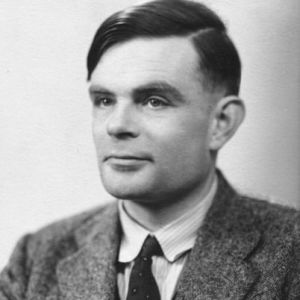
Alan Turing, whose machine became the bane of my existence for five weeks in college. None of which compares to what he endured.
The only thing that paused my revelry was a strange sensation underneath my feet and between my toes. Why were my feet wet? Why was…the entire floor wet? It was then that I realized that when I raced from the shower I had forgotten two very important things: one being I never shut off the water, and now the apartment was nearly flooded.
The second thing I had chosen not to do was actually get dressed. I had been solving the Turing Machine and celebrating my success completely naked. With all of the windows in my apartment opened. On all sides, which allowed several of my neighbors a front row seat to my victory dance. Not exactly Magic Mike, but they were all staring at me.
I stared back at them a moment. I’m certain a silly grin crossed my face, as I instinctively began to hide myself. I scanned the room for something to cover myself before meeting my neighbors persistent gaze. I then impulsively raced over to the window, stuck my head out and shouted “I SOLVED THE FUCKING TURING MACHINE!” and continued my celebration. The neighbors watched, still confused and intrigued by the insane white man.
A few minutes later I was dressed and outside. I leaped onto my motorcycle, and as I pulled out of the apartment parking lot, I glanced behind me. The neighbors continued to stare. I laughed out loud as I raced up toward campus. I continued to giggle as I handed to the computer disc to a confused Professor Otte, and giggled all the way home.
There are a number of lessons one can derive from this story. I think perhaps the most important one is this: Don’t ever take Advanced Symbolic Logic.
The Turing Test, Part One
My time in the Beach Flats neighborhood of Santa Cruz was my first experience living outside of my hometown of San Diego. It was also my first experience as a full time college student.
I had decided to major in philosophy for the simple reason that I loved the subject. It was purely a decision of passion–it had absolutely nothing to do with reason (David Hume would have been proud!) As a newly minted philosophy major, I was told that if I wanted to do graduate studies in the subject, I had to take something called Advanced Symbolic Logic. I did want to do grad work in philosophy–what would be the point of studying it otherwise?–so during my second quarter at UC Santa Cruz I signed up for the recommended course. I wasn’t intimidated at all. I had taken two other logic classes at the community college, and enjoyed them both. Advanced Symbolic Logic seemed like a challenge I was up for.
Except that it wasn’t.
Most of what you study in your introduction to logic classes is comparatively pretty basic. You start by taking deductive arguments and turning them into syllogisms, like so:
If it is raining, I will meet you at the theater. It is raining. Therefore, I will meet you at the theater.
Then you turn that into this:

And you get to refer to it by it’s cool Latin name, Modus Ponens. Then you’re off on your way to mastering logic. The problem was that I had clearly not mastered it as well as I thought, because Advanced Symbolic Logic very quickly began to look like this:

My teacher was Professor Otte (whom you met earlier). He sported a well-kept beard and was never dressed in anything but a t-shirt and shorts. The t-shirts always made some reference to rock-climbing, and he was so laid back, he didn’t even bother to write-up and distribute a syllabus. He outlined the class on the chalkboard the first day. That was our syllabus.
I was also the only undergraduate in the class. The other six students were linguistics and mathematics graduate students, so the class was largely a seminar on concepts with which I struggled to keep up. Every week, during professor Otte’s office hours, I was there waiting for him when he arrived and he would do his best to re-teach me what had occurred in class that week. When his office hours concluded two hours later, he kicked me out. He was far more patient with me than I think he actually wanted to be. Thanks to his help, and my determination, I did manage to keep up with the class–albeit with a thoroughly fragile understanding of what was transpiring.
A few weeks before the end of the quarter, Professor Otte announced what our final exam was going to be: we had to design a Turing Machine, named after Alan Turing, the great mathematician and computer scientist who helped break the German Enigma code during the Second World War. Modern day computers wouldn’t exist without Turing, so it was a fitting exercise to replicate the logic he used in their design. Our assignment was to design two programs that would carry out a specific required calculation each time. For instance, if the task was to always give the sum of two numbers minus four, it would have to work no matter which two numbers were put in. If I put it in a 6 and 7, it would answer 9, if I put in a 3 and a 2, it would answer 1, etc.
The first program I designed worked perfectly, and it took me all of ten minutes. Emboldened by my new confidence, I tackled the second assignment. This was taking much longer. It would work three, four, five sometimes six times, and then not work on the seventh. I spent hours every day trying to design the program, and then the next day I would hand a disc to Professor Otte, hopeful I had succeeded. At the next class, he would hand the disc back to me and bluntly observe that “it doesn’t work.” I was growing increasingly frustrated. There was clearly a solution, but I wasn’t finding it. Worst of all, time was running out on the quarter, and the professor made it clear I would not pass the class without two functioning Turing Machines.
I was in trouble.
Hombre Tortuga, Part Two

Beach Flats, in the shadow of the Santa Cruz Boardwalk Big Dipper roller coaster. The neighborhood where Hombre Tortuga became legend.
It’s been a long time since I published part one of this story, so it may behoove you to first read part one here.
Yes, to all of my new neighbors, I had become Turtle Man. This was somewhat reminiscent of when I played high school baseball, and all of the Latinos nicknamed me “Spicoli.” That was the name of Sean Penn’s character in “Fast Times at Ridgemont High,” and it was apparently the only pop culture reference my teammates had for a white kid with long hair. Oh, well.
There weren’t a lot of reasons why my new found friends in Beach Flats would find the need to summon me. In fact, the only reason I can recall was when they were playing soccer in the street and needed another player. From my apartment I would hear a shout of “Hombre Tortuga! Football!” and knew that was indeed the case. The locals seemed to be aware of which apartment complex I lived in, but never sure which particular apartment. So I would emerge from my doorway, as a chorus of ‘Hombre Tortuga!” would greet me, accompanied by hands raised in excitement. I would trot down and join the game.
And while I held my own as a high school baseball player, I made no pretensions about being a good soccer player. I decided my job was to be a placeholder. If the ball somehow found it’s way to me I quickly as possible made every effort to pass it to someone who actually could do something with it. This was sometimes a challenge, as I wasn’t always sure who my teammates were. The most common breakdown of competition in these matches was Guatemalans versus Salvadorans. If I had a better ear for dialect and language, I may have been able to focus in on their accents and make an accurate judgment. From there, I would be able to isolate any physical characteristics that made the two distinctive and therefore more recognizable. But I have no such ear–at least not one that can focus during the shouting and vernacular of a soccer game, so I had trouble ascertaining who was who. Happily, they eventually agreed to divide themselves with the tried and true method of shirts and skins. This made it far easier to hastily pass the ball to one of my teammates.
While the neighborhood didn’t have a good reputation amongst many other Santa Cruzans, I was actually very glad I had the chance to live there. I am not trying to diminish the neighborhood’s crime and drug problems (which honestly paled against some far worse places I lived in San Diego), but I found most residents to be friendly and welcoming. I recall one Christmas Eve when it sounded as if the neighborhood was having one massive party: loud salsa music, shouts of celebration, the frequent igniting of fireworks. I decided to turn my television to the Spanish language station and pretend I was in a different country. The illusion worked remarkably well.
My pet tortoise and willingness to join pick up soccer games was not my only recognizable characteristic in Beach Flats. Thanks to the stress of college, I ended up showing a very different side of myself to many of my neighbors. Indeed, it was a wonder I didn’t develop a new nickname: Hombre Desnudo.
That story I will tell in a week. Yes, a week. Seven days. I promise!
Still Here
Those of you who follow this blog know it is not unusual for me to disappear when school begins. However, my layoff has been significantly longer this year. Part of it has been due to some personal upheaval (we all know that tends to be exhausting and time-consuming). My life, however, has not been devoid of new projects.
To begin with, I became a member of the Board of Directors of the Daniel Trust Foundation. Daniel is a child survivor of the Rwandan Genocide who witnessed his mother’s death and lost his father and several siblings to the murderous brutality of the Hutu Interhamwe militia. After escaping Rwanda, he lived in other parts of Africa before a family member brought him to Bridgeport, Connecticut. He learned English, graduated high school, and attended Southern Connecticut State University. While a sophomore in college, he made the decision to come out and became an LGBT rights activist. Daniel would have every reason to be bitter and sullen but instead is an extremely upbeat, kind and generous young man. It is for this reason that he chose to create the Daniel Trust Foundation, which provides scholarships to high school seniors involved in bettering their communities, the teachers that inspire them, as well as a mentoring program for high school students. It is a great organization, and I am so thrilled to be on the ground floor to help build it into a something that lasts and supports students for years. I also love working with Daniel, who inspires me in more ways than I can name.

A Facebook banner I displayed with pride in honor of Daniel’s courage and important work.
In addition, I wrote my very first two act play this January whilst on a writing retreat at Mercy Center in Madison, Connecticut. I was there for a three-day weekend, and wrote a 60 page first draft. While it still has a way to, I am very pleased with the results and look to begin workshopping it this spring. It is entitled “Invincible Summer,” and is the story of young man diagnosed with Parkinson’s and his relationship with the older patient that mentors him. As you can imagine, it is intensely personal to me.

The beach at Mercy Center, an ideal location for a writing retreat.
And, if you missed it, I had an article entitled “On Storytelling” appear in the very first issue of “The Book Club,” on online magazine about reading and writing. I was honored to be asked, and am grateful for the invitation from the awesome Rubina Ramesh.
So that’s what I have been up to, and why I’ve been neglecting this blog. But I have a story from last July I need to finish telling, so I will be posting again later. As in today. No, seriously.
Coping with Parkinson’s, Warding off Depression
Like many of you, I have spent some time over the last few days thinking about Robin Williams’ death. As someone with Parkinson’s and also an addictive personality, I worry that I may at some point suffer from depression. Somewhere between 50-60% of Parkinson’s patients are diagnosed with depression, and addiction can be a side effect of the treatment. Thus, when I heard Williams had Parkinson’s, I wasn’t surprised. In an odd way, I was almost waiting for it. And here’s why:
Having Parkinson’s Disease sucks.
You are in pain most of the time you are awake, and because insomnia is a side effect of both the illness and the treatment, you are awake a lot more than you want to be. Ordinary tasks once taken for granted become nearly impossible, and you can succumb to impotent rage through the simple act of trying to tie your shoes. You grow tired of constantly dropping and spilling things, of wearing much of what you eat and drink. Walking becomes difficult, and you lose your balance almost without warning. You freeze in place. The medications make you forgetful and confused. You feel child-like and helpless, and you certainly don’t feel attractive or desirable. You lose your confidence, and you become nervous in social situations fearful of how your body and brain will betray you and make you feel foolish. Then you get up the next day and do it all over again.
Medication and treatment are helpful, but only for managing the symptoms, and sometimes side effects are even worse than the symptoms. Combine that with the stress that the illness puts on your closest relationships, it is no wonder some of us succumb to depression.
However, I am not one of those who have, and I intend to stay that way. In spite of all of those difficulties, I have learned some lessons that help. This is my list of how to cope with Parkinson’s. I make no claim to its completeness or universal efficacy. It’s what makes sense to me.
1. Find medical professionals you can trust—including a therapist. You don’t necessarily have to find a therapist who knows a lot about Parkinson’s, but certainly one who is willing to learn. The important thing is that you find one you connect with, and is skilled at getting you to think about what you need to. I would also recommend someone scientifically minded who understands basic neurology. This might not be the job for a sensitive type who’s office reeks of patchouli and likes to talk about damage to your aura.
2. Share with the people in your life, including your colleagues. This is very hard for me, being someone descended from a long line of repressed people who take every significant fact of their life quietly to their grave. I now work in one of the most supportive environments I can imagine, and I have fifty people watching my back. Don’t be afraid to share with strangers, either. I was at a teacher meeting a few months ago and a woman I didn’t know sat down next to me, and my walking stick fell into her lap. I apologized, and for the first time, told a stranger that it was for Parkinson’s. She then revealed that she had Parkinson’s, and also had a walking stick! We remain part of each other’s support network.
3. Find others with the illness. I am not into the support group model, but I have a couple of people in my life who suffer from the illness and are available to talk, email, or message. You may have wonderful people in your life who love you, and excellent medical care, but sometimes a bitch session with someone who knows exactly what you mean can be a tremendous elixir.
4. Make sure someone in your support network is unwilling to tiptoe around you and unafraid to be brutally honest. Many people will listen to you sympathetically, but don’t know what to say, and are sometimes fearful of saying the wrong thing. Find someone—your spouse, a friend, a family member, anyone—who doesn’t give a fuck about that. When you are feeling sorry for yourself, and making helpless excuses, sometimes there is nothing better than a loved one who lets you know in no uncertain terms that your moping is unacceptable. They may not give the reaction you actually want, but they almost always give the reaction you actually need.
5. Celebrate small victories. A couple of years back I started wearing a tie to work. This was a big change for me—I didn’t even wear a tie to my own wedding!—but what it did other than improve my sense of style was give me a chance to start the day with a dexterity challenge. If I got it tied correctly, I started the day with a win. Give yourself other chances for victories—pouring your tea without spilling it, finding the correct button on the remote on the first try. Give yourself permission, though, to fail, as it may not be your day. Be sure to reward yourself—three days of not spilling your tea? You get cake! It may not sound like much, but these little victories can be so good for your mental attitude.
6. Laugh. As much as you can. Don’t be afraid to use humor as a coping mechanism.
She: “Can you hand me a soda?”
Me: “Yes, if you would like it to explode in your face.”
He: “Can you take a photo of us?”
Me: “Sure, if you don’t mind looking like you’re in an earthquake.”
I was at my neurologist’s once waiting for an appointment when I struck up a conversation with another Parkinson’s patient. We ended up laughing our heads off imagining what the Parkinson’s Jenga Competition would look like: the winner stacked three, and it only took him two and half hours! You might make someone uncomfortable with those jokes, but never mind. They’re just going to have to understand it’s important to you. So if you’ve rewarded yourself with cake and then dropped it in your lap, be sure to laugh. But if you feel sad about that, call your brutally honest friend. She’ll laugh, because let’s face it: the irony of that is fucking hilarious.
7. Find a physical activity that works for you. Aside from the obvious benefits, joining activities creates new opportunities for support. Every time I have a new Yoga instructor, I take the time to introduce myself and explain that I have Parkinson’s and what that will look like in class. This conversation always ends with me receiving an expression of kindness and gratitude. I had a massage recently from a Hindu guru who pointed out that “I don’t have Parkinson’s, only my body does.” I have been thinking about that ever since.
If your body has Parkinson’s, I hope some of this resonates with you. If it doesn’t, I hope this gives you some insight into what it’s like. When someone is diagnosed with cancer, one of two things is going to happen: remission or death. With Parkinson’s, there is no cure, but it doesn’t kill you. That’s what makes the illness so hard to cope with, and why coping well is so very important.
From Idea to Perfomance in One Day
If you haven’t read it yet, it would make sense to first read my previous post…
I arrive at the Playhouse on Park Theatre a little before 8pm on Friday. It is here I will be meeting my director and my cast members. First, though, I introduce myself to Dawn Loveland, who will be running the 24 Hour Play Festival, and leading all of us through the process. I like Dawn instantly–she immediately makes me think of a younger Tina Fey (a comparison Dawn happily embraces). Each of the participants in the festival are required to bring a prop and the playwrights must include at least one prop in their plays. There are four playwrights, four directors, and twenty actors, and we each take a moment to introduce ourselves and our prop. After that, our names are literally drawn from a hat, and each playwright is randomly assigned a director, and both are randomly assigned five actors.
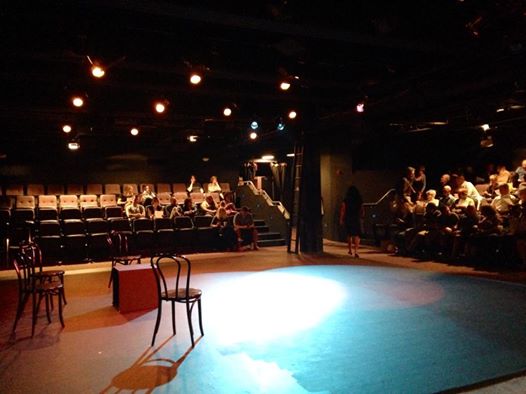
The theatre at Playhouse on Park. The photo was taken by photographer and director Kara Emily Krantz.
The director I will work with in an impressive young woman named Tasya Abbot. Tasya is a Theatre major from Hampshire College, focused on Shakespeare and Hamlet in particular. She is a veteran of the 24 Hour Festival–this is her third year directing. She is extremely bright but also poised in a way that no one her age has any right to be. We spend some time getting to know the cast: John Droney, Roy Donnelly, Rick Fiocco, Sabrina Herrera, and Ann Hutchinson. I like the personalities of the actors; they seem to posses that curious combination of confidence and anxiety common to all good actors. I feel very positive about who I am working with–I just need to make sure I write something worthy of their talents.
At 9pm, Tasya, John, Roy, Rick, Sabrina, and Ann all head home, and myself and the other three playwrights stay behind to write our plays. They are due at 7am. Dawn will stay with us the entire night, and will happily read our plays for feedback at any point we feel we need it. We each find a corner of the theatre and get to work while Dawn paints the stage floor! It’s going to be an industrious night for us all. I sit down and marvel at the fact I have ten hours to write a one act play that will be performed on stage 23 hours from now. For a moment, I wonder what would happen if one of us didn’t finish, and then it occurs to me: what if my play was about the fact that there wasn’t time to finish? I check with Dawn to make sure this isn’t an idea explored by a playwright at a previous festival, and she tells me two things I need to hear: one, it hasn’t been written before, and two, she loves the idea. I decide then that’s the play I am going to write.
I imagine three of the actors appearing on stage with random props, irritated and angry that they have no play to perform, and then discover to their horror that they are being watched by an audience. Just at the moment they are ready to panic, two other actors stroll on stage. They have a play, with dialogue, characters, a story…but the other actors do not. The three left out decide to create their own characters and integrate themselves into the play. So I need to script a play that gives the impression of being improvised by the actors. And it needs to be funny. At about 3:30, I show Dawn my draft. I ask her to tell me whether she thinks it works, because if it doesn’t I’ve only got three and a half hours to come up with something else. As Dawn reads, she is laughing and smiling. She tells me it works and that she really likes it. Relieved, I do a couple of more passes, title it “Unfinished” then head for home at 4am.
At 8am, Tasya, John, Roy, Rick, Sabrina, and Ann show up to begin working on the play, and I return at 12:30. Watching them work, I realize that my confidence in Tasya is well placed. She has a clear vision of what the play should be, and knows exactly how to get the actors there. It’s also clear the actors trust her, so I realize the best thing I can do is make sure I stay out of Tasya’s way. I also see that the actors are an extremely dedicated and skilled group who work hard all day through countless run-throughs and rehearsals, and then finally a full dress rehearsal. They even decide to run lines through the dinner break. I am honored to have my writing in the hands of such talented people.
Finally, at 8pm–24 hours after I met everyone for the first time–the play begins. “Unfinished” goes first and the cast absolutely nails it. They deliver the dialogue splendidly, fall easily into a rhythm, and perhaps most importantly, they seem to be having a great time. The audience responds extremely well to the play, so much so the cast has to pause a couple of times to let the laughter die down. When it’s over I am left feeling proud, exhilarated, and grateful. The other three plays are also quite good, so all in all the evening is a great success.
The 24 Hour Play Festival is exhausting, terrifying, intimidating, inspiring, invigorating, and one of the most challenging creative experiences I have ever had.
And I cannot wait to do it again.
The 24 Hour Play Festival
Beginning tomorrow, I will engage in what might be the most extraordinary writing challenge of my life. The Playhouse on Park Theatre in West Hartford, Connecticut will be hosting the 24 Hour Play Festival. While at first glance that sounds like a festival of around-the-clock plays, it is actually nothing of the sort. It is a festival in which a playwright, a director, and a cast of four have a single 24 hour period to write, rehearse, memorize, and then perform a one-act play before an audience!
Yes, you read that correctly. Friday at 8pm, I will report to the theatre to meet my director and cast. We will spend some time together getting acquainted and team building. After that, the cast and director will go home and I will get to work writing the play. It is due at 7am Saturday morning. When the script is finished, I get to go home and sleep (and anyone who knows me knows that the sleep part will not be occurring). At 8am, the director and cast will show up to begin rehearsing and memorizing my play. At 12:30 pm, I will return to work with my cast and director to help with costumes, props, and provide some technical assistance. Rehearsal work will continue through the afternoon, in addition to some script refining, followed by a full dress rehearsal. We will then all dine together, take a half hour to collect ourselves, and then…curtain!

The Playhouse on Park Theatre in West Hartford, CT. Host of the 24 Hour Play Festival.
So less than forty-eight hours from now, a play I have not yet written directed by someone I have never met featuring a cast I have never seen will already have had its premiere!
Is this insane? Absolutely! Can I wait for it to begin? Absolutely not!
So if you are in the area and want to support local theatre and enable mental illness, please come to the festival. It’s at 8pm on Saturday, August 2nd. Admission is only $10. Please see the Playhouse’s web site for directions and any further information: http://playhouseonpark.org/
I hope to see some of you there! Either way, expect a full report here next week…
Hombre Tortuga! – Part One
As I have mentioned in previous posts, I am a graduate of the University of California at Santa Cruz. At the time I attended, UCSC had some remarkable distinctions. It had no grade point average—most students were not given grades, but were instead given paragraph long narrative evaluations which clearly delineated their strengths and weaknesses. It was also a clothing optional campus; as a result “Naked Frisbee Guy” was a frequent sight at one of the colleges. It also has some exceptional and distinguished alumni—actress Maya Rudolph, filmmaker Miranda July, and writer Molly Antopol. If you are a uniquely talented female whose name begins with an “M,” UCSC is the place for you.
In spite of the fact I lacked those attributes, I still chose to attend UCSC. When I arrived in 1990, the city of Santa Cruz was still suffering the effects of the 1989 Loma Prieta earthquake. Most recall that earthquake from the images of the collapsed Bay Bridge or the interrupted World Series. Not everyone remembers that the quake’s epicenter was Santa Cruz, and its downtown commercial district was destroyed. When I moved there, many businesses were operating out of tents as they awaited insurance and federal monies to rebuild. Some didn’t survive. One of the predictable side effects of this hardship was a lack of employment opportunities and affordable housing, which is why I ended up taking an apartment in a place known as Beach Flats.
Santa Cruz was one of those odd places that had some of their poorest citizens living close to the water (some of its wealthiest citizens also, but not in Beach Flats). The Flats was largely a neighborhood of small aging houses and neglected apartment complexes dominated by South and Central American immigrants, most of whom worked picking up trash at the nearby beach boardwalk, cleaning toilets at one of the economy hotels, or busing tables and washing dishes at a busy chain restaurant.
Being one of the few non-Latinos in the neighborhood, it wasn’t long before the representatives of the underground economy found me. Usually, a young white man walking the streets of Beach Flats was there for one reason and one reason only: to buy drugs. The first few weeks after I moved in, I was frequently asked the question “Hey, you looking for something?” After the dealers realized that I wasn’t looking for something, and that I did in fact live there, they began to leave me alone.

This isn’t an actual photo of Zorro, but this is pretty close to what he looked like–sans the red ribbon.
I had another peculiarity: I owned a pet tortoise. The people in the neighborhood knew this about me because I would sometimes take my tortoise down to the local park and let him run around. He spent most of his life in a 3 X 3 box, and while he had plenty of food and water, and was kept warm with a red ultraviolet lamp, and seemed as happy as I suppose a tortoise could be, I still liked to let him out when I could. I would thus wrap a red ribbon around his shell, and let him wander through the grass and bushes of the local park. The ribbon was so I wouldn’t lose him in the shrubbery—a tortoise’s camouflage is remarkably effective.
Down at the park, there was always a contingent of Badass Latinos in their muscle shirts and hair nets, puffing on cigarettes and successfully conveying a “Don’t fuck with me” vibe. Whenever my tortoise would stroll past them on his way to some Indian Hawthorn he fancied, the Badass Latinos’ faces would light up like children at the zoo. They would all point and shout “Tortuga!” and race off after the little guy. Sometimes the tortoise would rush back over to me, and try to bury himself underneath my hip. It was the closest to cuddling I would ever get with a reptile.
Often, one of the Badass Latinos would wander over to me. The conversation was usually some variation on this:
“Man, is that your turtle?”
“Yes.”
“What’s his name?”
“Zorro.”
“Zorro! Man, that’s fucking hilarious! His name is Zorro!”
I didn’t realize it at the time, but not only was I giving Zorro some much-needed exercise; I was ingratiating myself with the locals. I discovered this in a surprising way one evening when it became clear one of my neighbors was trying to get my attention by shouting a phrase in Spanish:
“Hombre Tortuga! Hey, Hombre Tortuga! Donde estas?”
I had become Turtle Man.
“Relics”: A Poem for My Father
Those of you who follow this blog know this is about the time I disappear for a while. As the school year winds down, the tasks pile up, and something gives. It has been a particularly difficult spring–I can say without exaggeration that it has been the single most stressful year I have ever experienced as an educator. And is most often the case, virtually none of the stress has been caused by my students. There are some things to share about what has been happening, but all in good time. In spite of spring time habit of neglecting my blog, there has been much going on with my writing: in March, I was invited to submit my very first guest blogging assignment, and I did two readings in April. The guest blog post should see publication soon, and one of the readings I did in April is partly the genesis of this post.
I have written about my father before, and the influence he had upon me as an author. I have also told the story about how he stood up for me against an irrational principal–galvanizing in me a lifelong skepticism for authority figures. February is the anniversary of both my father’s birth (the 21st) and his death (the 9th). As a result, it is a difficult month, because I am always caught between how to celebrate his life and to mourn his death since the two are now inextricably linked. I decided a couple of years ago that perhaps the best thing to do is stop fighting that ambivalence–February is always going to feel like this, and I should learn to accept it. It was out of this thought that the poem below emerged. I have never published it, or attempted to, but I have no shared it at a couple of readings, and it’s always well received. So I will publish it here.
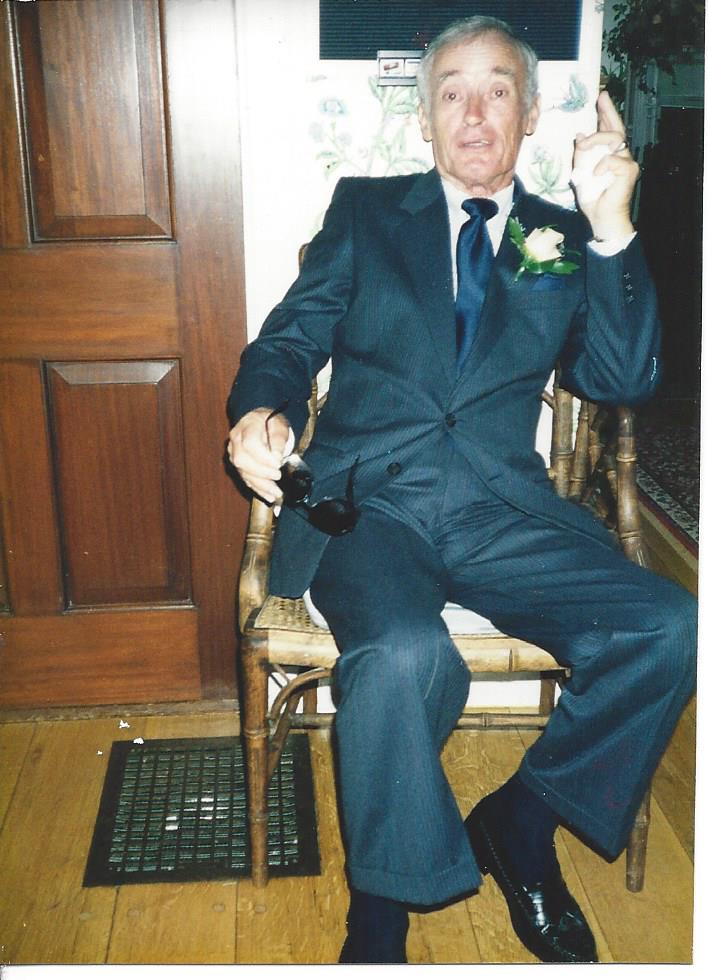
My father, photographed in July 2000. The last picture I have him before his death in 2003.
Relics
The package was nothing but white cardboard
held together with glue and clear tape.
It hadn’t even arrived special delivery.
He found it on the porch when he got home.
He used a letter opener
to sever the tape
and jumped
when the flaps popped straight up.
Hiding beneath layers of bubble wrap
was a metal container
the color of charcoal.
Inside that was a heavy plastic bag
filled with a gritty black dust.
The bag was clasped together
with a gold tag engraved
with his father’s name.
He pushed his way through the overgrown woods
to the river where his father fished as a boy.
He thought about birthdays that arrived
with no presents, or even phone calls.
But then he remembered the night
his father held his hand and spoke gently
explaining why Rick would just let Ilsa
fly off into the darkness.
Cradling the bag
in the crook of his arm
he smiled
wishing his father
had always been
this easy to hold.
Cold Hard Logic
Professor Otte had left me a message asking me to meet him at his office. As the Professor was teaching my Advanced Symbolic Logic class, I spent a lot of time in his office trying desperately to understand the class I was taking. It was a small class–there were seven of us, and I was the only undergraduate. The others were mathematics and linguistics graduate students. I had always been good at logic–I scored in the upper 5% on the logic section on the GRE–but I desperately wished the class had come with subtitles. I was sure Professor Otte wanted to discuss some assignment I had botched up, but that wasn’t why he called me (there is a another great story from this class, but I will share it next time).
The reason was a tutoring job. There was a student athlete over the hill at San Jose state who was taking a logic class, and needed tutoring from an expert. As there was no philosophy program at SJSU they gazed southward down route 17, across the Santa Cruz Mountains, and settled on Professor Otte for a recommendation. He selected me–the student struggling the most in his logic class. When I asked why not any of the grad students who clearly had access to the logic Rosetta Stone that I did not, the Professor told me that he thought I had the best social and communication skills in the class, and would therefore be a better teacher. Given the social awkwardness that hung over the class like smog in the San Fernando Valley, his compliment struck me as equivalent to being called the thinnest kid at fat camp. Or the finest ballerina in Galveston. But I could use the extra money, and I was curious to see how well I could communicate logic to someone who actually knew less than I did. So I accepted the job. (Of course, now I teach philosophy and logic to high school students, so guess what, Professor? Your instincts were good.)
So I climbed on to my 250cc Honda Helix motorcycle (shoving by long-haired, scraggly bearded self under a helmet and climbing on the Helix to teach logic was about as badass as I ever got) and headed over the mountains to San Jose. I was greeted at the door by a middle-aged and very kind Japanese couple, who expressed warm gratitude that I had traveled to help their daughter succeed in the logic class. I was ushered into the living room, fussed over, brought green tea and bean cakes, and treated like a long-lost nephew. Finally, my student arrived, and I felt my heart skip a beat when I saw her. She was beautiful, and had probably the kindest and most welcoming smile of any woman I had ever seen. Unlike other instances when I have been surprised by a beautiful woman, I kept my cool.

Hey, she looks familiar!
The parents bid a hasty retreat, and left us alone to do our work (but not so alone that the parents weren’t within ear shot in the room adjacent). I quickly saw that she was taking a Formal Logic class, and that while she understood it, her athletic schedule was causing her to miss significant class time. I noticed her text was Patrick Hurley’s “Introduction to Logic”–a book I knew well from two logic classes I had aced. I thus felt supremely confident that I could be a very effective logic coach.
And she was an excellent student. She immediately picked up the difference between Modus Tollens and Modus Ponens, could design Hypothetical and Disjunctive Syllogisms at the drop of the hat, and even mastered the Reductio Ad Absurdum. She could easily identify the difference between deductive and inductive logic, grasped the nuances of necessary and sufficient condition, and wrote truth tables with such skill it would have even made Wittgenstein proud (once he was done lambasting us for studying philosophy after him). She was a natural, and really seemed to enjoy mastering the material. We had a great time–it was one of the first moments in my life when I really felt the joy of teaching.
On one of my last visits to the house, I passed by her trophy case–it was packed with awards from her career as an ice skater. I paused to admire her accolades, and then turned to her and said something really insightful, along the lines of ‘Wow. You’re really good!” to which she humbly replied. “I do all right.” We made some more small talk, and then I headed home.
After my very last visit, when I felt confident my protégé would nail her final exam, the whole family came out to say goodbye. Dad handed me an envelope which I would discover contained a bonus for all my efforts, and as I pulled away I glanced back at the house to see them waving to me from the front stoop. I remember wondering if I would ever see them again.
I did–but it wasn’t until the following January when I happened to be watching the Winter Olympics and realized that my student was a star athlete by the name of Kristi Yamaguchi. I watched her win the gold medal that year, adding a powerful exclamation mark to a career that has also included thirteen world and national championships.
Oh, and one “A” in Formal Logic.
 Danger Is My Business