A Twenty Year Retreat
For nearly two decades, I have been attending the annual Martin Luther King weekend writers’ retreat at Mercy-by-the-Sea (a Catholic retreat center) in Madison, Connecticut. The retreat was originally organized by the members of Still River Writers, the writers group I have been with since April of 1998. Despite the fact that the retreat moved from Madison to Enders Island (another Catholic retreat center on Long Island Sound) for a few years and has occasionally shifted to President’s Day weekend, this retreat has been a constant in my life over the last twenty years.
The building we occupy at Mercy is called Seascape. It is different from the rest of the buildings on the campus, partly because it is newer than the other structures, which tend to be dark and monastic. Seascape is brighter, painted in pastels, with several large windows to view the sea and welcome the sun. It also feels more like a private residence, because unlike the rest of Mercy, it was–Phil Donahue and Marlo Thomas once called it home. When they decided to relocate from Madison, they donated the building to Mercy.
Due to my proximity to Mercy and my work schedule, I am usually the first to arrive. After I settle in and unpack, I make myself a cup of tea and enjoy the views. I like to pretend it’s my own personal beach house until someone inevitably arrives to shatter the illusion. It is always fun while it lasts…
Over the years, I have forged a number of wonderful, enduring relationships which have helped me grow both as an author, but most importantly, as a person. The exposure to all of the poets, prose poets, novelists, short story authors, non-fiction chroniclers, memoirists, playwrights, screenwriters, and songwriters over the years have influenced me in ways I am only just beginning to understand.
In that time, I have written five screenplays, one teleplay, four stage plays, a few dozen poems and a handful of essays. I have won thirteen awards, was twice nominated for the Pushcart Prize, published some of the poems and essays, and began blogging. I have also optioned two of my screenplays, seen three of my one acts produced, held a staged reading for my full length play in New York, and found an agent. I sincerely believe that none of that would have occurred without the annual retreat providing me with lengthy blocks of time to write, helpful feedback from peers, and a confidence that has increased with each passing year.
And I tend not to waste those blocks of time. A few years ago, a wrote the first draft of a 95 screenplay over one of these weekends; my roommate had to excuse himself and write elsewhere because he found it exhausting to be in the presence of such mania. I can’t really say I blame him. I also wrote the first draft of my full length stage play “Invincible Summer” at Seascape, and this year wrote 40 pages of my new play–and I am quite happy how it’s turning out.
Of course, the retreat is also where I met the woman I love–fifteen years ago! To say that our lives have changed since that first meeting is to significantly understate the matter…
We can at times look back over the years and reflect upon a decision that radically shaped the trajectory of our life. My decision to attend my very first writers retreat during the waning months of the Clinton Administration unequivocally falls into that category.
Why Unions Matter, Part Four
To finish up this series, I am going to address many of the most common objections about unions, and show why these either don’t hold water, or are based upon misconceptions. There are many; I am going to focus on the five most common I encounter in opinion pieces, views expressed to me in person, and social media posts.
-
- People needed unions in the past, but not today. I think my discussion of the costs of neoliberal economic policy has debunked this, but just to sum up: wages are in decline, the cost of living has increased, profits are at record highs, both of which can be directly attributable to the decline of unions beginning in the 1970s. If it were true that unions were no longer necessary, then the decline in union membership would lead to an increase in wages and quality of life. In fact, the opposite has occurred.
- Unions obtain benefits for themselves other workers lack. Why should they get special treatment? My usual response to this is: if you work in an industry where some of the workers are unionized, and others are not, and you find yourself in the latter category, then… why aren’t you unionized? Chances are that union you resent would be very happy to have you as members. Furthermore, the assumption that unions get “special treatment” is not a valid one; unions get fair treatment for their employees. If you find yourself resenting union benefits, it’s likely because you are not being treated fairly. Lastly, even if you are non-union in a heavily unionized industry, you do benefit, because that union tends to drive the wages and benefits up. A nonunion employer still has to compete the union employer. I knew someone who was a non-union ER nurse, and her wages and benefits were very strong because most of the nurses in her town were unionized.
- I’m a non union salaried professional who has to work with union employees. Their contract lets them go home before me and my assistant makes more than me. How is that fair? Simply put, it’s not fair. But the problem may not be the union contract, it might be yours. If you are expected to work more than a forty hour work week, and your are not paid more than your assistant, then I don’t think you received a fair deal. I think the problem is your employer taking advantage of you. Too bad you are not in a union…Additionally, as a salaried professional, you probably think of your job as a career. To many blue-collar union employees, they have a job. They aren’t doing it because of their dedication to whatever industry you happen to be in. They want to put in their 40 hours and go home to their families. That, frankly, sounds much healthier than working 60 hours a week and collapsing onto your bed for a restless night sleep. And if that’s the only way you can get the job done…then the problem is your employer.
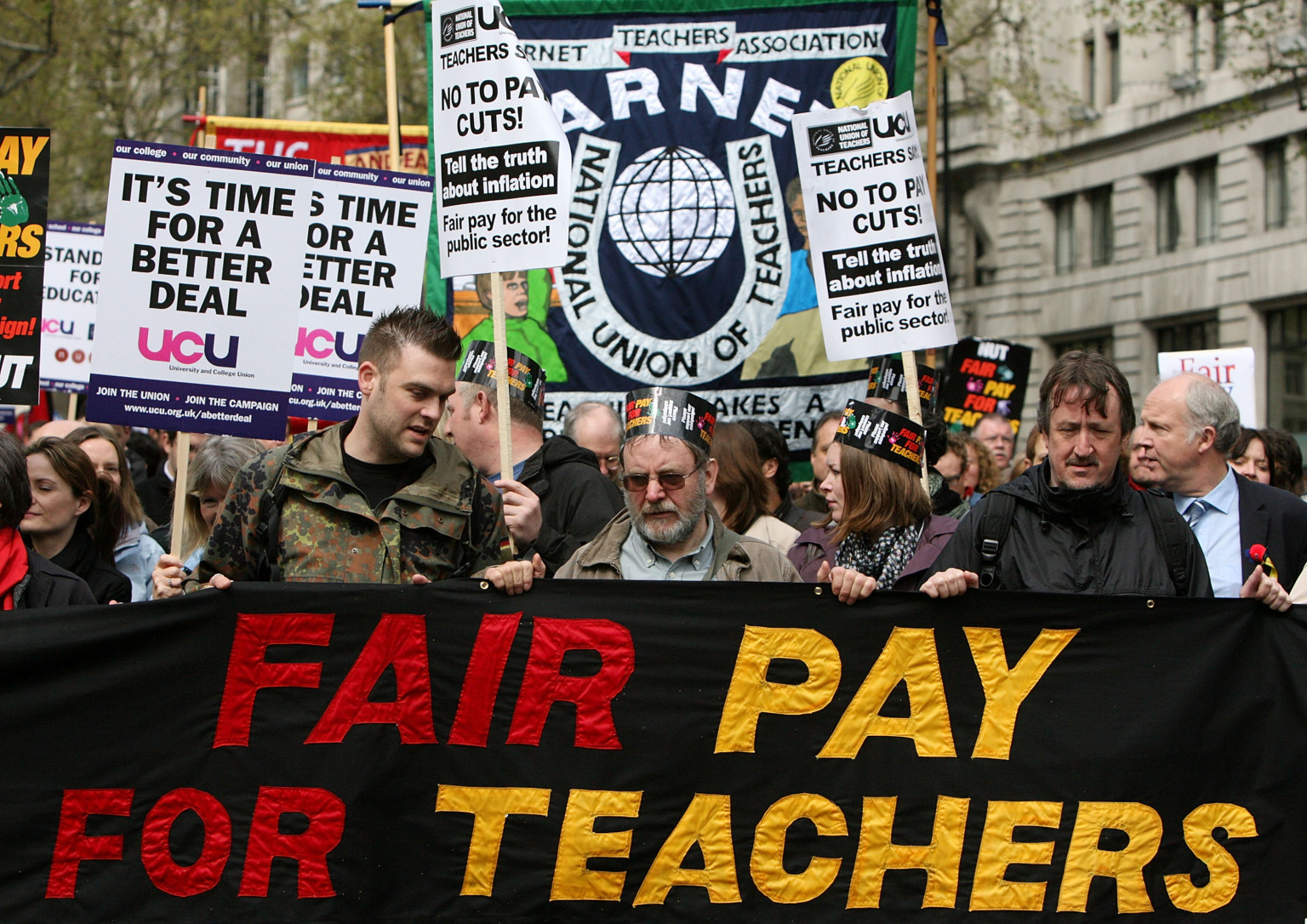
- Unions protect incompetent workers. There is some validity to this. As a teacher, we often hear this common objection We are told it’s impossible to fire union teachers, or state employees. And yes, just cause clauses and due process procedures do make it harder to dismiss contracted employees. But it is hardly impossible. If an administrator or supervisor feels that an employee is not doing their job, they can follow the process and have them dismissed. They just have to be able to document the problems. An attentive, competent leader should be able to do that–and usually they succeed. Many supervisors, however, don’t want to bother. Or those that do fail to follow procedure. If that’s so, the issue isn’t the bargaining unit–the issue is leadership. School reformers spend a great deal of time discussing the problem of teachers in schools, but rarely discuss administrators. Any teacher will tell you that there is a dearth of good leadership in schools. Administrators are often failed teachers, who by definition, tend to be poor leaders, or individuals with business backgrounds and no educational experience. As a result, they are largely ineffectual. A few years ago, I worked with a teacher close to retirement who ceased to read the work handed in to him. He would assign a grade based largely on how he felt about the student, but never read their work. Students would intentionally put silly messages in the work to see if he noticed; he never did. This was common knowledge at the school, and students complained about it. The school leadership could have done something about it, but they chose to ignore it. And while certainly the teacher’s behavior was on him, it wasn’t his union contract that protected him. It was poor leadership.
- Why do you need due process, anyway? The era of sweatshops is over in the United States. First of all, I’m not sure I’d say that to a fast food employee. Or, someone working in a garment district…in a sweatshop. Aside from that, though, due process protects employees from personal vendettas and incompetence. If you think neither are a real problem in the workplace, then I suspect you are not actually employed. I have had colleagues had their lives turned into a living hell due to the personal vendetta of a superintendent. I have also had many female colleagues made uncomfortable by a sexually inappropriate male colleague who held power in the district. A colleague in another district was falsely accused of an inappropriate relationship with a student, and another was disciplined for the poor performance of students she didn’t actually have in class. Whether these incidents were the result of vendetta or incompetence is not always clear. Regardless, due process offers union employees a level of protection. Keep in mind: I work in a school. I am supposedly surrounded by intelligent, educated people. So if it happens there, it can happen anywhere. All workers should be entitled to some level of due process. If most employees do not have this protection, the solution is not to eliminate it for those that do have it. Of course, there are some laws that can protect non-union employees from some of these situations. How, then, did those laws get on the books? Union organizing.
In these last four posts, I have attempted to make it clear why unions are still important today–arguably, as important today as they have ever been. As human institutions, they are by definition imperfect, but I think the historical and economic evidence make it clear that they have done more to benefit working and middle class people than just about any other force in history. And that, more than ever, is why individuals with power and wealth have worked so hard to discredit and dispose of them.
The truth is, they have nearly succeeded. The only thing that can stop them is us.
Why Unions Matter, Part Three
I think its easy to see how neoliberalism would put a giant stake through the heart of private sector unions. But what would be the advantage of breaking public sector unions, if they were not affecting the profit margins of a private enterprise? Why such economic (and actual) hostility?
There is no one answer this question. The answer is as complicated as it is multifaceted. I will do my best to break it down as follows:
- The Libertarian Objection: Many conservatives have accepted the libertarian/Randian perspective that there is no such thing as the collective good. There are only individuals. If you accept that as axiomatic, then collective bargaining is hostile to your view of economics and liberty. You already think of tax collection as theft. The idea that tax money would therefore go to pay unionized workers is unthinkable. As former Libertarian Party candidate Gary Johnson described it, “all services should follow the Uber model.”
- The Taxation Objection: The bastard child of the Libertarian Objection, this is the idea that government should be smaller, deliver fewer services, and charge little or no taxes. Unionized workers bargaining for contracts that include cost of living increases and health insurance make it difficult to keep those precious taxes lower. So, eliminate unions and their contracts, and you can, as Grover Norquist put it, “Cut government…down to the size where we can drown it in the bathtub.” It is this philosophy that has motivated the likes of Scott Walker and Rick Snyder to help crush collective bargaining in their pro-labor states. You cannot cut taxes for the wealthiest residents of your state and balance your budget without cutting spending. You can cut spending if your public sector workers have their salaries and benefits cuts. That can’t really occur until you either dispose of (or signifantly hamper) collective bargaining.
- Fear of Solidarity: As the Powell memorandum makes clear, businesses, multinational corporations, and the wealthy believe it to be a moral imperative to concentrate their power. The biggest threat to that concentration is unionism. Public sector workers have, by and large, been popular and provide services many citizens depend upon. Becoming a unionized public sector worker has also been a common path for working class Americans–especially people of color–to join the middle class. If being in a union is aspirational, that makes it a threat to wealth and power, public or private sector. You remove that opportunity, it ceases to be an aspiration. Wages are down, taxes are down–and profits are at record highs. This is not an accident, or the result of the “Invisible Hand” of the market place. This is engineered through legislation and litigation.

Another factor at play here is the distinctions between public sector employees. Many public workers will be attacked and devalued by corporate media, with two notable exceptions: police and fire departments. The Janus v AFSCME decision affects these unions as well, but there is far less anxiety expressed from those bargaining units. Part of the reason is that many police and fire departments tend to donate funds to Republican candidates, whereas other unions tend to support Democrats (for reasons I will get into in part four). The other reason is that police and fire provide a service that the wealthy value over all the others: they protect property.
It’s easy for corporate media to trash teachers, bus drivers, public health care workers, and public college professors, because those with wealth and power will never use their services. If they are of no use, why pay for them? But they have use for police officers and firefighters, so their collective bargaining units are tolerated.
Former journalist and current charlatan Campbell Brown for years has worked to try to privatize education–which cannot happen until the unions are gone. Ms. Brown has sadly, run out of valid arguments to make her case, so she usually defaults to the charge that teachers unions “protect child molesters.” What she is referring to is the due process rights public sector employees (and some private sector union members) have if if they are accused of misbehavior. Police officers also have these due process rights, but Ms. Brown has yet to accuse police unions of “protecting child murderers.” It would seem there is a double standard at work here.
Economists Joseph Stiglitz, Dean Baker, Paul Krugman, and Thomas Pikkety have made it clear in their research that the higher standard of living brought about union contracts not only created the middle class, but the investment in public sector unions has injected billions of dollars into the economy. Simply put, people with economic security spend more, which stimulates all of the other economic sectors. These sectors function as a tax base, so the state’s investment pays itself back countless times over. As a result, the economy grows and wealth is generated. There is a problem, though–the wealth is not concentrated into the hands of the few. It is those hands that have worked so hard to reverse the tide–and Janus is their most recent victory.
In part four, I will refute some of the most common objections to the existence of public sector unions.
Why Unions Matter, Part Two
It’s unclear how many at the time took Lewis Powell’s memorandum seriously. What is not in dispute, however, is that what occurred in the subsequent decades makes it clear that business and corporate leadership began to behave as if they were following Powell’s suggestions.
Between 1970 and 2014, the United States lost over eight million manufacturing jobs–five million of those since 2000. The vast majority of these jobs, or course, were union jobs. This would make sense if this decline of manufacturing was coupled with a decline in consumer spending and Gross Domestic Product (GDP), but the opposite is true. What happened?
Many argue that the issue is automation–the replacement of industrial laborers with robots and other improved technologies. Economist Dean Baker, though, makes the case in his book “Rigged” that there is no evidence for that assertion. Simply put, automation does not account for the amount of job loss coupled with the increase in GDP (which now stands at over $19 trillion). What would account for it, then?

The answer is simple: globalization. Most of those manufacturing jobs have been lost to overseas firms in the developing world, wherein wages, benefits and regulations are significantly less expensive. American workers earning cost-of-living wages simply cannot compete with the poverty wages of a teenager from El Salvador.
Thus, the process becomes two-pronged: first, you ask high wage union workers to accept wage freezes, reduction in benefits, shorter shifts, etc. to keep costs down. If the union doesn’t accept the terms, then the factory is moved, and all workers are out of a job (not to mention all of the service workers in the factory towns who will be thrown out of work due to a decrease in economic activity). So, the unions accept the pay cuts in hopes of keeping their jobs, only to lose them anyway when the factory closes a few years later.
This is the thing to keep in mind: the auto, textile, steel factories, etc. that shuttered their doors to move their operations to cheaper developing world outposts were all turning profits at the times of the plant closings. Most in the hundreds of millions, a few in the billions. But stockholders have to be satiated, so the plants were closed, profits rose–and wages fell.
Part two: the transition from a manufacturing economy to a service economy. Service jobs tend to be low skilled, highly compartmentalized, and easily replaceable. As a result, service jobs are usually low wage. The combination, then, of globalization and the expansion of the service economy has pushed wages down to the extent that a minimum wage worker today earns less than 3/4 the wage value as a minimum wage worker in 1968. Of course, that statistic wouldn’t be troubling if today’s cost of living was 3/4 what it was in 1968. But it’s much higher. That drastic change cannot all be attributed to some assembly line robots.
This is why the idea of a minimum wage set at $15 is not unreasonable: what is being requested is the equivalent of a five dollar increase spanning the last fifty years. To put it another way–one dollar per decade. That’s ten cents a year. By that standard, a $15 minimum wage request nearly qualifies as conservative.
Lower wages have also produced this consequence: many Americans who are employed full-time at low wage service jobs still qualify for public assistance. The federal government last year spent $6.2 billion providing welfare benefits just to gainfully employed citizens. This amounts to a subsidy to multi-billion dollar multinationals who can’t be bothered to pay their employees a living wage.
This is the legacy of Neoliberalism. It is important to remember that theses are policies not limited to Republicans, as the presidencies of Carter, Clinton, and Obama can attest.
With the destruction of private sector unions and a reduction in the real value of wages, there was still one target left for Powell’s disciples: the unions of the public sector. Undermining these collective bargaining units would prove to be more complicated.
Why Unions Matter, Part One
The recent supreme court ruling in the Janus v AFSCME decision has dealt a serious blow to both public and private sector unions. The ruling appears only limited to public sector unions, but rest assured, it will have an effect on private sector unions as well.
Over the last few decades, public and private sector unions have been under attack by a number of forces: politicians (not all right-wing; some are moderate Democrats), wealthy organizations like Americans for Prosperity (funded by the libertarian Koch Brothers), the American Legislative Exchange Council, not to mention the entire neoliberal economic process. Unions for years have been the path for working class Americans to enter the middle class. Unions have worked to raise wages and the standard of living not just for their members but for all workers. Protections we sometimes take for granted such as overtime pay, workman’s compensation, laws regulating child labor all exist because of unions.

Given that unions have managed to create a system wherein working and middle class Americans benefit financially from the country’s prosperity, it’s not difficult to see why they would become a target. If you run a corporation, your primary function is to maximize wealth for your shareholders. One of the ways you do that is by cutting labor costs. If there are organizations of workers who collectively bargain for a fair share of the pie, that’s less money for the shareholders. That’s how a corporation functions. That’s why only 7 percent of workers in the private sector are organized into a union. To understand why these same organizations who don’t want private sector unions also turn their attention to public sector ones, we need to go back to the beginning.
The Birth of Neoliberalism
From the post war era through the late 1960’s, the United States had become the wealthiest nation in world history. Thanks to unions, workers shared in that prosperity: over 28% of the workforce was unionized. To many business and political leaders, this was intolerable. This concern was characterized by corporate lawyer and soon to be supreme court justice Lawrence Powell. In 1971, Powell felt compelled to assert, in a memo that was to help galvanize business circles, that the “American economic system is under broad attack.” This attack, Powell maintained, required mobilization for political combat: “Business must learn the lesson . . . that political power is necessary; that such power must be assiduously cultivated; and that when necessary, it must be used aggressively and with determination—without embarrassment and without the reluctance which has been so characteristic of American business.” Moreover, Powell stressed, the critical ingredient for success would be organization: “Strength lies in organization, in careful long-range planning and implementation, in consistency of action over an indefinite period of years, in the scale of financing available only through joint effort, and in the political power available only through united action and national organizations. ”
In short, ordinary people were becoming too powerful, and that had to stop. What’s one of the ways you stop them? Attack the organizations that give them power.
Get rid of their unions.
Summer Check In
I had planned to write a blog post about the writing I had managed to complete, but it occurred to me that my summer has been so much more. Thus, invoking the spirit of the Harper’s Index, I present my Summer So Far:
Number of scripts completed: 4
Number of books read: 4
Number of turtles rescued from the road: 4 (It might actually be three–I think I rescued the same one twice. Hard to know with turtles.)
Number of concerts attended: 2 (Michael Franti and Brianna Thomas with Wycliffe Gordon)
Number of times running into Michael Franti in line at a food truck: 1
Trips to the New York Botanical Garden: 1
Number of plays I have written staged by an acting company that failed to invite me to their performance: 1
Trips to Rochester, NY to celebrate my girlfriend’s mother’s birthday: 1
Number of household organizing projects completed: 7
Number of end tables assembled: 1
Number of framed pictures hung: 2
Number of terrifying documentaries (“Three Identical Strangers”) seen about a social experiment to separate twins at birth: 1 (that’s plenty)
Number of kayak trips on Lake Taghkanic: 1 (that’s not enough)

Number of pounds lost: 8
Number of attended midnight showings of “The Room,” possibly the worst film ever made: 1
Number of spoons thrown during screening of “The Room:” Too many to count
Number of classic TV Series binge watched: 1 (“The Prisoner”)
Number of blog posts written: 2
Number of girlfriend’s granddaughters: 2
Number of girlfriend’s granddaughters who are awesome and so much fun to spend time with: 2
Number of camping trips I had to back out of due to poor health: 1
Number of Parkinson’s clinical trials participated in: 1
Number of gardens planted in girlfriend’s back yard: 1
Number of sumac trees cut down in girlfriend’s front yard: 14
Number of experiences of sumac poisoning: 1
Number of accidental compost fires: 1
Number of therapeutic massages: 5
Number of doctor’s appointments: 5
Number of yoga stretches, boxing punches thrown, acupuncture needles received, underwater exercises, great meals, cups of tea, hugs, kisses, doggie cuddles: Too many to count.
Times I felt loved like I never have before: every second that passed.
Armed, and In Charge of a Classroom
Many have asked me about President Trump’s recent suggestion to arm school teachers as a method of deterring and responding to school shootings. My intuition is that it’s a terrible idea, but I decided to listen and consider all of the arguments being put forth in support of this proposal. To paraphrase a philosophy professor I once had: I have considered what you have to say, and I’ve decided I’m still right.
British thinker W.K. Clifford was a proponent of an idea called Epistemic Responsibility: in short, one should not hold a belief if there is no evidence to support it. Bertrand Russell echoed this sentiment when he observed that “It is undesirable to believe a proposition when there is no ground whatever for supposing it to be true.” So what does the evidence tell us?
In a piece headlined “Guns Do Not Stop More Crimes, Evidence Shows,” Scientific American quoted physician and gun researcher Garen Wintemute’s summary of the state of the evidence: “There are a few studies that suggest that liberalizing access to concealed firearms has, on balance, beneficial effects. There are a far larger number of studies that suggest that it has, on balance, detrimental effects.” Daniel Webster, director of the Johns Hopkins Center for Gun Policy and Research found that “The more guns are readily available, the more shootings occur. That’s what the latest research shows. When states make it more easy for people to carry guns, the number of incidents of aggravated assault grows.” University of Washington epidemiologist Fred Rivara observed “There is no data supporting [the] argument that the further arming of citizens will lessen the death toll in massacres like [Newtown]. Mother Jones magazine, which maintains a database of mass shootings, pointed out that despite a 50 percent increase in the number of private guns since 1995 and numerous laws making it easier to carry a concealed weapon, there are virtually no cases of an armed civilian stopping a shooting spree. (Thanks to Jim Naureckas of Fairness and Accuracy in Reporting for compiling this data).

Of course, there are some anecdotes about shooters stopping a home invasion, and that’s certainly not to be dismissed. However, there is a difference between using a weapon to stop someone entering your home and having the presence of mind to stop a mass shooter in a public place with people screaming, scrambling for safety, and AR-15s blazing away. Training someone to use a gun does not automatically suggest they are going to be grace under pressure. We’d all like to think that we will be cool and calm, but the fact is, not everyone is going to be. Consider that the New York City Police Department–arguably the best trained police force in the country–only has an 18% success rate when discharging their weapon. It’s hard to imagine the Math Department doing any better–and easy to imagine them doing much worse.
This also raises the issue of police entering a school in an active shooter situation. They will have a split second to decide who is the “good guy with the gun” and the “bad guy with the gun.” It may not always be obvious, and there will undoubtedly not be time to carefully weigh the evidence. The Daily Show’s Jordan Klepper explored this in a piece a couple of years ago. It’s worth watching here: Good Guy With a Gun.
There is also, as President Trump has said, the issue of deterrence. He insists that shooters are attracted to the fact that schools are gun free zones–never mind that night clubs, country music concerts, malls, and movie theaters are not gun free zones. The other issue is that the vast majority of school shootings have ended with the shooter’s suicide. Someone suicidal is unlikely to be deterred by the increased likelihood of their own death.
The entire notion of guns as a deterrent is suspect as it is. We are told by Wayne LaPierre and Dana Loesch that we will feel safer with armed civilians in our schools, coffee shops, baseball games, etc. I certainly didn’t feel safer on a tour of Mesa Verde with the guy next to me wearing a sidearm and a KKK tattoo–and I imagine the Navajo tour guide wouldn’t have felt any safer if he had known. Furthermore, if large numbers of African-Americans, Muslims, Sikhs, and South Asians begin going through their days armed, one can be certain the NRA narrative would change almost instantaneously.
Of course what this comes down to is money. If the percentage of armed teachers President Trump has suggested were to come to fruition, that would be 700,000 more guns. This would be a spike in gun sales that would make the gun manufacturers–the NRA’s largest source of financial support–ecstatic. The gun manufacturers are already worried: since Trump was elected, the Second Amendment crowd is no longer afraid their weapons will be confiscated and gun sales are way down. This is the reason that the NRA has tried desperately to play up the violent threat of Black Lives Matter and Antifa. A new enemy must be found.
And if they can’t be sold as credible threats, then I suppose my students will just have to do.
Landing an Agent
To many authors, the search for an agent or manager begins to resemble the quest to locate a mythical creature. One may come to think they have a better chance of locating a Roc in its natural habitat.
Certainly, this was my case for many years. And like many success stories of this genre, it came about due to the confluence of hard work and good fortune.
First, the hard work: Over the last fourteen years, I have completed five screenplays, one teleplay, three one-act plays, and one two act play. And two novels. Plus, nearly 100 poems. That’s a lot of writing. It may not be Alexander Hamilton (or L. Ron Hubbard) prolific, but given I have worked as a teacher each of those fourteen years whilst battling Parkinson’s, I’ll take it. Most of my dramatic writing I have brought to the playwright’s lab at the Pulse Ensemble Theatre in New York City.
The woman who runs the lab is a superb screenwriter and playwright—Ms. Lezley Steele. She is also an excellent teacher. When you workshop a script with her lab, you always get superb feedback. Plenty of criticism, of course, but it always comes with ideas on how to fix the problems, and praise for what does work in your script. I always left the lab feeling that no matter how much revision I had to do, I was capable of doing it. Most of the playwrights I’ve met who know Lezley agree—no one gives better feedback.

Ernest Thompson
I am also proud to call Lezley my friend. Our friendship has allowed us to stay in touch and encourage each other through both our creative endeavors, and the roadblocks life sends our way. When I had completed my two act play, “Invincible Summer,” Lezley was kind enough to read it. She has actually read multiple drafts, always providing me with her high level of advice. After one of the revisions, she announced much to my surprise that she would like to send my play to her agent.
I was flattered, but also cautious. Even if he agreed to read it—which he may not—there was no guarantee he was going to want to represent me. Soon thereafter, Lezley informed me that she had contacted her agent and he was willing to read it. Thus, I sent off my play to Mr. Earl Graham.
And then I waited.
One day in March, I walked outside my school building and noticed a voicemail on my phone. A number I didn’t recognize. A New York exchange. I played it back: it was Earl, wanting to talk to me. As my dear friend Darlene put it: “He’s not calling to tell you he hates it.”
Jason Miller
Indeed, he called to tell me he loved it and wanted to help get it placed in a theatre. He also wanted to meet me for lunch soon. So, during my April vacation, I took the train down to the city and had lunch with my agent. I’ll be honest—I love that I get to say that.
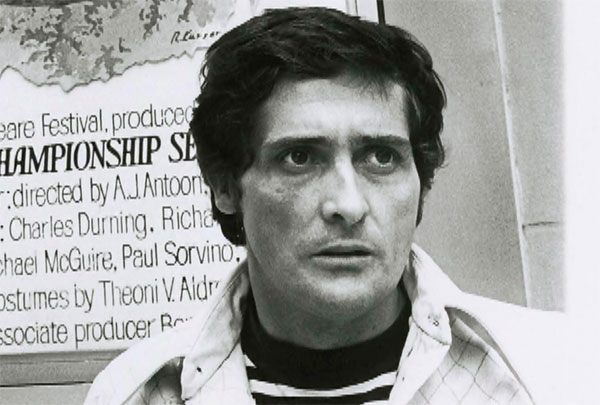
Earl is an incredibly warm man, who told great stories about his career in theatre, his life in New York, and the fascinating people he’s known. I learned that he has represented some impressive clients, such as Ernest Thompson (“On Golden Pond”) and Jason Miller (“That Championship Season”—also Oscar nominated for playing father Damien Karras in “The Exorcist”) He reiterated how much he loved my play, how much his assistant loved it , and how much his partner did. He was also clear—it is very hard to get a new play in a theatre. It would likely take a while, and it may not happen at all. I need to be patient and have realistic expectations. But if he could get someone to read the first twenty pages, he felt strongly they would be hooked–like he was. I understood the challenges he laid out, but I am still grateful to have this man in my corner.
After Earl agreed to take on my play, I had planned on contacting Lezley to tell her. It appears though, Earl beat me to it. I opened my in-box to find this message from her:
Earl called me today with the wonderful news that he is going to work on getting your play done. He thanked me for sending him a beautiful play. He said he cried when he read it. I am so pleased. I’ve given him other playwright’s plays before (just a few) and he has had no interest in them. So I had my fingers crossed.
And even though it annoys her when I tell her so, I will always be grateful to Lezley.
On the Passing of Robert Hardy (1925-2017)
Many Americans are unfamiliar with the name Robert Hardy. Some Harry Potter fans will recognize him as the actor who portrayed Cornelius Fudge, the Minister of Magic, in several Potter films. My familiarity with him goes back much further.
When I was in junior high school, I became an enthusiast of the “All Creatures Great and Small” book series by James Herriot. I was equally enthralled by the BBC television adaptation which ran for seven seasons, spread out over thirteen years. Robert Hardy played the relentlessly memorable character of Siegfried Farnon. Siegfried was a superb veterinarian, highly skilled and competent at his job, but was also plagued with a poor memory. He could be stubborn and self-righteous, yet kind, generous and charming. He was always unwilling to accept blame for his mistakes, yet was an incredibly patient and effective teacher and mentor. In short, he was a complex and multidimensional character. Hardy sank his teeth into this splendid role, and put on what my father would describe as a “clinic in acting.”
“Watch carefully,” my father directed as we watched an episode. “Notice the shifts in his facial expressions, the changes of tone in his voice. The subtle adjustments in body language.” My father went on to explain that these were not an actor’s choices, but instincts—they couldn’t be taught. All the great actors had them, and the best part was the audience was usually unaware of these actions; they just knew the actor was good. I developed an affection for Hardy, the character he played, and the series itself. It is the only television series of which I posses each and every episode.
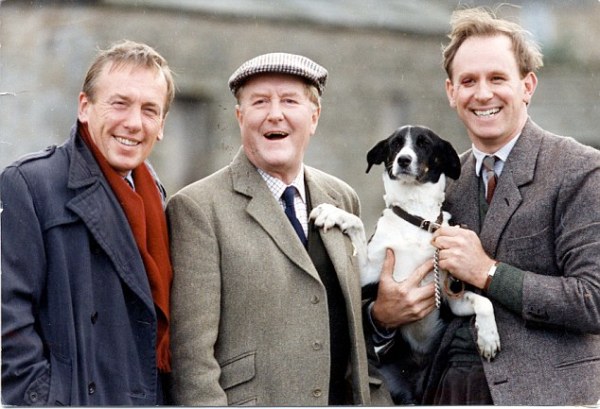
Hardy, flanked by his “All Creatures” castmates Christopher Timothy and Peter Davison
But Hardy was so much more than that. He made a name for himself as a young man playing “Henry V” on stage. His research into Henry became so extensive Hardy ended up writing a book about the Battle of Agincourt. He also became so fascinated with the longbow–a key to British victory in that battle—that he became one of the United Kingdom’s leading experts on the weapon. While a young student at Oxford, he had the good fortune to study with both J.R.R. Tolkien and C.S. Lewis. He also befriended a drama student named Richard Burton. They would remain close friends until Burton’s death. One of Sir Richard’s biographers described Hardy as Burton’s “sane friend.” Lord knows the man needed one.
He also played Winston Churchill countless times on television and stage (including a one man show in Paris—in French). Many accomplished actors have given great performances as Churchill. None of them were better than Hardy. None of them.
Perhaps more important than any of that, Hardy was a kind man, generous with his time. I know this personally. Last year, I read on the BBC website that Hardy would soon turn 90. I had always wanted to write him a letter, and express to him my appreciation, and I thought—if I’m going to do it, I should do it soon. I located his representative on IMDB, and mailed the letter.
A few months later, I received a reply. That was surprising enough, but the letter he sent me was hand written. A few excerpts, subject to handwriting interpretation:
“My Dear Fellow,
Thank you so much for your letter. I am always delighted to hear from my American friends, and surprised when they fail to mention Harry Potter! I am thrilled my work on “All Creatures” meant so much to you. It was a brilliant show, and I am very proud of my association with it. I especially enjoyed your description of what your father said about my acting. How wonderful it must have been to have a father who enjoyed and knew the arts. While I am very sorry he passed away so young, always be grateful his last words to you were an expression of pride. Most of us are not so fortunate…
Given what you describe as his great love of words, I imagine your father was a reason you became a poet and a playwright. I therefore have no doubt he is still very proud of his son…”
Very truly yours,
Timothy Sidney Robert Hardy.”
Adieu, Siegfried. Rest in peace.
Staging an “Invincible Summer”
And now for some good news. This happened back in October, but I seemed to have difficulty finding the time to write about it. The wait is over…
On October 9, 2016, at the DeSotelle Theater in Manhattan, I experienced the very first staged reading of my play “Invincible Summer.” It was a great to have a play that had been rattling around in my head for a year and half finally performed on stage by actors, under the tutelage of a veteran New York theater director. I learned a great deal from the process, and I am so grateful to have gone through it.
It all started last January, when a friend of mine named Larry Leinoff (who is also an excellent playwright) expressed admiration for my play and encouraged me to stage a reading. He felt it was ready, and it also happened that Larry runs a company (Stage Dot Org) that puts on staged readings! We talked back and forth for months while I worked on the play, received feedback from Larry and others (including a dear friend and another great playwright, Lezley Steele). By early summer, I was happy with the play and ready to begin organizing my reading.
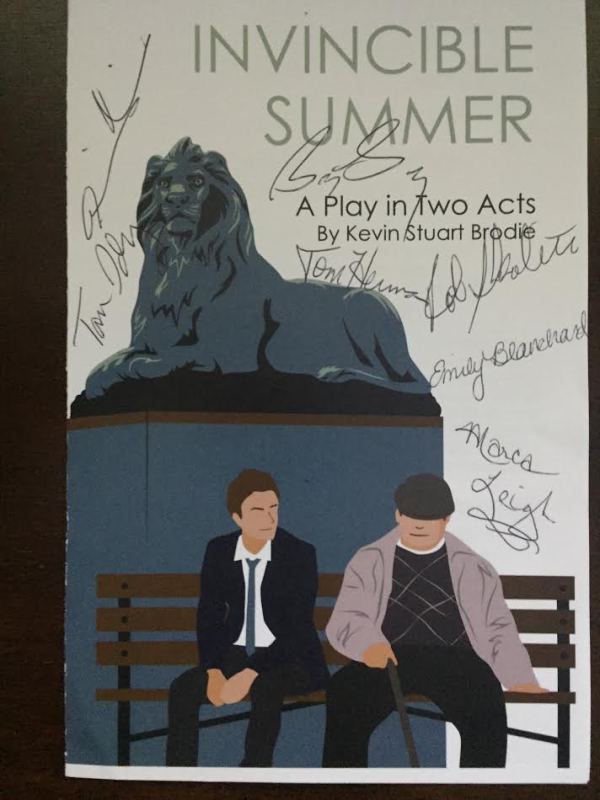
Larry recommended a director that he knew and thought highly of: Tom Herman. We met for lunch in August, and I was grateful that Tom liked my play and was very interested in directing the project. After some discussion, we agreed upon a date, and worked hard on making the reading happen.
One of the first things I learned was that staging a reading is a complicated process. It takes time to find the right performance space, the right actors, and to agree on rehearsal times, all within the budget you have chosen to work with. Of course, whenever you have smart individuals with strong opinions working together, you are going to have disagreements. That is inevitable. There were times when it looked like the reading might not happen; there were times when it seemed as smooth and as effortless as painting a polar bear in a snowstorm.
By late September, we had a venue, a cast (Rob Skolits, Marca Leigh, Brian Henry, Adrian Naccari, and Tamara Daley–I also recruited my colleague Emily Blanchard to come and play piano), and an official program designed by Melissa Nosal, a former student. We had a reading!
Happily, it went very well. The cast worked extremely hard, and put on an entertaining and professional performance. It was exhilarating to discover how much of my play worked and also to get a sense of what didn’t work. There were about 25 people in the audience, 15-20 of whom had come down from Connecticut to see the reading. I was very grateful to all of my friends who were willing to make that trip. They all gave me great feedback–much of it positive, but also some very helpful critical feedback that I know has made the play better.
Lezley is now helping me get the play into the hands of other professionals who can get it produced. When I expressed my gratitude to Lezley, she wrote this in an email:
You don’t have to be grateful to me. I believe in your play. Not just that it is a well written play but also because it is topical, and dare I say, commercial. I also believe in you. Having a play produced is a nightmare. You have to have the right personality to get through the process. I believe you do….I forgot to mention that I was moved to tears twice while reading the script.
It appears I have reason to be hopeful.

