Austin Film Festival Journal: Part Two
I didn’t think I would have my very first Austin Film Festival panel discussion at St. David’s Episcopal Church. We were even in what is called “The Old Sanctuary”–which means stained glass, wooden pews stocked with hymnals, and a monastic atmosphere.
It seemed a bit out of place to have Michael Grillo and three screenwriting semifinalists seated before an Austin Film Festival banner in this setting, but that’s where we were. As it turned out, I would be visiting this church on multiple occasions over the next three days. Dad was an Anglican, so I guess a part of me felt a bit like being home.
The three semifinalists were selected at random, and Mr. Grillo had read their scripts. He had significant praise for all of them, which meant a great deal, given how many scripts he has likely read in his forty plus year career. One of the writers, David Prosser, I later connected with at a party hosted by the Nickelodeon Writers’ Program, and we exchanged scripts. I’m looking forward to reading his this week.
What Mr. Grillo did was very cool–he made it clear that his job as a producer was to find a way to ensure your vision on the page makes it on the screen. Using the three writers on “stage” with him, he pulled examples from the scripts of what would likely be production challenges: fight scenes, CGI, rain, animals. He described how as a producer, he would be inclined to try and talk you out of some of the challenging things in the scripts. He also made it clear that if you think there is something essential to your story, that you don’t want to remove–fight for it. Don’t just give in, because you want to be seen as a team player. If you want it in, Grillo said, then it’s my job to figure out how.
He also made another really important point: don’t let my concerns as a producer affect how you write your scripts. Write the story you want to tell–if you have a rainstorm on 2/10 of a page, and it’s important to your story, leave it in there. Don’t edit your script as you write it, thinking a producer will want to change it. If the story is good, and a producer wants to make the script, let him/her worry about that later.
This I felt was excellent advice. A few years ago, when one of my scripts was optioned (sadly, it was never produced) , I found myself compromising more than I really wanted. I was trying to be a team player, I was trying to get the film made, I wanted to show I was flexible, etc. After listening to Michael Grillo, I decided to go back to that script and remove everything I added from the producer’s notes I wasn’t comfortable with (in fairness, some of their notes did improve it–but not all). I’m much happier with it now.
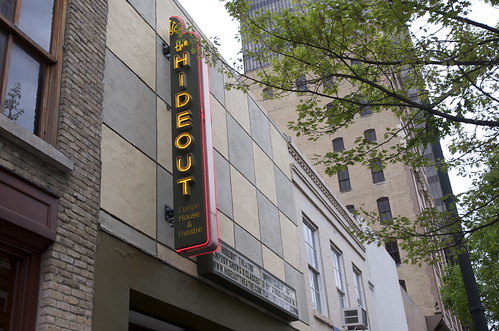
After that first panel discussion, I decided to go see a film (it is a film festival, after all). The movie was playing at the awesome Hideout Theatre–a combination coffee shop and improv theatre! I had some time before the screening, so I ordered a Dirty Chai, prompting the barista to ask me if I wanted “Stormy Daniels dirty, or Hillary Clinton dirty?”
The film I saw was called “The Witness.” I knew it was a story about a lawyer from the International Criminal Court trying to find a key witness from the Bosnian War, and that it was one of the last performances of the great Bruno Ganz. I was expecting something along the lines of a serious courtroom drama–“Judgment at Nuremberg” for the Serbs. I was not expecting an adventure story, and the attorney’s arc took him to places I did not anticipate. Overall, I really enjoyed the picture, and was pleased that director Mitko Panov was there for a post film Q & A. Sadly, the volunteer tapped to interview Mr. Panov seemed ill-prepared, so instead of waiting for more poorly thought out questions, he just kept talking about the things he thought we should know about his film.
There was a Writer’s Guild of America, West party after the film; however, a Texas thunderstorm was now tearing through Austin, and I had been awake 23 straight ours. Knowing I was tired, with no desire to be soaking we, and that there would be other parties over the next few days, I summoned a RideAustin vehicle and went to my hotel.
A few hours of sleep, then I would be ready for a big, full day on Friday.
Austin Film Festival Journal: Part One
The alarm went off at 1:30 in the morning.
That wasn’t a mistake, or a malfunction. That was the plan. My flight left Boston Logan airport at 5:45 a.m., and my apartment in Connecticut was 90 minutes away. Plus, one must build in the two hours which may or may not be necessary to pass through the TSA’s own Patuxai gate (Reminder: sign up for TSA Pre-Check).
In spite of the sheer ghastliness of the hour, I was out the door by 2, at parking by 330, and in the airport shortly after 4. The flight, of course was delayed, and my connecting flight in Atlanta was scheduled to depart early (why is a flight scheduled to leave early?), so I had to move quickly from one plane to the next. In spite of being forced to check my luggage, the second flight was a breeze and I was in Austin shortly after 11 a.m. local time.
Most of us have areas in our lives in which we are unlucky. Love, finding fulfilling work, health–the end is listless, as they say. For me, it’s airport shuttles. The usual process for me is I wait, the shuttle doesn’t come, I call the hotel, they scramble to find it, and then it arrives. It’s unusual for me to spend less than an hour anticipating the arrival of an airport shuttle. (When Darlene and I returned from Colorado this summer, we had to wait a very long time for our parking shuttle–in fact, the only reason we got picked up was that a driver heard the radio dispatcher trying to locate our shuttle and took it upon himself to come get us before his shift even began. If it wasn’t for that guy, we’d still be waiting on a curb in Queens). After my customary phone call, I discover that my hotel does not have its own shuttle–I have to go downstairs to a kiosk in a hidden corner of baggage claim one cannot find unless they are specifically looking for it, and tell the people at the kiosk I’m headed to the Hampton Inn. Finally, after another quarter hour, I am on my way to my hotel.

The room, though is ready three hours early, so I can check in. I drop off my luggage, and hail a ride from RideAustin–my very first foray into ride-sharing. The cool thing about RideAustin is that, unlike Uber or Lyft, it is a nonprofit organization. You can even round your fare up and donate the difference to a charity of your choice. It’s quick and efficient, and gets me downtown in twenty minutes. Plus, I don’t feel exploitative, which is always a good thing.
I reach the Driskill hotel, wherein the festival is headquartered. I check in, pick up my badge (see the photo above), and I am ready to go! But more than anything, I’m hungry. I was at Logan before any of the eateries opened, and both my flights were short, so I was only able to get a drink and a snack. I haven’t eaten an actual meal since Wednesday night.
Darlene and I have been doing a cleanse/diet that is reportedly good for people with neurological disorders. I’ve lost over 12 pounds, and I don’t feel lethargic after I eat, and my stomach is significantly\y quieter than it once was. The diet largely consists of eating green things and protein. On this trip, however, I have given myself permission to eat carbs–particularly via the delivery system known as a tortilla (this is Texas, after all). I find a nearby restaurant called The Iron Cactus, and I order myself some cheese enchiladas with black beans. Chips and salsa. I am one happy guy.
After lunch, I head to a nearby Episcopal Church for my first panel discussion, with Michael Grillo, a producer who has worked on a few films you may have heard of: Defending Your Life, Silverado, The Accidental Tourist, Anchorman, Road to Perdition, Cast Away, Gladiator, American Beauty, Saving Private Ryan, The Deer Hunter, Young Frankenstein–oh, and the last two Avengers films. I’m looking forward to hearing what he has to say.
Headed to Austin!
Over the past few years, I have won thirteen screenwriting contests and placed in a couple of dozen more. At many festivals and through on-line communications, I have gotten to know fellow writers with whom I placed. Inevitably, the question of what other contests we had entered would arise, and there one was one festival that always entered the conversation: the Austin Film Festival.
When it came to Austin, though, the conversation was always one-sided: my writing colleagues would talk about how they placed in Austin, or had reached the top tier, traveled to the festival, and how great it was. A few years ago when I was one of the ten screenplay finalists at Cinequest in San Jose, nine of us had also placed in Austin.
I was the one exception.
And I remained so for years. I sent all of my scripts to Austin, often more than once. I never received any reply, outside of the usual polite rejections. I would improve my scripts, send them again. They would be winning and placing elsewhere but never in Austin. I was even a finalist for Table Read My Screenplay at the Sundance Film Festival. When the same contest was reproduced in Austin, I submitted again. No love from Texas.
I had finally decided that for whatever reason, the Austin Film Festival and I were not meant to be. I had given up trying to figure out why other writers who were receiving similar accolades as I were also hopping on a plane to Texas every October. I started to think it would be easier for me to be elected governor of Texas than place in the AFF contest. No explanation would ever be forthcoming–that’s just how it is.
Thus, it was really little more than a whim that prompted me to enter their play writing contest this year. It was only the second year of the contest for plays; for many years, the word was that if you wanted to be a screenwriter, you focused on that medium. Show runners and film producers didn’t take playwrights seriously–unless you were David Hare or David Mamet. This perspective was emphasized to me in my MFA program.
The winds, however, had begun to change, and playwrights were starting to be viewed as a good talent pool for writers rooms or writers for hire. The AFF, which always tries to be ahead of the cinematic curve, identified this shift in trends and created a play writing competition. So, I took a shot and sent them “Invincible Summer.”
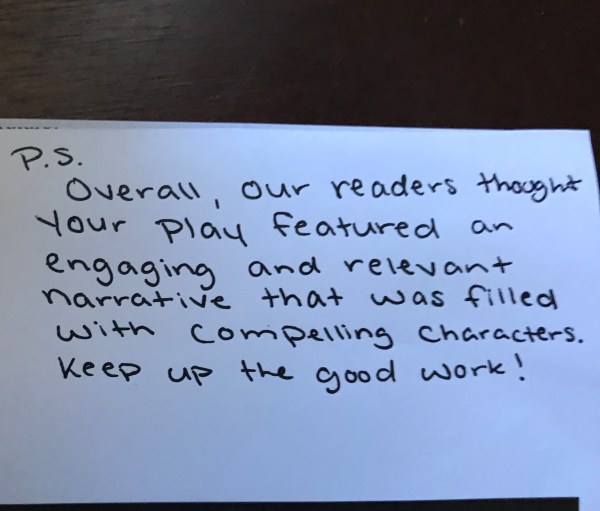
To be honest, I almost forgot about it (or perhaps tried to) until two weeks ago. It was then that I received a call from the festival informing me that my script had reached the upper tier, and I was invited to Austin! (You can see the handwritten note on my notification letter in the photo above). A whirlwind of travel arrangements and exchanged emails followed. In just a few frantic days, I had managed to put everything I needed in place. I even had the days off approved by my principal and superintendent.
So there will be panel discussions, round table discussions, writer only parties, winner only parties, a chance to meet contest judges, filmmakers, and producers. I’ll receive my prize, and I’ll even get to see some films!
Good things come to those who wait. And become playwrights.
You can view my schedule here.
Hanging on to the Towel
When you are a writer struggling to find an audience for your work, it is hard to stay focused. Whether you are a novelist trying to get an agent or publisher to read a book proposal, a playwright trying to get his work produced, or a screenwriter trying to find a producer to option her work, it can be a frustrating life. You will have significantly more failure than success.
As a result, it’s hard to accept that much disappointment, and continue to move forward. You may feel your work is improving, you may receive some positive feedback from peers, or you may feel your foot might be edging in the door (“A publisher is considering your work”) only to have it slammed shut on you (“They’ve decided to pass.”) It’s easy to see why most aspiring authors give up.
A few years ago, I felt that I was on the cusp of success. One of my screenplays won thirteen different contests (and placed in a number of others) and was even a semifinalist for the Nicholl Fellowship. The Nicholl is the most prestigious screenwriting contest in existence–just being in the quarterfinals earned requests for my scripts from producers. I had a manager, a few option offers from producers, and then…nothing. It all fell apart.
It was easy to get discouraged. I started to wonder if I was going to be one of those people who got this close to their dreams, only to have them “brush by me like a stranger in a crowd” (A line from Field of Dreams). A good friend of mine (also a writer and filmmaker) reminded me that what was happening wasn’t a Kevin Brodie problem–it was a screenwriter problem. He was right, and remembering that helped.

A few years of worsening health and emotional turmoil also put the breaks a bit on my writing career. I eventually shifted to playwrighting, which did see my work produced (if only for one night) and did earn me an agent. The excitement I was finding in playwriting sent me back to my screenplays, and I spend most of the past two summers revising them. It was heartening to realize I still believed in them–and also felt that I more I worked, they were getting better. It was time to start again.
So, for the first time in five years, I placed in a contest–the StoryPros Awards. I was a finalist. It was a contest I had won before, but I was still very pleased to be a finalist. It’s not as good as winning, yes, but it was still validating. People out there like my work. Some even think I should win a contest. It was exactly what I needed.
So now I have four stage plays, five screenplays, and a teleplay. What is most important is that I am once again confident about sending them out into the world. Even if I don’t place in the next few contests, that StoryPros result will continue to encourage me.
Maybe I will have the success I dream of, or not quite that but still a good career, or none of it will work out. The only thing I do know is that it isn’t yet time to give up.
“Sight”: A New Poem
I don’t usually include poems in this blog, but writing poetry is a part of who I am. My first paid publication was a poem; I joined my first writing group (Still River Writers) as a poet. I consider myself largely a stage and screenwriter (not to mention a blogger), so writing poems has become a rarity.
That anomaly appeared last weekend with a poem that had been churning inside of me for several years. I had attempted to write it many times, but it never seemed to work, so I put it aside, and worked on other projects. This time, though, the poem came.

Sight
A few miles outside Taos, New Mexico
is where the Rio Grande Gorge cuts
through deep layers of sediment and basalt.
Not quite high enough to reach the heavens,
a bridge puts the two hundred meter drop
directly beneath your feet.
Cumulus castellanus
arc at eye level,
but gazing down at the river
it is difficult to tell
if the water is reflecting the clouds
or it’s the sky that mirrors the water.
Tourists populate the west
end of the highway–
munching on churros, gulping sodas,
inhaling fry bread.
Herding themselves to the north
side of the bridge, they take in
the distant majesty of the
Sangre de Cristo mountain range.
At the very least, they try to find
a great selfie spot.
On the south side of the bridge
there are no tourists, no spilled drinks,
no viewfinders.
There are instead black ribbons
each with a name and age
scrawled in gray sharpie–
Sandra Santiago, 17
Goldenstar, 14
Unknown, 25.
Unknown?
I can’t help but wonder
if the gorge rushed up and maimed her
body with such violence
that the coroner finally decided
to just give up.
Or, maybe no one claimed her
because she knew that
the void left behind
would be visible to no one.
My First Three Act
It’s always a satisfying feeling when you have progressed enough with a piece of writing that it feels like time share it with others. In one sense, the work is “finished,” although once you share it with other writers you know it’s not even close. Yet, it’s still a lovely place to be–you’ve gotten this far, so you know your piece has potential. It has a beginning, a middle, and an end; it likely has characters you like, and the odd good line.
My most recent project is special for a couple of reasons. One, it’s my first three act play (I have written three one acts and one two act). Even though I still love screenwriting, and even wrote a poem this week, I find I am thoroughly enjoying my foray into playwrighting. It feels like every new idea wants to manifest itself as a play. Who am I to resist?
The second reason this project is special is the topic: the American Indian boarding school system. If you aren’t familiar with the history, in 1879, the United States and Canadian governments instituted an educational program for the children of their native populations. Native children were taken from their parents against their will and placed in these boarding schools throughout the country. In these schools, the students were not allowed to speak their own language, practice their religion, have contact with their families, or express even the slightest inkling of individuality. Any such infraction was met with abuse and violence.

The point of this was for the US and Canada to solve their “Indian Problem” by eradicating native culture from it’s youngest members. The objective, according to Captain Richard Henry Platt, the army officer selected by the US to create and supervise the school system was to “kill the Indian, save the man” in every pupil. Research indicates that the rate of abuse in these schools was 100%. Since the operation of these schools was contracted to the Catholic church, sexual abuse was also rampant. And if you are starting to feel grateful that such a practice has the virtue of being distant history, you should know that the last school in this system stayed open until 1990.
I had never heard of this system until my grandfather told me about it when I was a teenager. The reason he saw fit to share this with me was that he himself had been enrolled in one of these schools, and six decades later, he was still traumatized by the memory. He was more willing to discuss fighting in the Pacific theater during World War II than his experiences in the boarding schools. The only thing he told me is that he had tried to escape three times–and once he hid in a barn.
So I have written a play set in 1950 wherein a teenage boy named Daniel escapes from one of these schools and hides in a barn. Since my grandfather gave me no details, I have decided to fill them in. The barn is owned by a family of Sikhs from Punjab who have recently fled to escape the horrors of Partition. They must decide whether to hand Daniel over to law enforcement, or protect him and risk their immigrant status. Daniel, meanwhile, has to decide whether he can trust this family of strangers and allow himself to be helped or take his chances on the run and riding the rails.
The title of the play is “Save the Man.” I will always wonder if my grandfather were still alive, he would be able to watch it.
The First Launch
After 22 years in the high school classroom, I have had my share of graduates who have gone on to do amazing things. An environmental lawyer. An emmy winning computer animator. A counselor for a sexual assault crisis service. A grammy nominated sound engineer. An FBI agent. A television director and editor. An opera singer. A program director for Habitat for Humanity. A stage actor. A founder and director of a dance company in New York. That’s just part of the list. Flipping through their bios on pages like Linked In, it’s easy to be impressed. It’s also an honor to know that I may have been able to contribute to their journey in some way. And of course, it makes me very proud.
Last week. though, was a first: I had never before had the good fortune to attend a former student’s book launch. It’s always a good day when one of your former students stops by to visit you. It’s even better when that student presents you with a signed copy of her recently published memoir.
 I had the good fortune of having Ludmila as a senior in my philosophy course. My first impressions were good ones–she was intuitive, very smart, funny, and a strong writer. As I got to know her, I learned more of her story. Born in the Ukraine, she was adopted from an orphanage by an American couple at age 14 (very late for a typical adoption) and arrived without knowing a word of English. A mere seven years later, here she was writing, reading, and discussing philosophy in her second language. When she shared with me some of the trauma she endured during her young life, I was simply in awe of her fortitude. “A Single Desperate Prayer” is the story of her childhood, and her journey to the United States as an adoptee.
I think it is fair to say the book launch was an unqualified success. The room at the Jonathan Trumbull library (in Lebanon, CT) was overflowing with attendees–extra chairs had to be brought in, and standing room likely violated the fire code. Ludmila read three chapters, did a short PowerPoint not only on her life, but on the work of Hope Now Ministries (more on that below) This was followed by a thoughtful Q&A, and then the book signing. Happily, all of the books brought to the reading were sold. Aside from seeing Ludmila, it was also great to see former students, colleagues and parents that I’ve known over the years.
And all of us were brought together in joy to celebrate this remarkable young woman.
To learn more about Ludmila, and order a copy of her book, visit her web page.
To learn more about Hope Now Ministries, which provides financial aid for orphaned children in Crimea (from where Ludmila originally hails), visit their web page. Ludmila is donating 10% of her book sales to New Hope Ministries.
King of Pain
It may seem a bit obvious to say, but living in chronic pain is incredibly difficult. If you, like me, find yourself in this situation, you know whereof I speak. If you don’t, I think it is difficult for you to understand what it truly is like to live a life wherein each step one takes is a painful one.
I think part of the perception comes from how those of us with chronic pain are perceived. If we have a cane, or a walker, or other obvious signs of a life lived with discomfort, it is easy for others to have empathy. They see the struggle, they imagine how they would feel if that was them, and they understand on some level how hard it would be. They may even be motivated to help, or feel gratitude for their own good health.

When the chronic pain is less obvious, when we don’t always show the overt signs of living in pain, such empathy seems harder to come by. This is understandable–we don’t appear to be in pain. We aren’t groaning, moving slowly, straining so much tears pour out of our eyes. How much pain could we be in?
This is a reasonable question, and frankly has no simple answer. It is complicated by the fact that people may not believe you are truly in pain; perhaps you’re a whiner, a big baby, a wimp. Suck it up. Be a man(advice sometimes inexplicably offered to females)! Shake it off! Medical professionals may also doubt you are in the level of pain that you proclaim. It is understandable why medical professionals may be skeptical–they certainly have their fair share of patients who may be craving attention, hoping for an opioid prescription, or just afflicted with Munchausen’s Syndrome.
Being aware of why someone may not take your chronic pain seriously doesn’t make it any easier when someone doesn’t. This is why it is important to have an understanding as to why many of us in constant pain don’t seem to meet your presuppositions of what it is supposed to look like. There is a simple reason for this disjunct between expectation and reality:
We’ve gotten used to it.
Before I continue, I want to unequivocally reject the term “Chronic Pain Warrior.” I once used this term myself; I suppose there was a certain dignity in it. I don’t think warrior is a good metaphor for this type of condition. First of all, wars are fought by choice. There is a moral argument made by both sides during a war–the reason a soldier is fighting in war is an ethical one. For a good reason, perhaps, but most likely for a bad one. Either way, being a warrior is a role that one chooses for oneself. I never chose my pain, and never would have. So I am not a warrior.
What I have become (and there are so many like me) is one who has figured out how to adapt. Being in chronic pain forces this type of adaptation. You develop an ability to cope. First you start by ignoring the pain. When that doesn’t work, you find ways to distract yourself from it. Then, when that no longer accomplishes what you need it to, you finally reach acceptance. I am in pain. I am always going to be in pain. I need to make peace with this, or I will cease to live, and my life will be replaced instead by a melancholy existence.
When you reach this acceptance, something remarkable happens. Your brain finally understands what you want it to do, and your synapses continue to function in spite of your pain. It’s always there, and you always notice it. But it doesn’t stop you from climbing out of bed, from showering, from climbing in and out of your car, from doing your work. From walking and exercising. Yes, all of it hurts, and maybe you still wince from time to time, but you realize much to your surprise that you can cope with it. Why? Because you have to. You have no other choice.
My pain comes largely from Parkinson’s Disease (I have other neurological issues that contribute to the pain, but that is too much to discuss here). The aches and pains in my joints and extremities on some days can feel intolerable. The strain of constantly coping with the discomfort of Parkinson’s on my nervous system and muscles adds to the pain. Indeed, my body developed a largely inexplicable back and leg pain that was originally assumed to be a herniated disc. I was given three cortisone injections, a facet injection, sent to physical therapy, a chiropractor (who succeeded in making my pain worse, while his office manager hounded me for payment before ever sending me an invoice). Nothing worked. I was convinced it would never improve, and struggled mightily to reach acceptance.
Of course because nothing was working, medical professionals I consulted seemed to doubt I was in the pain I claimed. The disc was not sufficiently herniated; and if it were, one of the treatments would have certainly worked. My orthopedist–who was perhaps the most empathetic of all of my doctors–suggested I take an EMG to ascertain the levels of which my nerves appeared disrupted by the pain. The EMG was unpleasant, but the results were clear; I was in a great deal of pain. With no other option, a neurosurgeon got the brainstorm to treat my symptoms, and not continue to search for an underlying cause. I was prescribed a nerve pain medication, which worked remarkably well. This meant I had damaged nerves in my lower back and legs, but from what? The only answer appeared to be the strain on my body from Parkinson’s.
Even though the nerve pain has receded, my good ol’ Parkinson’s pain remains. This is a truth of chronic pain–you are never pain-free, there are just levels which are easier to tolerate than others. This can be complicated and frustrating, because a medical professional will ask me whether something hurts–yes, of course it does. It always hurts, whether you do what you’re doing or not. It just hurts more or less. The other strange side effect of being in constant pain is you don’t realize immediately if you hurt yourself. You are constantly trying to figure out where any cuts and bruises originate, because you didn’t realize what you had done. Why is my elbow bleeding? Where did that bruise on my knee come from? Sometimes you can figure it out, but otherwise, you throw a band-aid on it and get on with your day. (By the way, the person who finally invents a band-aid you can open one-handed will become a billionaire.)
I know many with chronic pain can no longer function well, and have lost the ability to cope. They tend to live very sedentary, probably unhappy, lives. I understand this completely–it takes a great deal of energy to be in chronic pain. There are days when I don’t want to get up and face it. One of these days, I may become like them.
I don’t know when that day will come. For now, I cope. But please, don’t call me a warrior, or some other New Age trope. I’m in pain, and I’m alive. And if you aren’t able to see it or understand, I’m afraid my life is under no obligation to make sense to you. It just has to make sense to me.

