Growing Up Part-Time Indian Revisted, Part Six
We arrive at the local jail off of the reservation. As I had been arrested six times before, this was an establishment with which I was rather familiar. I had, though, never before been shipped there was so many others—about 200 altogether, and I doubted the jail had the capacity for us all. To solve that problem our jailers shoved us into tiny cells in which were crammed together like refugees in an internment camp. We felt like it as well.
Most disturbing, none of us who required medical attention were getting any. When we screamed at the guards, begging them to help those most in need, their response at most was swearing and admonishments to keep our mouths shut. Mostly they just ignored us. We were growing more and more worried, until a group of EMTs entered the wing and begin extracting those that needed the help the most, finally dispatching them to the local hospital. Relieved, we were still covered in each other’s sweat and blood, and it was hard to move in our cells. No surprise we began to direct our anger at each other—which was probably by design.
The door to our wing opened again, and we waited for the guard to again tell us to “Shut the fuck up!”—but to our surprise, it was not the guard that appeared before us. A hush fell over the entire wing as we realized who had just entered: a Lakota Indian with his dark hair pulled back in a pair of long braids, six feet of attitude and charisma that entranced everyone in his orbit, including the guards. Oh my God, do you know who that is? Holy Shit! It’s Russell Means! Russell Fucking Means!
The guard opened one of the cells and Russell entered. Instinctively, we made a place for him to sit, but he waved us off. He told us how he had been with us on the reservation, how he negotiated the medical assistance for the protestors in exchange for spending the night in jail with us and not alerting his media contacts until morning. I suspect our jailers really didn’t want him in there because the sight of Russell immediately lifted our spirits.

Russell Means was with us!
And that wasn’t all—he told us great stories about being a member of the American Indian Movement, about Marlon Brando, Larry Flynt, and his new friend, Daniel-Day Lewis. He told hilarious jokes, and got us all to sing Lakota songs together. This jocularity was clearly too much for our jailers, as they frequently popped in not to tell us we were too loud, but to remind us we were in jail and not to be enjoying ourselves that much.
Relaxed, many of us began to drift off to sleep, and at the very least felt things would be better in the morning. This calmness, though, was clearly the last straw for our jailers, who decided to play one last card: they set the toilets to flush over and over again, and the wave of irritation and anger began cascading its way back through the wing. Russell, a veteran of many arrests, was familiar with this tactic, and gave us all some excellent advice: “Don’t think of it as flushing toilets. Imagine yourself on a beach somewhere. That sound is the tide coming in. Trust me. Close your eyes and do that. It will be fine.”
And he was right. It did begin to sound like that, and I think we were all asleep within ten minutes. Finally having to concede defeat, the toilets shut off, and those still awake enjoyed a snicker of satisfaction.
The next morning, we were released and followed Russell Means outside. He gave a brief statement to the press, after which we stumbled to busses, waiting rides, and any other way we could to get home. It wouldn’t be so easy for my Uncle Chester, who was found guilty of attempted assault on a federal officer and spent several years in federal prison. All for the crime of having a cattle ranch.
For those who may not be aware, or who believe that land rights issues are a thing of the past, or that casinos have become the great equalizer for American Indian tribes, this story should be a reminder that there is much work left to be done.
Growing Up Part-Time Indian Revisted, Part Five
As expected, we were ordered to move. When we refused, the tanks were rolled in closer, but we gambled that they wouldn’t actually use the National Guard to fire on a group of unarmed civilians on what was essentially a foreign country, so we called their bluff. The tanks rolled backwards, and the guardsmen were ordered back. We were given another chance to surrender, and our silence gave them the only answer they were going to receive. That’s when the mercenaries–the rather unfunny group of individuals with the funny name of the Wackenhuts–were ordered forward.
The Wackenhuts are intimidating–trained paramilitaries, armed to the teeth, head to toe in desert camo. Unlike law enforcement agents, Wackenhuts are private security, so they do not need to identify themselves if asked, and they wear latex gloves to ensure they leave no finger prints on anyone they arrest. This gives them something of a license to treat those they arrest with a certain amount of roughness, as it is hard to identity “the scary looking dude in camo with an AK-47” as they describes virtually every member of a Wackenhut battalion. Still, we squeezed each other’s arms tighter, determined to keep our promise to Chester.
The Wackenhuts took several intimidating steps forward, then marched off to the sides to make room for the fire trucks. It was at that point we knew how we were going to be dealt with. We would come to find out later that the reason they had to import San Francisco firefighters is they couldn’t find any in the area willing to do their dirty work for them. I am also certain the overtime bill for the SFFD was staggering. I also hope no one in the city by the bay lost their lives in a fire that day, because the trucks had instead turned their hoses on us.
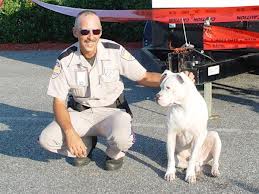
Wackenhuts: not actually this cuddly
I had been beaten, tear gassed, pepper sprayed, but this was first experience with a fire hose. I do not recommend it. I suffered a direct hit to my sternum, and a hose sized bruise stayed there for over a week. Another protester ended up with a ruptured spleen, another was hit in the face with such force his eye popped out of his socket. The hoses pushed our line of defense out of the way in a matter of minutes, and two hundred human beings looked like the pebbles and leaves being hosed off a driveway.
After we were adequately saturated, and laying in a puddles of pain and water, then the Wackenhuts moved in to make the arrests. They were, as ever, less than gentle. They dragged people by their hair, thumped some with billy clubs (including myself–twice), elbowed others in the face as we were literally dragged off to the waiting empty school busses. Before placing us on the busses, they handcuffed with plastic zip ties. Mine was tied so tightly my wrists instantly began to bleed–and I was by no means alone.
After what seemed like hours, but was probably more like minutes, the bus was filled with protestors, sopping wet, bleeding, moaning in pain–one of us holding his eye socket inside his head with nothing but his hands. All of our pleas for medical attention were ignored as the bus finally lurched forward, on its way to incarcerate us.
Growing Up Part-Time Indian Revisted, Part 4
I have been arrested seven times. Many people who know me–especially my students–find that hard to believe. Mind you, I have never been convicted, but it remains something of which I am very proud. This is due to the fact that my arrests were all for the crime of civil disobedience.
I don’t claim to be their equals, but I embrace the fact that I am associated with the thought and actions of Thoreau, Gandhi, King, the Danes during the Second World War, and the Polish Solidarity movement. I would like to say that my actions of myself and those I stood with made just as much of a difference, but I know that’s not true. I do think, however, that our actions had something to do with the fact there has not been an explosion at the Nevada Test Site since 1992.
There are many stories of my arrests, but I am going to tell this one, as I think carries with it extremes: an extreme miscarriage of justice, and an extreme response to those who wished to peacefully prevent it.
My Uncle Chester was a cattle farmer. He was more than that, of course–like many Baby Boomer American Indians, he fought in Vietnam. The military recruiters did a good job of reaching out to young men on Indian reservations during the 1960’s, convincing them that they were going to rise the defense of indigenous people (the South Vietnamese) against an invading colonial army (the North Vietnamese). A chance to be a warrior, like their ancestors. Many young men were seduced by this pitch–particularly in light of the fact that had few other job opportunities on the reservation. So why not? Chester was one of those who decided to join.
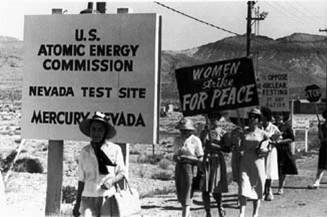
There is a long history of civil disobedience at the Nevada Test Site
One day he was hurt in what he described as a covert mission into enemy territory, and a rather inconvenient chunk of shrapnel ended up in his leg. He was patched up, and honorably discharged, but since his mission was secret, he was never given a purple heart, and was declined the pension for soldiers wounded in combat. This may seem difficult to believe, but when you speak to American Indian men who were wounded in Vietnam, they have a very similar story. This makes me doubt this was a coincidence.
Chester, though, had put all that behind him, and a successful cattle ranch that he loved to run. Then one day, federal agents cited him for the crime of “overgrazing on federal land”–a crime that only applies to those who lease land for their livestock. The law specifically states that reservation Indians are exempt from this law, but it was being invoked against him. He was slapped with a staggering fine which he could not pay. So, all of his cattle was confiscated–which we have always suspected was the real reason for his arrest. Some much larger cattle rancher with political influence pulled strings to shut down his operation. The feds, though, weren’t satisfied with this. They announced the value of his cattle did not equal the value of the fine, and if he couldn’t pay, he would be incarcerated.
So many of us decided that would never happen. The day that he was going to be arrested, we were going to put ourselves between the federal agents and Uncle Chester. They were going to have to go through us to get to him. There were about two hundred of us–we locked arms and made a circle around Chester’s cottage.
Facing us were two FBI Agents, a battalion of mercenaries, two divisions of the Nevada National Guard, several tanks and military helicopters, not to mention two San Francisco Fire Department hook and ladder trucks, and several empty school busses. We didn’t know what was about to happen, but we knew it was going to be ugly.
Yes, I Am Grateful
I know it is something of a cliché to write posts with this title near Thanksgiving, but I am going to for a couple of reasons. One, it’s now Friday–Thanksgiving is over! The real reason, though, is that something rather extraordinary happened to me at work this Monday, I feel compelled to write about it in these terms.
Don’t worry–next time, I will return to the Duck Valley Reservation to continue my story as a Part-Time Indian. You won’t want to miss my foray into civil disobedience. Until then…
You may recall the amazing response I had to World Parkinson’s Day last April. In that case, I planned the event, communicated it to my students and colleagues, and asked for their assistance. If you read that post, you know how everyone came through in a big way. This past Monday, however, my colleagues and friends at the high school really outdid themselves.

I’m one of the first people who arrive at the school, so I rarely see my colleagues when I enter the building. However, as they began to arrive, I noticed that many of them were all wearing the same button: a button with a circle and a line through the letters “PD.” These buttons were created by the Parkinson’s Action Network, and they are part of the Network’s campaign to stomp out Parkinson’s. I had never before seen the buttons, but I had plenty of opportunities to make up for that because all of my colleagues–teachers, administrators, custodians, secretaries, instructional assistants–were wearing them. And they were doing so in honor of my birthday.
Moreover, upon entering the teacher’s lounge, I noticed a massive cake with the words “Happy Birthday, Kevin” and several more NO PD logos decorating the frosting. It turns out Sandy, the school nurse, and two other teachers (Jeff and Diane) hatched this master plan to show support for my fight against my illness, and decided the best way to show that support is by surprising me on my birthday. Anyone who knows me has probably worked out that I had a lot of trouble keeping my eyes dry that day. I certainly felt supported–and tremendously special.
So that’s one of the reasons I am grateful this week. Do you like and admire your work colleagues? That’s great, but let me tell you something–I will put my coworkers up against any other group of coworkers anywhere. I know they’d come out on top.
Growing Up Part-Time Indian Revisted, Part 3
It may seem self-evident to point out that seeing an atomic explosion was the single most terrifying thing I have ever seen in my life. When I saw it explode, I was not aware of Robert Oppenheimer’s quote: “Now I am become Death, the destroyer of worlds.” When I read that quote several years later, I had no difficulty at all understanding what he meant. Unlike Oppenheimer, I was not responsible for the existence of the bomb, but the explosion was such that it seemed to be destroying a fabric of reality in front of my eyes.
I think the thing that is most shocking about watching an atomic explosion is the fact that for the first few seconds there is…silence. You see the cloud slowly begin to rise, and you wonder: where is the deafening boom? The cloud grows larger and larger, seeming to absorb and expel all of the matter in its vicinity. You continue to watch, bracing yourself for the sound, but it does not come. Just when you are at the point where your brain begins to reconcile the fact that you are watching an explosion that will generate no sound at all, you are suddenly hit with a wave of deafening thunder. We were miles away, but the entire mountain we stood on trembled with such force I was certain it was going to collapse around us. Growing up in California, I have endured about a dozen earthquakes, including the Loma Prieta earthquake in 1989 that leveled significant parts of the San Francisco Bay Area. No earthquake could even compare to the rumbling of the earth I felt that day.
I stared helplessly as the cloud expanded and rose, dwarfing the hills and mountains behind it. As it expanded, growing thousands of feet every second, I would become convinced that it couldn’t possibly grow any larger. Then it would. Then I would try to convince myself that it was now as large as it possible could be. Then, a few seconds later, it would be twice the size it was before. Looking back on it, I realize now that I may have actually been bargaining with God: please don’t make it any larger than this. Or this. Or this. And each time it did, I could feel more of the planet dying, more of my family history being obliterated, and my connection to my ancestors slowly eradicated. I felt alone, found myself questioning the meaning and purpose of any human being alive. If we could do this, we didn’t need God. We didn’t need the devil. We had accomplished the task of making our entire civilization disposable, and virtually every other living creature along with it.

Bill Bryson wrote in his memoir of growing up in the 1950s how Americans felt indestructible, so much so that tourists used to picnic in the desert and watch the bomb explode. After words, scientists would scan them with Geiger counters to see how radioactive we were. This was also the time that we thought that a turtle named Burt could teach us to “Duck and Cover” so we could survive a nuclear attack, and that bomb shelters were worthwhile investments. I am often tempted to laugh at those absurdities, but when I think about the explosion I witnessed, I find it almost impossible to do so.
On the way back to the reservation, my Grandfather said nothing to me, even though I sat in the car trembling and weeping the entire drive. When we got back, I felt compelled to ask him why he wanted me to see that. I was so angry at him for showing that to me. He must have known what it would do to me, that it was an image that would keep me awake for the next several nights and haunt me to my final day on this planet. When I finally mustered the question, I expected him to give me the type of answer he usually did: you’ll understand later, that’s for you to decide, or why do you think? For one of the few times in our relationship, he gave me a pretty direct answer:
“That bomb is a part of who you are. It represents everything that’s been taken from us, and everything we need to fight against to take it back. You needed to see it because that’s part of your fight now, and will be for the rest of your life.”
I stared at him a moment, not really comprehending everything he meant by that. Finally, some part of me seemed to understand, so I nodded as my sobs grew louder. He pulled me into an embrace and let me cry into his chest. I still remember the scent of leather and tobacco that filled my nostrils.
And you know something? I’m still nodding to him. Even today. Because that day changed me forever.
Growing Up Part-Time Indian Revisted, Part 2
Yes, it’s a long title, but it will have to do.
Spending my youth on the reservation presented a particular number of challenges. First of all, I kept my feet firmly planted in two very different worlds. Life on the reservation was as different as it could be from my neighborhood in San Diego; it was smaller, there was more poverty, and the pace of life was far different from that of a major California metropolis. For one thing, I had to learn how to live on “Indian Time” on the reservation. No one had a clock, or a watch, and when I enquired about the time, the conversation often went like this:
Me: What time are we having dinner?
Grandpa/Aunt/Uncle: When everyone gets here.
Me: When are we going to leave?
Grandpa/Aunt/Uncle: When we’re ready.
I remember how irritated I used to be by this when I was younger, but after a while, I learned to embrace life in this way, and realized it made much more sense. As my grandfather used to say, “You should live on Indian time. White man time will give you stomach cancer.” I think he stole that from a movie, but his point was well taken.
I also loved the fact that my Indian relatives were quiet, and didn’t insist on me talking all that much. As a young man struggling with a stutter, this was a blessing. I hated having to speak, and I hated the often impatient tone with which I was treated when I couldn’t get my words out. I remember once when my Uncle Steve asked me a question once, and when I tried to answer, he just put his hand on my shoulder and said, ‘Don’t worry about it, dude. You don’t have to talk. Just get good at listening. Most people are shitty at it.” I remember the feeling of relief that came over me when he said this. Not only did I not have to talk, but my inability to speak might make me good at something no one else is? This stutter thing might not be so bad.
As quiet as my relatives were, they could be brutally honest and direct. I recall one long drive I was on with my grandfather and two uncles were on our way to a Pow-Wow (I don’t recall exactly where). For the first two and a half hours, no one in the car said one word. Then, my Uncle Steve turned to my Uncle Clyde and said “That hat looks stupid.”
Clyde gazed at Steve a moment, processing his brother’s opinion. Finally, he replied “I like this hat.”
Steve simply shrugged, and then said “Okay.” No other words were uttered for the next ninety minutes.
There was another trip I took with my grandfather in silence I sometimes wish he had spoken to me more. The only thing he told me was that we were going for a ride, and then we headed south. After a long drive he pulled off the road, and we spent a half an hour scaling a nearby hill. When we reached the top, my grandfather began to pray. I didn’t really understand what we were there for at first until he put his hand on my arm and pointed.
“You want to look there. Should be any minute now.”
It was then that I realized where he was pointing: the Nevada Test Site.
Growing Up Part-Time Indian Revisted
Back in February, I was asked to give a talk at Eastern Connecticut State University to give a talk on growing up as a part-time Indian. I had been meaning to come back to this topic for some time, hoping to expand on this story for those of you who didn’t hear my talk. Which, let’s face it, was most of you. All these months later, I have returned to it.
I borrow the title from Sherman Alexie, whom I hope can forgive me, because it really did apply to me. I would spend ten months of the year living in a residential southern California city (San Diego) and then spend my summers in the Duck Valley Indian Reservation on the Nevada-Idaho border. To say that I lived my young life in two very different worlds would be to understand the matter significantly. As a young man, I struggled mightily to figure out which world I truly belonged to. I still sometimes wonder.
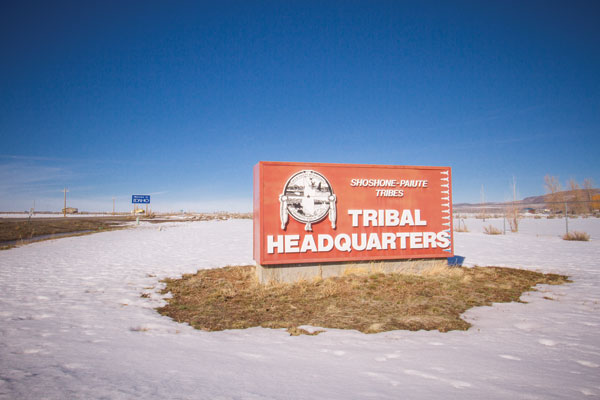
A little background: the Ruby Valley Treaty of 1863 recognized Western Shoshone sovereignty and the tribes right to control 60 million acres of territory, most of it in Nevada. Like many treaties between American Indian nations and the United States government, it has been ignored and violated over the centuries. This should surprise no student of American history. Whether the example is the horrid Trail of Tears, the slaughter at Wounded Knee, small pox blankets, or the ghastly boarding schools of the twentieth century, Indian sovereignty has been scarcely respected. Unless, of course, your tribe has a profitable casino that provides the tribe with political clout. This is the case of Foxwoods and Mohegan Sun here in Connecticut; most reservation Indians do not live in environments flush with cash.

In addition to these crimes, the Western Shoshone have had to cope with two other egregious violations of their land rights: one on end of Shoshone territory is the Nevada Test Site, where since 1951, 1021 atomic tests have occurred on lands that by treaty belong to the Western Shoshone. The end result is that the Shoshone nation is the single most bombed nation on earth. It is common to read the terrible accounts of Hiroshima and Nagasaki, or the test on Bikini Island, and all humans should be aware of this. No other country in the world has had to endure the destruction caused by the detonation of over 1,000 bombs, in addition to the sicknesses and health issues brought about by the amount of radiation released into the atmosphere and the environment.
That would be bad enough, but on the other end of Shoshone territory is something called the Yucca Mountain Nuclear Repository. Despite its holy status to the Western Shoshone, Yucca Mountain was annexed decades ago for this purpose, and no member of the tribe has been able to set foot on the Mountain since. In the meantime, a tunnel several miles deep has been dug in anticipation of the repository opening and accepting shipments of nuclear waste from throughout the country (and, if profitable, the world). Never mind that no member of the tribe consented to the use of the mountain for this purpose, or that it rests on an aquifer and an earthquake fault. The good news is that Harry Reid’s clout in the United States Senate has kept the repository from opening. There is no guarantee, though, this will remain constant.
It is into this environment I found myself thrust each summer I visited the tribe. I had no idea how it would fundamentally form the person I would become in ways so profound I am still struggling to understand them. And it is with this background I will next time begin to tell my story.
It’s Been Too Long
Once I returned from France in July, it seemed like my life kicked into high gear again. Before I knew it, I was getting ready for a new school year, attempting to understand a new teacher evaluation system no one could adequately explain, contract negotiations with my local Board of Education, trying to be an effective union president, and oh yes, teaching my classes. And then the next thing I knew, the first quarter was over, and it was November! And I hadn’t posted anything since July. It goes by way too fast.

So now I am back, in spite of the fact that I am well into National Novel Writing Month (8400 words and counting!). Thus, I am going to use this newfound writing energy to keep up with this blog with more regularity. I have many more stories to tell, some updates on my screenwriting, and thoughts about the current state of teaching. Lots of things knocking around in my head that will soon find their way to this page. It won’t start today, as this is a short message to let you know I haven’t disappeared. I will be back tomorrow with a much longer post–one far more worthy of my excellent readership. Until then, thanks for your patience.
Reflecting on France
Fifteen days. Two flights, eight train rides, countless Metro rides, half a dozen boat trips on the Seine, a cable car ride up and down the Eiffel tower, one rather tense van ride around the Arc De Triomphe, a week of driving in Provence, and lots and lots of walking. And through all of that traveling, I noticed a number of things about France that I wanted to share here as a summary. First, some of my favorite things:
–A great way to end a trip is to be voluntarily bumped from a flight so you get air ticket vouchers in Euros, a free hotel stay, three meals, and a bonus day in Paris. Thanks, Ralph Nader! And thanks to Melissa, our dog sitter, for agreeing to stay an extra night.

— Croissants and pastries are amazing! And French people do actually walk around with baguettes. It’s not just a stereotype.
–The Metro Subway System is efficient, easy to navigate and understand. The one in Montreal has all but three of those qualities, so it’s clearly not a language issue.
–France is very English friendly, and most of the people we met were very kind, helpful, and open. Yes, a couple of rude waiters, but I can find those in New York City speaking my own language. In contrast to the stereotype we have in the United States, the French are a very welcoming people.
–The French love their dogs, and bring them everywhere: on trains, into restaurants, into museums. They might be more dog crazy than the United States.
–Museums are really crowded, which can be annoying at times…but it’s really exciting so many people want to see art, so no complaints here.
–There is nothing better than eating a crepe on the street!

And now some wry observations:
–The United States may not have a lot of manufacturing to export, but we do a great job of exporting our popular culture. I saw a lot of Europeans wearing Yankee caps, Hollister shirts, and a number of other pieces of clothing containing geographical and cultural references they may not have understood. It’s interesting, because you rarely see “Surf Marseilles” shirts or hats for the Bruges football team in the United States. Globalization is clearly alive and well, but as usual, it’s a one-sided endeavor.
–Parisians, you have a beautiful city, but please stop treating your parks like ash trays and garbage cans. It is much more fun to sit in a park that doesn’t resemble the back lot of a recycling center.
–Romas, I know that France and virtually every other European nation has treated you like second class citizens since like, forever. But does that scam where you pretend to find my dropped wedding ring and sell it back to me really work? I got proposed to by at least six Roma women and one man.
–French drivers really help me appreciate the cool, reasoned approach of Italian drivers.
–Young French people: you are beautiful and handsome, but won’t stay that way unless you quit smoking. Fever cigarette butts in the parks as well.
And a few rants:
–American tourist: the reason we don’t use the term “mineral water” has nothing to do with the fact that our water was fewer minerals in it. We just don’t use that term to describe our Poland Springs and our Aquafina. Both of those contain minerals. If you have more thoughts like this, please keep them to yourself.
–American father with his teenage daughters who wanted to see Shakespeare and Company: Why did you storm our of there shouting “I am not staying in that place. We are leaving. Now!” What were you afraid of, exactly? Books? Ideas? The fact that your teenage daughters were interested in reading? Maybe you should have relaxed and had a mineral water.
–All tourists who run across the roundabout to get to the Arc de Triomphe: did you notice there is no crosswalk? Please use the tunnels the good people of Paris so generously built for you so you don’t have to race screaming through traffic, and literally run the risk of being scraped off the hoods of taxis by irritated French policemen wearing hazmat suits. Thank you.
–And to the young man at the mass in Chartres Cathedral: First of all, no one since the Reagan administration ended has any excuse for wearing a Chucky from “Child’s Play” t-shirt anywhere, much less into one of the most beautiful cathedrals in the whole world. I wasn’t raised Catholic, and haven’t been to a mass in 25 years, but even I know you aren’t also supposed to take photographs during the service. There were just so many things wrong about you.
Thanks to all of you who went along with my first foray into travel writing. I hope you enjoyed it. I sincerely hope these posts gave you some sense of how really wonderful a trip it was.
Be Happy–Eat Chocolate!
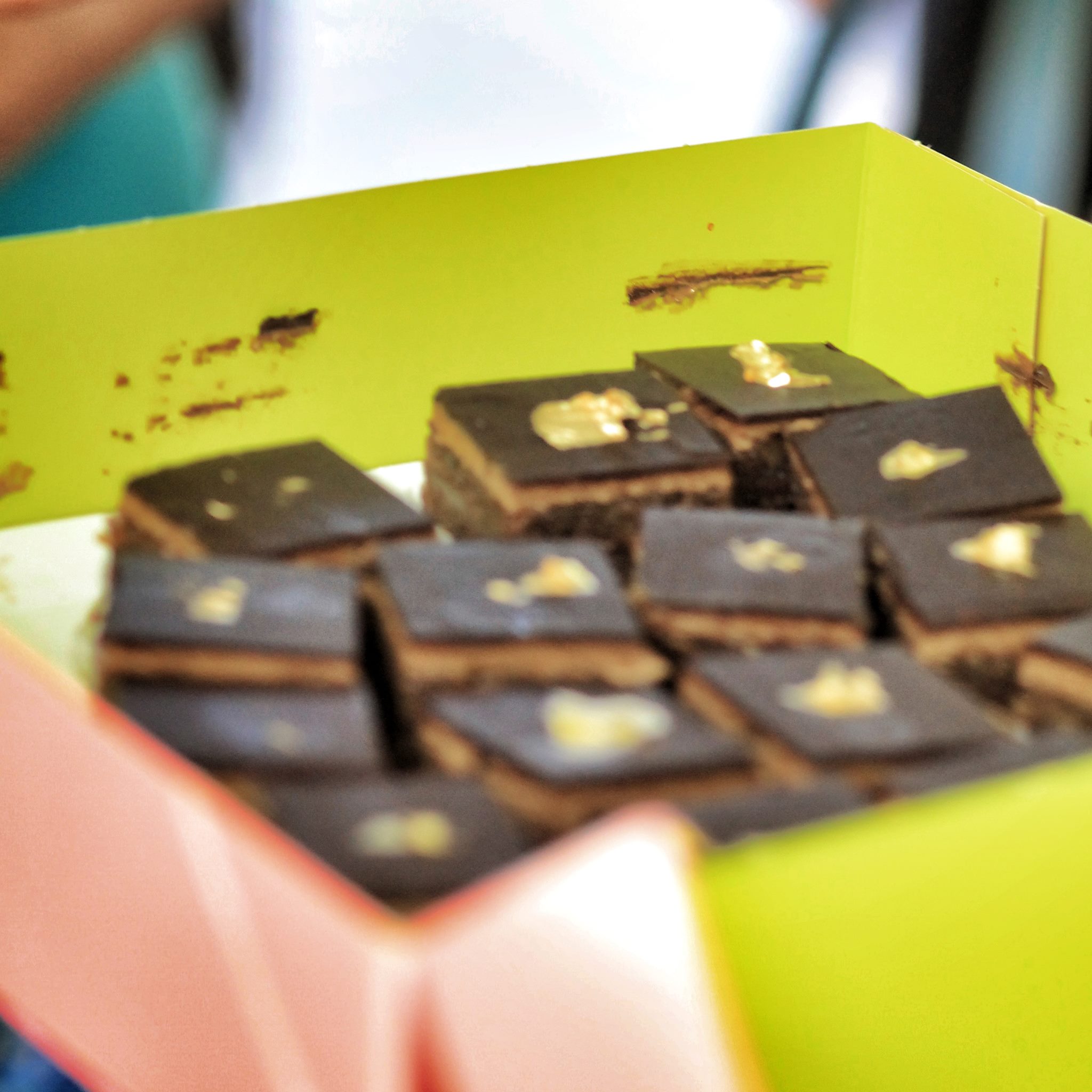
Opera pastries. Rich and delicious!
One of the best things about Paris is, of course, chocolate. What better way to learn (and taste) the different types of Parisian chocolate than a tour? Ours, sponsored by a company called “Paris Walks” and let by an American expatriate name Richelle did just that–and more.
First was a visit to a patisserie, where we sampled scrumptious chocolate eclairs and the out-of-this-world opera pastries pictured above. Chocolate, buttercream, sponge cake, and vanilla all stacked up for a decadent, satisfying whole. Richelle also took the time to point out some of the more curious aspects of the neighborhoods in which we passed–Moliere’s birthplace (and later, his statue); a pharmacy that once sold invisible ink used by one of Marie Antoinette’s lovers to send her discreet notes (the advertisement that the pharmacy carried such ink is still visible on the building’s facade); fragments of the nearly thousand-year-old wall erected to protect Paris from the English; and a trip through the Vero-Dodat, one of Paris’ last remaining arcade (covered) passageways. Our minds were nurtured as much as our bellies.
All bets were off, though, when we visited three superb chocolate boutiques: the first was Cote de France, wherein we sampled dark and milk chocolate ganaches and pralines. We were taught the proper way to sample a real piece of chocolate (bite into it once, feel the snap, and let it melt in your mouth). We were treated to different, surprising flavors including hazelnut and ginger. The second boutique was Michel Cluziel, where we sampled bits of dark and milk, the best hot chocolate I have ever had in my life, and a praline spread described as “Nutella without the palm oil.” A jar of the spread somehow found its way into our suitcase.
The final stop was a chocolatier appropriately named Jean-Paul Hevin, who treated us to a variety of samples including raspberry chocolates and even salted caramel macaroons. At this point my amygdala and my taste buds were in overload as Richelle bid us adieu.
Stumbling back out into the sun, we wandered up and down rue Saint Honore, blissfully reeling from our chocolate high. Why would you need anything else?
 Danger Is My Business